TL;DR
Does the “one landing page per city × per service” programmatic SEO playbook still work?
No — Google now penalizes templated page networks that swap city names, AI-written or not, and the penalty can hit your whole domain. Mass-produced city-times-service pages are exactly what its spam systems look for. A small set of location pages with real local substance outranks and outlasts the template play.
The pitch shows up in every “programmatic local SEO” course, every AI-content SaaS demo, every $99/month “landing page automation” tool: spin up one landing page per city × per service, feed each one an AI-generated variation of the same template, and dominate long-tail local search.
Fifty cities. Ten services. Five hundred landing pages, live in a weekend. Every combination — “HVAC repair Alhambra,” “HVAC repair Pasadena,” “HVAC repair Whittier,” on down the list.
In 2019, this worked well enough that plenty of home-service businesses built entire funnels around it.
In 2026, it does not work. And Google’s scaled content abuse policy — announced in March 2024 and enforced ever since — specifically calls out the “data-template pages that swap location names” pattern as one of the violations.
After the March 2024 update rolled out, 45% of low-value sites lost traffic overnight. A significant share of those were programmatic landing-page networks built on exactly this template.
What the scaled content abuse policy actually says
Google’s own definition, from the policy launch:
“Generating many pages primarily to manipulate search rankings, with little or no value added for users.”
That phrasing was deliberate. It made two things explicit:
1. The intent matters, not the tool. Google’s own guidance repeatedly emphasizes that the policy applies “whether automation or humans are involved.” A human writing 500 near-identical city × service pages by hand is just as much a violation as an AI generating them.
2. “At scale” is the trigger. A single well-written landing page for “HVAC repair in Alhambra” is not scaled content abuse. Five hundred landing pages that are 90% the same template with just the city and service name swapped is.
The specific pattern Google’s search team called out in the policy documentation:
“Data-template pages that swap location names, product names, or keyword variants into identical page structures, generating thousands of pages with minimal unique value.”
That is a precise description of the “50 cities × 10 services” programmatic SEO recipe that dominated home-service marketing playbooks from about 2019 to 2023.
The AI content misconception
There’s a related myth that needs killing at the same time: “Google penalizes AI content.”
That’s not what Google actually said, and it’s not what the data shows. Ahrefs ran an analysis of 600,000 top-ranking pages and found:
- 86.5% of top-ranking content uses at least some AI assistance
- The correlation between AI-generated content and Google penalties is essentially zero (0.011)
- Sites using AI as augmentation — for research, drafting, editing — see no inherent ranking disadvantage
Google’s own position on this has been consistent since 2022: they evaluate AI-generated content using the same quality signals as human-written content. They reward helpful, reliable, people-first content regardless of whether it was produced by humans or machines.
So AI content itself isn’t the problem. The problem is what Google’s spam-policy language calls “unrefined AI drafts” — templated, low-effort, mass-produced pages that share obvious statistical fingerprints and add no unique information beyond swapping in a variable.
That is exactly what most “AI programmatic local SEO” strategies produce.
Why the “50 cities × 10 services” combination is the specific trap
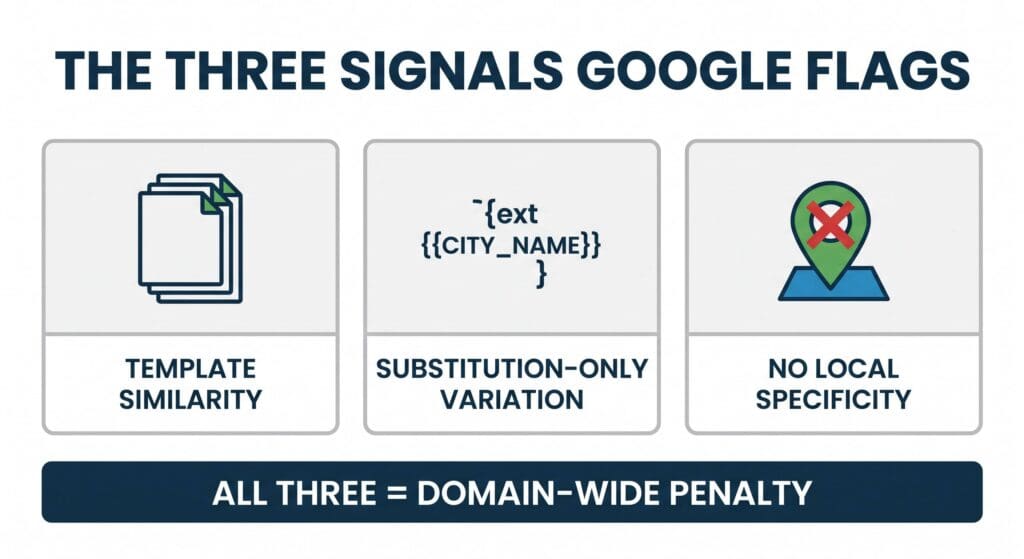
There are three signals that make a network of city × service pages get flagged as scaled content abuse:
Template similarity. Every page shares 90%+ of the same DOM structure, the same H1 pattern, the same three-section body, the same CTA. Google’s systems compare cross-page similarity across your site, and the pattern is trivially easy to detect.
Substitution-only variation. The pages differ only in variable substitution — the city name changes, sometimes the service name changes, but the actual content adds no unique local information. There is no reason a customer would find a Google-crawled version of “your Alhambra HVAC page” more useful than “your Whittier HVAC page.” That reader-facing uselessness is what the Helpful Content signal is designed to detect.
Local specificity absence. The pages don’t mention any actual local businesses, streets, neighborhoods, climate specifics, permit requirements, common service issues in that city, or anything else that would demonstrate the page was written for that city rather than targeting the city name.
When a site has all three of these signals across hundreds of pages, Google’s Helpful Content signal — refreshed in December 2025 and running continuously — treats the entire domain’s helpfulness score as compromised. That doesn’t just hurt those 500 pages. It hurts every other page on the site.
What Google’s own examples of penalized practices look like
The March 2024 enforcement pass documented specific penalized practices. Two of them map directly onto home-service programmatic SEO strategies:
Data-template pages that swap location names, product names, or keyword variants into identical page structures, generating thousands of pages with minimal unique value. This is the “HVAC repair in [City]” landing page network verbatim.
Sites using translation of content from other sources into multiple languages with AI to multiply page counts without creating original value. This is the same pattern extended across language variants.
The consistent thread across every penalized example was manufacturing many pages that add no additional user value beyond appearing to target more search terms. That is the whole design intent of “50 cities × 10 services” landing page automation.
What actually works for a home-service business in the SGV
The alternative isn’t “no local landing pages.” It’s fewer, better, and legitimately different pages.
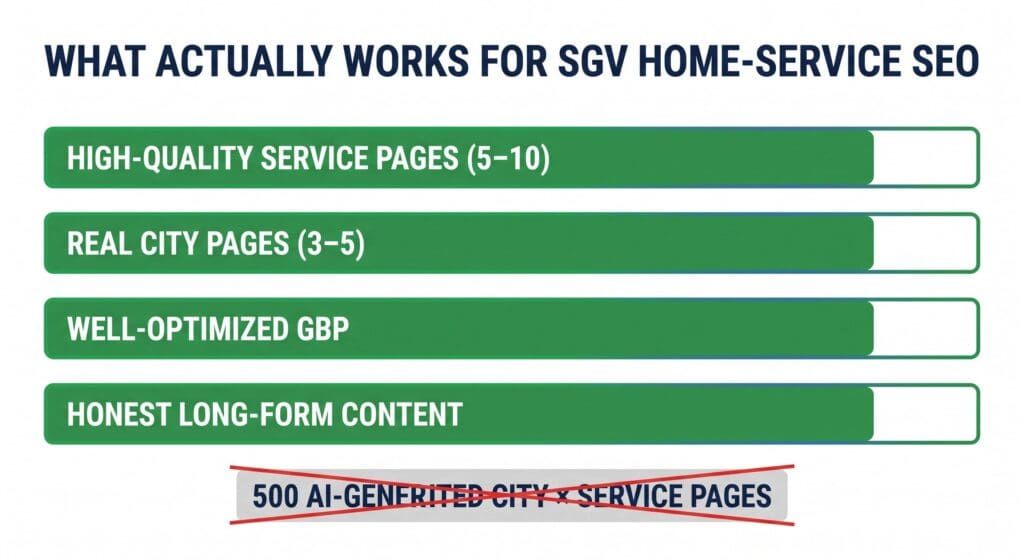
For a home-service business in the SGV, a working local landing-page structure looks like this:
One high-quality primary service page per major service. Not “HVAC contractor” as a page. “AC repair,” “furnace installation,” “mini-split installation,” “HVAC maintenance plans” — each as its own genuinely useful page, with actual content about how that service works, what typical costs and timelines look like, what SGV-specific issues you see (older Bakelite wiring in East LA fixer-uppers, refrigerant leak clusters in Pasadena mid-century installs, the specific inland heat pressure the SGV puts on undersized units).
A limited number of city-specific pages — three to five, not fifty. For your top three service cities where you actually do the most work, a legitimately city-specific page can rank well. That page should include:
- Actual city-specific content (neighborhoods you serve, common local issues, permit info, response times)
- Photos from real jobs you’ve done in that city
- Reviews or testimonials from actual customers in that city
- Local citations (Chamber of Commerce mention, if you have it)
- Category-specific service and pricing info that’s actually different from your general pages
If you can’t write that kind of legitimately-different content for a specific city, you don’t need a landing page for that city yet. What you need is a service page that mentions your service area broadly, and to build up city-specific evidence over time.
Your Google Business Profile does the fine-grained local work. For an HVAC contractor in Alhambra, a well-optimized GBP with 13 secondary categories, a proper services list with descriptions, and a real business description that mentions your service area cities will out-rank a network of 50 landing pages every time. And it won’t put your entire domain at risk. We covered what actually decides the map pack in our post on the “post four times a week” myth.
Real content on your own site. Long-form articles, real case studies, honest posts about problems you fixed. This is the “helpful content” Google’s systems are designed to reward. One good article about “why AC units in the SGV work harder than in coastal cities” is worth more than fifty template pages.
A related trap: spinning up hundreds of low-quality backlinks from Fiverr to try to rank the same programmatic pages — the two shortcuts are usually sold together, and they fail together. See our post on cheap Fiverr link packages.
How to tell if you’re already caught
If you own a home-service site that has any of the following, this is worth an honest audit before Google’s next enforcement pass:
- A URL structure like
/services/[service]/[city]/with hundreds of combinations live - Landing pages that were generated from a template with variable substitution, whether by an agency or a tool
- AI-written city landing pages that were bulk-created and never editorially reviewed
- Blog posts that were AI-generated in batches (say, 20+ at once)
- Sudden traffic drops in March 2024, December 2025, or during any spam update — those are the enforcement windows
If any of those apply and your search traffic has been declining, the cause is often the programmatic content, not the “SEO” you’ve been paying for on top of it. Fixing that requires removing or genuinely rewriting the low-value pages — and often improves rankings within weeks once the domain-wide helpfulness signal recovers. A free audit is the quickest way to see where your site stands before you decide what to cut.
How City Boost handles this
We don’t build programmatic landing page networks, and we don’t advocate for them.
For SGV home-service businesses, our website design and development work focuses on a small number of genuinely useful pages: proper service pages, real city-specific pages for your top service areas, and long-form local content that answers what your actual customers actually search for. If your site has a legacy programmatic network from a previous agency or an early attempt at “AI SEO,” we audit it, identify what’s harming your domain-wide signal, and clean it up before we build anything new.
The related family of shortcut traps — buying cheap Fiverr backlinks that trigger SpamBrain within days, buying reviews that trigger the FTC’s $51,744 per violation rule, keyword-stuffing your GBP name in a way that gets you suspended — all show up in the same audit. They’re all the same underlying pattern: scale a shortcut, and Google’s systems eventually catch it. Every one of the alternatives is genuinely simpler, and works.