TL;DR
Does posting on my Google Business Profile 3–4 times a week improve my map-pack ranking?
No. Independent testing has repeatedly shown that regular posting doesn't move map-pack rankings. Posts help engagement — they can win the click from someone who already found you — but rankings are decided by proximity, profile completeness, and review velocity. Put the posting hour into reviews and profile depth instead.
Every home-service owner in the SGV has heard some version of this pitch: “post on your Google Business Profile three to four times a week and you’ll rank higher in the map pack.”
It’s a clean, marketable rule. It’s also wrong.
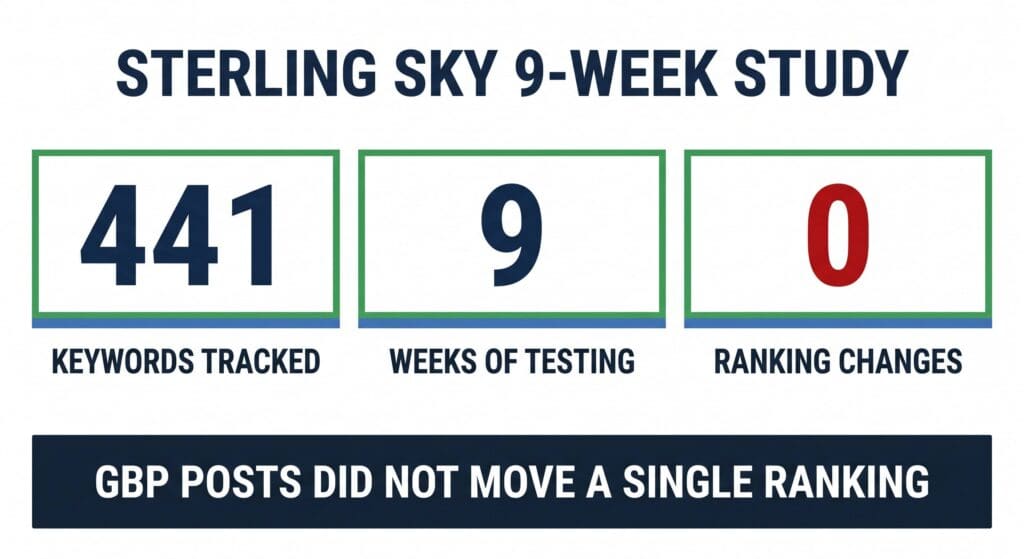
Sterling Sky — one of the two local-SEO research firms Google’s team actually cites — ran a controlled 9-week study tracking 441 keywords. The result: posting on your Google Business Profile moved zero of those 441 keyword rankings. Not “a small effect.” Not “helped for some verticals.” Zero.
That result matters for an HVAC contractor in Alhambra, a plumber in Pasadena, a roofer in Pico Rivera. Because most home-service owners in the SGV are being sold a monthly “GBP management” package where a big chunk of the fee goes toward writing posts. That budget is buying nothing in terms of where you show up in the map pack — and there’s a much better use for the same money.
What Sterling Sky actually measured
The 2026 study wasn’t opinion. It was a controlled test:
- 441 keywords tracked across a controlled set of businesses
- 9 weeks of consistent posting on the profiles
- Rank tracking at the same locations, at the same times, throughout
At the end, the researchers compared before-and-after positions across all 441 tracked keywords. The number of rankings that moved because of the posting activity: zero.
This isn’t a controversial finding among the people doing the actual research. Whitespark’s 2026 Local Search Ranking Factors survey — the other big data source local SEOs rely on — puts GBP posts near the bottom of the factors that influence local pack rankings, well behind proximity, GBP completeness, and review velocity.
Here’s what Sterling Sky’s data did show: Google Posts with a Call-to-Action button generate about 2.3x more clicks than posts without one. Posts absolutely help with engagement — click-throughs to your site, direct calls, direction requests. They just don’t move your ranking position in the local pack.
The distinction matters. Engagement and ranking are two separate things. A well-designed GBP post can earn you the call from someone who already found your listing. It won’t get more people to find your listing in the first place.
Why the myth persists
If the data is this clear, why does the “post four times a week” advice keep getting sold?
It’s easy to package and price. Weekly-post output is a deliverable you can bill for. “We optimized your Google Business Profile in a way that produced measurable ranking improvements” is a lot harder to sell than “here are the four posts we published this month.”
Short-lived correlations get treated as causation. When someone starts posting on GBP for the first time, they often make a bunch of other changes at the same time — cleaning up their categories, adding services, uploading photos, responding to reviews they’d been ignoring. Rankings improve. Whoever was managing the account credits the posts.
Google-employed people never said posts were a ranking factor. John Mueller and the GBP team have been asked about this on the record more than once. The answer has been consistent: posts are for customer communication, not ranking. But that’s not what the ecosystem of GBP-management vendors wants to hear, so the myth keeps circulating.
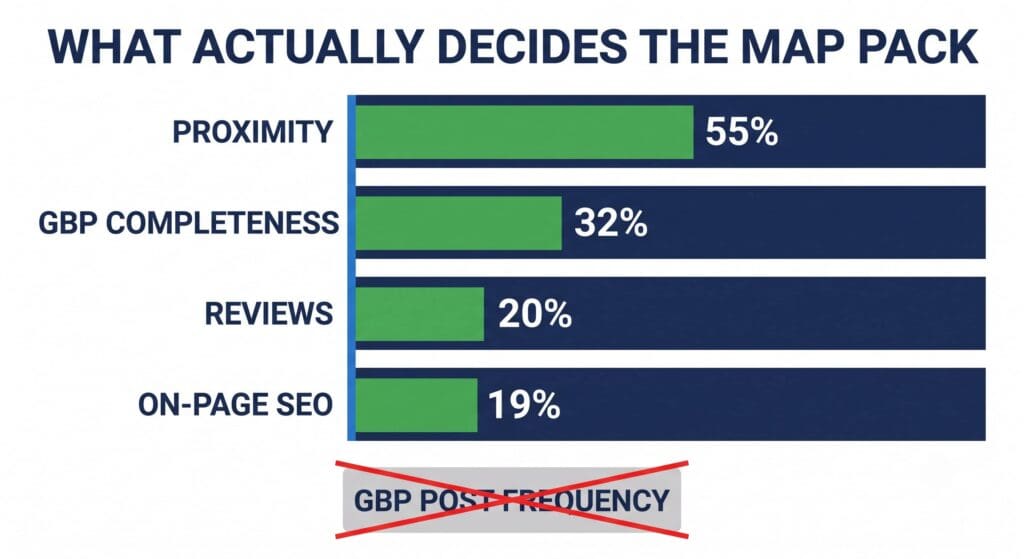
What actually decides the local map pack
For a home-service business in the SGV, the factors that actually move rankings in the map pack — in rough order of weight from the 2026 research consensus — are:
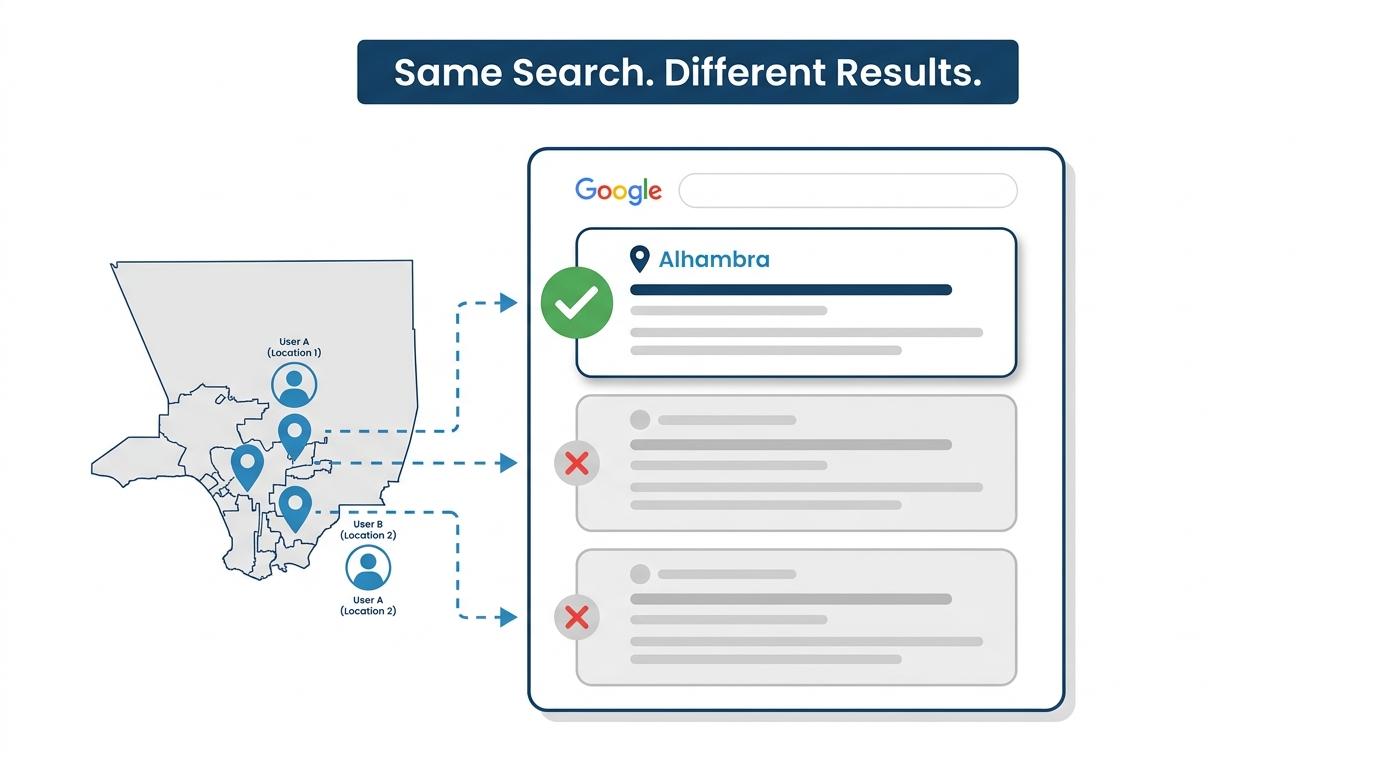
Proximity (about 55%). Whether Google shows your business for a search depends heavily on how close you are to the person searching. This is the reason a plumber in Whittier can dominate Whittier searches but be invisible in Alhambra even if their SEO is perfect. Proximity isn’t something you can post your way out of.
Google Business Profile completeness (about 32%). Correct primary category, all applicable secondary categories, complete services list with real descriptions, accurate hours, service area radius, photos, attributes. Filling this in the first time is a one-hour project that pays off for years. Sterling Sky’s related research on this specifically found that adding granular services to a GBP produces ranking improvements for both exact-match and related keyword searches. That’s the opposite of the null result on posts.
Reviews (about 16–20%). Total count, velocity (how often new reviews come in), response quality, and rating recency. In 2026, review velocity is one of the strongest signals in the map pack. This is also where the biggest gap tends to be for home-service businesses — great work, no cadence for asking for reviews. Buying reviews to fake this signal is a genuinely bad idea now — see our post on why buying reviews backfires.
On-page SEO (about 19%). Your actual website matters more than most GBP-focused advice admits. Correct schema markup, service pages that mention specific cities you serve, a clean homepage with your NAP (Name/Address/Phone) matching your GBP exactly.
Notice what’s not on this list: the frequency of GBP posts, the number of blog posts you publish per month, or the “domain authority” of your backlinks. None of them are among the top signals in 2026. (More on why the backlink piece is a trap in our post on cheap Fiverr link packages.)
Where GBP posts actually help
Posts are not useless. They’re just not a ranking lever. What they do genuinely help with:
Click-through rate. A post with a CTA visible on your profile can earn you the call from someone who already found your listing. That 2.3x number Sterling Sky measured is real.
Trust signals for humans. A profile that hasn’t been touched in three months looks abandoned. A profile with a recent post about a service call you did in Rosemead reads as an active business.
Time-bound announcements. A Labor Day deal, a same-day-service window opening, a seasonal urgency (“furnace check-ups before the December drop”) — these are legitimate uses of a post.
Where posts don’t help is in ranking position. Publishing four posts a week to move up the map pack is like changing your business’s Facebook cover photo to affect your Yelp reviews. Different systems.
What to do with the hour you’d spend on posts
For an HVAC, plumbing, electrical, or roofing business in Montebello, Monterey Park, Pico Rivera, or any SGV city, if you have one hour a week for GBP work, spend it on the factors that actually move the pack:
Answer the questions customers ask — on your website and profile. Google retired the public Q&A box in late 2025; its AI now answers profile questions by reading your website, your services list, and your review responses. A tight FAQ on your site and complete service descriptions put category-relevant, city-specific text exactly where the AI looks.
Add or refine your services list. Every service you add — with a real description, not just a name — gives Google another signal about what your business actually does. Sterling Sky’s research on this specifically shows measurable ranking improvements.
Upload job photos with real captions. Not stock photos. Actual jobs, with the neighborhood or intersection named in the caption. Google’s image AI reads captions.
Send review requests. The last three customers you invoiced. Text them a direct link to your GBP review page. Do this every week for six months and your review velocity will be miles ahead of every competitor in your city who’s busy posting instead.
Also worth avoiding: keyword-stuffing your business name to try to force ranking improvements. That one is genuinely dangerous — Google can and does suspend profiles for it. We break that down in our post on the keyword-stuffed business name trap.
How City Boost handles this
Our Google Business Profile management work isn’t a fixed number of posts per month. It’s category and services optimization, review-cadence workflows, profile-completeness audits, and the specific per-city tuning that actually moves you up the map pack in the SGV.
If you’re currently paying an agency to post four times a week and you’re not sure whether it’s producing any ranking change — pull up your rank tracker (or our free Local Rank Checker) and compare where you were three months ago to where you are now. If the answer is “same,” the agency has been billing you for something that doesn’t work. And you now know exactly what to spend the budget on instead.