TL;DR
What happens if I buy Google reviews in 2026?
Far more than it used to. Buying reviews now violates the FTC's Consumer Review Rule — fines can run tens of thousands of dollars per violation — and Google's detection catches purchased batches, bringing suspensions, scrubbed reviews, and public warnings. Even an old bought batch is worth cleaning up. A steady stream of real reviews wins anyway.
A few years ago, buying twenty Google reviews from a $30 Fiverr gig was a low-stakes gamble for a home-service business. Sometimes it worked for a while, sometimes the reviews got scrubbed, but almost nobody got seriously punished for trying.
That window closed. In 2026, the same twenty reviews can now cost you:
- A federal civil penalty of up to $51,744 per violation under the FTC’s Consumer Review Rule
- Full suspension of your Google Business Profile
- A public warning banner on your profile telling every customer that Google removed fake reviews from your listing
- The permanent tanking of the review-velocity signal that would have taken years to build honestly
Between Google’s new AI-driven detection and the FTC’s rule that came into force in October 2024, review-farming for local businesses became one of the most quietly dangerous marketing shortcuts an HVAC contractor, plumber, or roofer in the SGV can take. What follows is what actually changed, what Google is now doing about it, and what to do instead.
What Google actually built in 2024–2025
Google’s review-abuse detection used to be a filter that ran periodically and caught the obvious offenders. That’s not what’s running anymore.
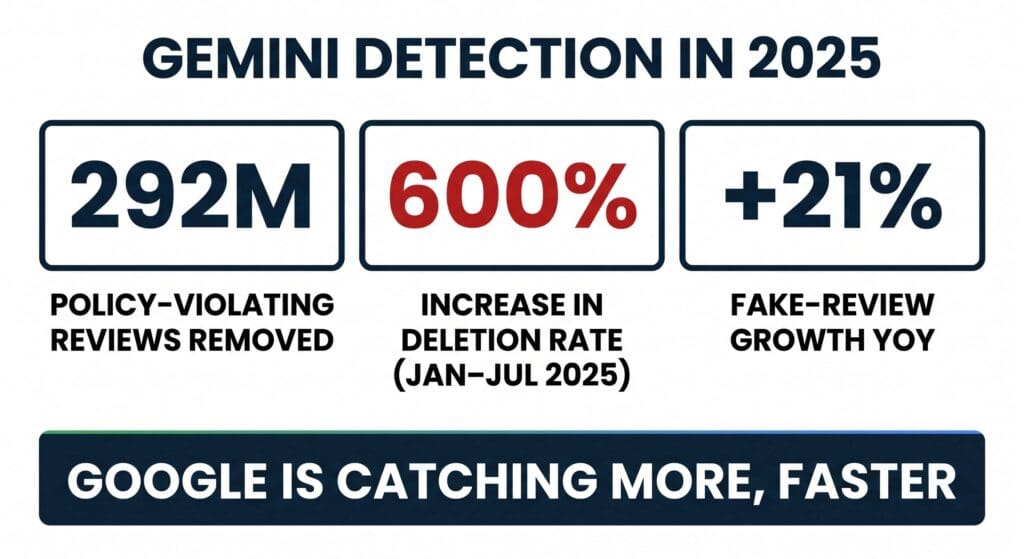
Since 2024, Google has been running its Gemini-powered detection system across the entire Google Maps review corpus. The numbers Google itself published tell you what’s happening:
- 240 million+ policy-violating reviews removed in 2024
- 292 million+ reviews blocked or removed in 2025
- Review deletion rates increased 600% between January and July 2025 as the new detection systems scaled up
Gemini isn’t looking for keyword patterns. It’s looking for coordinated posting patterns, language-fingerprint similarity across reviewer accounts, geographic anomalies (twenty reviews for an Alhambra HVAC company from IP addresses that never leave the Philippines), review-timing spikes, and reviewer histories that don’t match the “real customer” profile.
The output is faster and more thorough than it used to be. A batch of fifteen five-star reviews from unrelated first-time reviewers arriving in the same week no longer takes six months to get identified. It often takes days.
The FTC rule that changed the risk profile
Detection alone would already be a problem. What made the risk far worse is that in October 2024, the FTC’s Consumer Review Rule (16 CFR Part 465) came into force. It made buying, selling, or facilitating fake consumer reviews a federal violation with civil penalties up to $51,744 per violation — and “per violation” can mean per fake review.
The FTC has been enforcing it. In December 2025, the FTC issued ten warning letters to companies suspected of violations. Earlier that year, they settled with Rytr, an AI writing tool, for providing subscribers with the means to generate false consumer reviews at scale.
For a home-service business owner, the practical implications:
You are the one on the hook. The rule is written broadly enough that it targets the business that benefits from the fake reviews, not just the Fiverr seller who wrote them. The seller in the Philippines is unreachable. Your Google Business Profile isn’t.
The Fiverr seller has zero liability for you. When your profile gets hit, the seller has already been paid and moved on to the next gig. You’re the one who has to explain to Google, the FTC, and eventually your customers what happened.
“I didn’t know” doesn’t help you. The FTC rule doesn’t require intent. Paying for reviews — knowingly or not — is enough to trigger a violation.
What Google’s enforcement actually looks like now
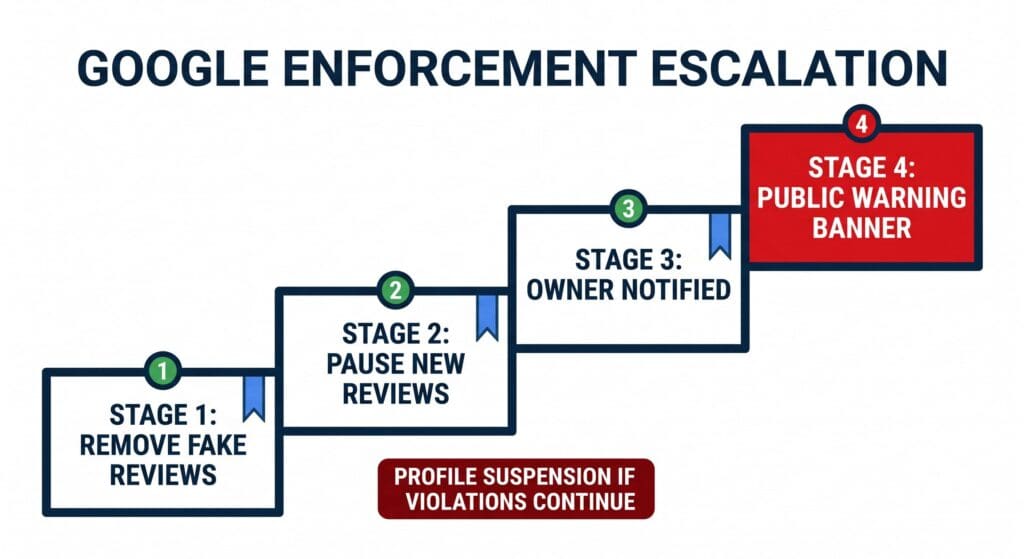
When Google’s Gemini system detects a review-manipulation pattern on a profile, the enforcement isn’t a single event anymore. It’s a four-stage escalation that plays out publicly:
Stage 1: Content removal. The suspected fake reviews get taken down. This is silent — you might not even notice, but the profile’s review count drops.
Stage 2: Pause on new reviews. For a period of days or weeks, no new reviews can be posted to your profile at all. Even legitimate customers can’t leave a five-star review during this window.
Stage 3: Owner notification. The Business Profile owner gets an email from Google explaining what was detected and warning that further violations will escalate the response.
Stage 4: Public warning banner. This is the one home-service owners often don’t know exists. When violations continue, Google displays a public notification banner on the profile — visible to every customer searching for your business — saying that suspicious activity has been detected and reviews have been temporarily paused.
Stage 4 is not fixable by “waiting it out.” The banner remains for weeks and gets seen by every customer looking at your listing during that time. For a business ranking in the map pack for high-value emergency calls (leaking pipe, no A/C in July, roof damage after a storm), the banner arrives at the worst possible moment.
If violations still don’t stop, full profile suspension follows. Reinstatement requires a review-request process with Google’s Trust & Safety team that can take weeks and often fails on the first attempt.
Between Q1 2023 and Q2 2024 alone, the number of GBP suspension reports globally increased by over 80%. That trend has continued through 2025 and 2026.
Why “just a few reviews” is still risky
The most common rationalization is: “I’m only going to buy five or ten reviews from a domestic-looking service. Google can’t detect that.”
Gemini isn’t looking for individual fake reviews. It’s looking for patterns across your entire profile history:
- Velocity anomalies. If your profile normally gets one review a month for two years, then suddenly gets six in a week, that’s a spike Gemini flags regardless of what the reviews say.
- Language fingerprints. AI-written reviews (from Rytr, ChatGPT, or similar) share statistical patterns across accounts. Gemini specifically flags these.
- Reviewer history. A “customer” whose only Google reviews are five-star reviews for six unrelated small businesses in the last two months looks nothing like a real customer.
- Geographic clustering. Reviews for your SGV plumbing business coming from IP addresses in a specific cluster (or worse, all from the same office building) trigger obvious flags.
- Response-writing similarity. If the “customer” reviews and your own responses to them share language quirks, that gets flagged too.
You don’t need to look guilty. Your profile needs to not generate a pattern-anomaly signal. The cheaper the fake reviews are, the more they cluster into the exact anomaly patterns Gemini catches.
For an HVAC contractor, plumber, roofer, or electrician in the SGV, the underlying issue is the same regardless of how many reviews you buy: even one bought review permanently taints the reviewer-authenticity signal on your profile. Google’s system doesn’t forget flagged reviewers.
What to do instead
The reason “buying reviews” keeps looking attractive is that legitimate review generation feels slow. It doesn’t have to be.
For a home-service business in Alhambra, Pasadena, Whittier, or any SGV city, a real review cadence is genuinely simple:
Text the last three customers you invoiced. A one-tap link to your GBP review page. Do this after every completed job, not just once a quarter. If you’d rather not run the ask by hand, our review automation sends it after every job without anyone having to remember.
Ask on the same day the work is done. Not next week. Customers write reviews when the memory is fresh — the “your AC is blowing cold again” moment on a July afternoon.
Make it as easy as one tap. A short link, not a “please leave a Google review” paragraph in an email. The friction between “customer wants to leave a review” and “review actually posted” is where you lose 80% of them.
Respond to every review. Specifically. “Thanks for the kind words” is templated noise. “Glad we got your Lennox back up before Sunday’s heat wave” is a real response — and it also plants category-relevant, city-relevant text on your profile that Google’s ranking systems actually reward.
That approach produces a review-velocity signal that is real, that Gemini won’t flag, and that will out-perform any bought-review scheme in the map pack. It also builds review count that keeps working for years, not weeks.
For context on how this fits with the rest of the map pack picture — proximity, GBP completeness, on-page SEO — see our post on what actually decides the map pack for SGV home-service businesses.
And a warning on a related enforcement risk: stuffing keywords into your GBP business name to try to boost rankings can get your profile suspended for a completely separate reason. We break that down in the keyword-stuffed business name trap.
How City Boost handles reviews
Our reputation and reviews management work doesn’t touch fake-review generation. It builds the review cadence that produces the real signal:
- Post-job review-request workflows tied to your invoicing so requests go out the same day
- Response workflows that keep every review acknowledged in a way that helps ranking, not just PR
- Review monitoring so you know when new reviews land and can respond within 24 hours
- Analytics on review velocity, rating trend, and response rate — the metrics that actually influence the map pack
If your profile has any history of bought reviews — even a small batch from a previous agency or an early attempt years ago — that’s worth auditing before Google’s next detection sweep catches something you’ve already forgotten about. That’s the kind of thing our audits surface — start with the free one. The Fiverr-backlinks side of that same audit story is covered in our post on cheap Fiverr link packages.