TL;DR
Why does my contractor website stop working after a few months?
Because websites are built once and then left alone while your business keeps changing. Stale service lists, outdated pricing, and old testimonials send Google mixed signals. The fix is keeping your site current—either manually, through a maintenance plan, or with AI agents that handle routine updates automatically.
Your plumbing website looked great the day it went live. The service list was accurate. The pricing was right. The photos were fresh. That was probably eighteen months ago.
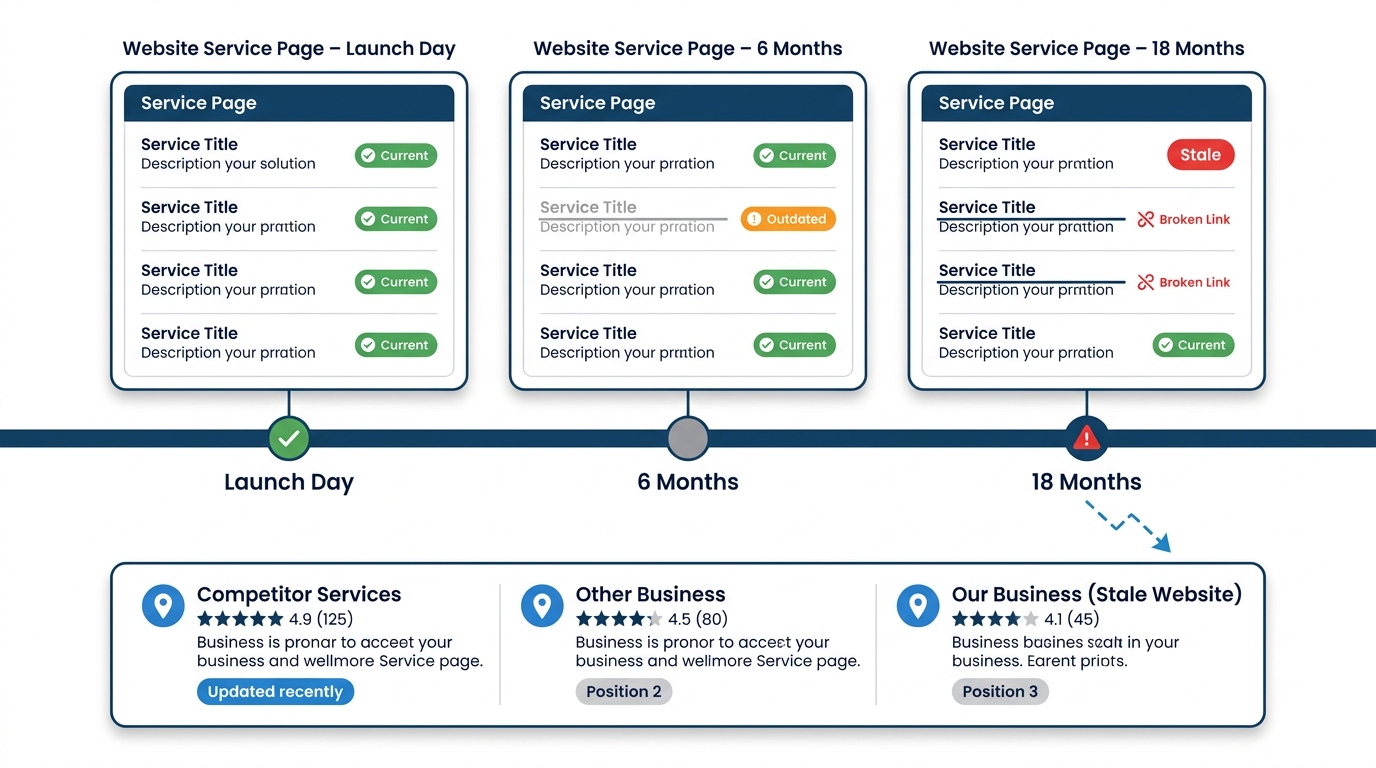
Right now, someone in Whittier is searching for a water heater replacement at 8pm on a Tuesday. Google is looking at your site and seeing a service list that still mentions a special you ran in 2023, a “contact us for pricing” button that goes nowhere, and testimonials from customers who moved away two years ago. Imagine a competitor — an HVAC shop in Downey that updated their site last week — sitting above you for “water heater replacement Whittier.” Their service page reflects current pricing. Yours doesn’t. Google picks them.
This isn’t a story about bad web design. It’s a story about time.
Every Website Is a Snapshot — and Snapshots Age
Pierre Burgy, co-founder of Strapi, put it plainly: “The market moves, the messaging shifts, a competitor launches something, and the careful thing you built slowly stops matching the company it represents. A year later, it is a period piece. Not broken, just behind.”
That’s the situation most HVAC, plumbing, and electrical contractors in the San Gabriel Valley are in. The site works. The phone number is right. But the content is a snapshot of your business from whenever you last had a slow week and remembered to log in.
A quick scan of any SGV contractor category on Google Maps turns up the same pattern: service pages listing expired specials, service area copy that doesn’t match the Google Business Profile, pricing sections that haven’t moved since before the last materials price spike. Every one of those mismatches is a signal Google reads as ambiguity — and ambiguity costs you calls.
Freshness is a real factor in how Google evaluates local service pages. A page with no updates, no current pricing, no recent testimonials is a page that slowly slides down the results while the shop that updated their site last month climbs past you in Alhambra, Rosemead, or Pico Rivera.
The 80% Nobody Wants to Do
Keeping a website current isn’t mostly about writing. It’s mostly chores.
Broken links when you change a service page URL. Images uploaded uncompressed that are slowing your load time. A meta description that still says “serving the greater LA area” when you now specifically cover Downey, Pico Rivera, and Montebello. An accessibility tag missing on a new photo. A pricing section that hasn’t been touched since you raised your dispatch fee.
None of that requires creativity. It requires attention — and attention is the one thing you don’t have when you’re running a crew.
Burgy’s team found that when they broke down what actually keeps a website healthy, the vast majority of the work is “rule-bound, repetitive, and completely joyless.” Checking that design updates propagated everywhere. Catching a broken link. Flagging an unoptimized image. None of it is where your talent lives. It’s the work you’d be relieved to hand off — and it’s the work AI agents are now built to handle.
What Autonomous Website Agents Actually Do
Wix recently launched a platform called Symphony specifically designed for small local businesses — the kind of shops that don’t have a marketing department. According to Search Engine Journal, Symphony deploys AI agents that learn your specific business workflows, then handle day-to-day tasks across your site without requiring you to prompt them manually each time.
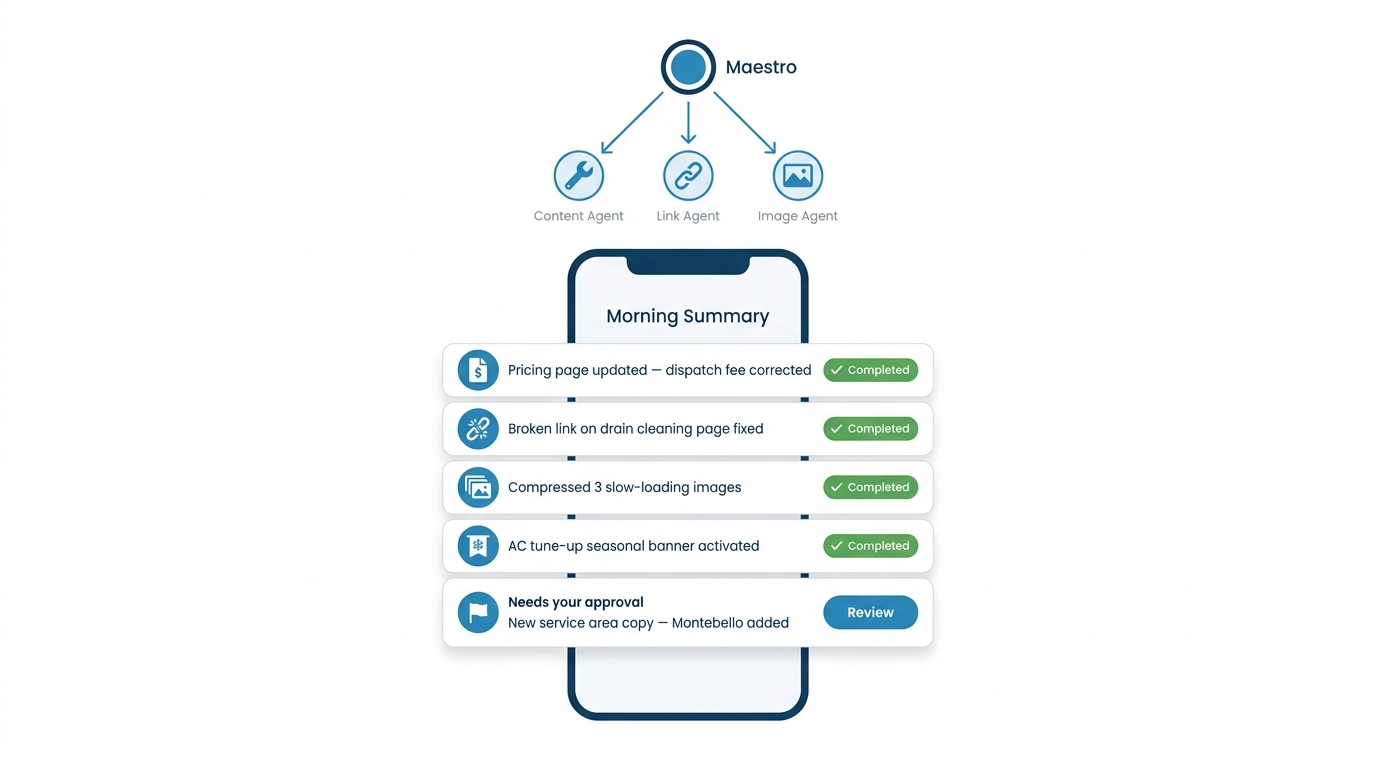
The key piece is something they call Maestro — an orchestrating agent that watches what’s happening across your business, identifies what needs attention, and assigns work to specialized agents. Those agents work within pre-approved boundaries, flag anything that needs your sign-off, and send you a morning summary of what they did overnight. Wix’s COO described the goal plainly: “any business owner can have the team they need to scale.”
That morning-summary model matters. Burgy’s team learned this the hard way when they built a fully autonomous system and watched people hesitate — not because they distrusted the technology, but because different parts of the site belong to different people, and everyone wants a different level of control. The right model isn’t “hand it over completely.” It’s “automate the chores, flag the decisions.”
For a plumber in Downey or a roofer in Pasadena, that plays out like this in practice:
- Your current service list stays accurate as you add or drop offerings
- Seasonal content — AC tune-up specials in May, heater checks in October — gets surfaced and retired on schedule
- New reviews from Google get pulled into the site without you copying them manually
- Broken links and slow-loading images get caught before Google does
- Pricing pages reflect what you’re actually charging, not what you charged eighteen months ago
What Agents Can’t Do (And Shouldn’t)
An agent can check that your service page for drain cleaning mentions Whittier and Pico Rivera. It cannot decide whether your brand voice sounds like a trustworthy local shop or a corporate franchise. It can flag that your “About Us” page hasn’t been updated since your son joined the crew. It cannot write the paragraph that makes a homeowner in Montebello trust you enough to call.
That judgment stays with you. The mistake is thinking the whole site is made of judgment. Most of it isn’t.
Here’s the harder position: most web agencies sell you a launch and disappear. You get a nice-looking site, a handshake, and a login you’ll never use. That model is broken for local service businesses, and AI agents are the first practical alternative that doesn’t require hiring a full-time content manager. The chores get done. The decisions stay with the person who knows the business.
This is how you should think about your website design and development investment. A site isn’t a one-time project — it’s infrastructure. Build it to maintain itself on the routine stuff, and spend your attention on the parts that actually need your judgment.
What This Means for Local Search in the SGV Right Now
Google is paying attention to signals most contractors in Alhambra, Whittier, and Downey aren’t thinking about. How recently was your service page updated? Does your site reflect your current service area? Are there fresh testimonials? Is the content consistent with what your Google Business Profile says?
A stale site doesn’t just look bad to visitors. It looks ambiguous to Google — and ambiguous is the enemy when someone in Rosemead needs an electrician today and Google has to pick between you and three other shops. Fresh, accurate information that matches your actual business is what moves you up that list. More keywords and a fancier homepage won’t do it.
The businesses that win local search in the SGV over the next two years aren’t necessarily the ones with the fanciest websites. They’re the ones whose sites stay accurate, stay fresh, and keep sending Google consistent signals that they’re an active, current, real business — the kind a homeowner can trust when their water heater gives out at 8pm on a Tuesday.
One Thing You Can Do This Week
Pull up your website right now and check three pages: your main service page, your pricing or estimate page, and your about page.
Ask yourself: does this reflect what my business actually looks like today? Are the services listed ones you still offer? Is the service area current? Are the testimonials recent?
If any of those are more than six months out of date, that’s your starting point. You can fix it manually, have it handled for you — hosting and maintenance is part of our website work, so the chores get done without you logging in — or look at tools like Symphony that handle routine updates automatically. If you want a clear picture of what’s drifted before you decide, request a free audit: it covers the website, and the report lands in five to ten minutes.
Your best day shouldn’t be the day it went live.