TL;DR
Why do my Google rankings look different depending on where someone searches from?
Google's May 2026 core update made organic rankings significantly more volatile based on the searcher's exact location. There is no single 'position 1' anymore. For local service businesses, this means your Google Business Profile signals—especially recent reviews and accurate service area settings—now matter more than ever.
Your cousin in Pasadena searches “emergency contractor near me” and your business pops up. A homeowner six miles away in Alhambra types the same thing and you’re nowhere. Same query. Same day. Different results.
That’s not a glitch. That’s Google’s May 2026 core update doing exactly what it was designed to do.
What Actually Changed in May 2026
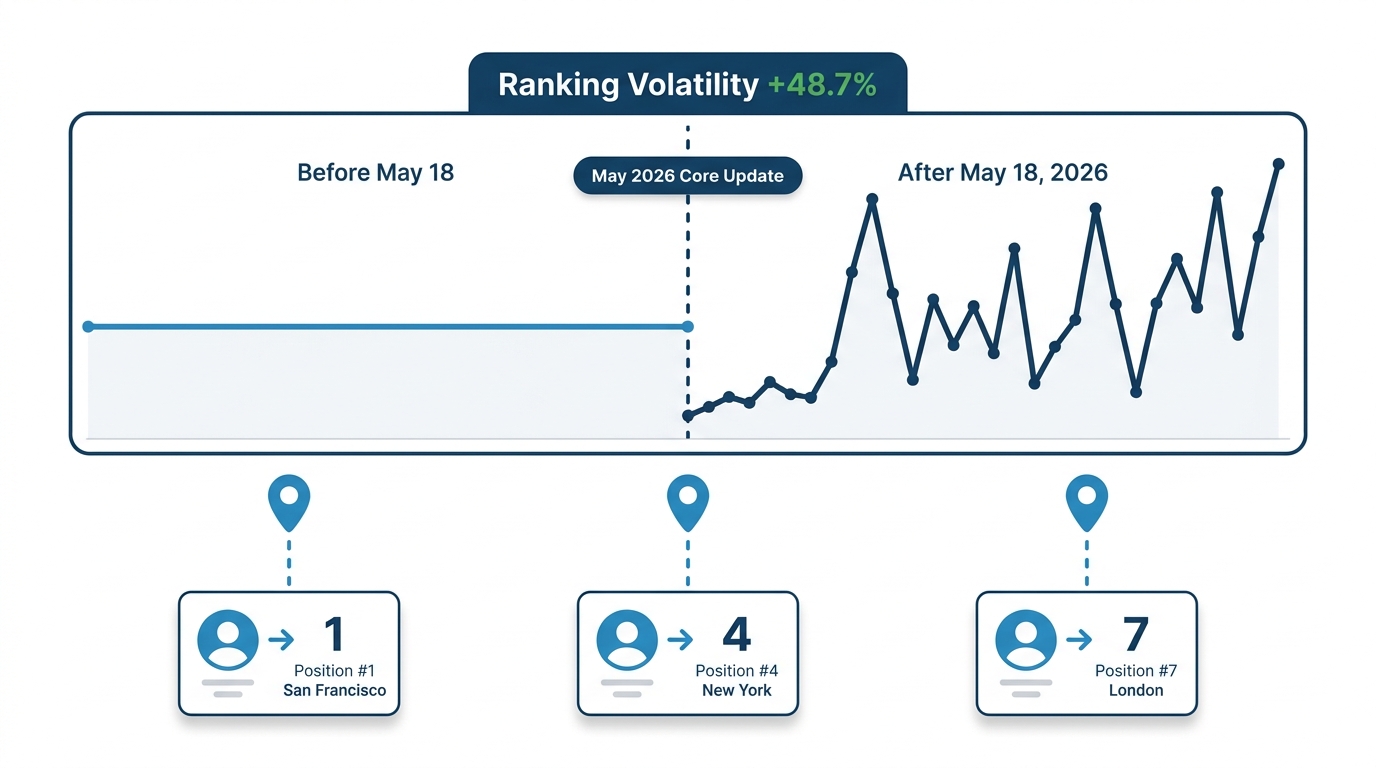
SEO researcher Joy Hawkins and the team at Yext pulled data from 8.16 million location-specific screenshots of search results and found something significant: starting the week of May 18, 2026, organic ranking volatility jumped 48.7%. Not for a handful of sites — 97% of the reports they examined became more volatile.
The effect was strongest on mobile searches that include a geographic term — what SEOs call a “geomodifier.” Think “general contractor Alhambra” or “plumber Long Beach.” Those queries now return meaningfully different ordered results depending on where the person searching is physically standing.
This is not personalization. Personalization is Google showing you sites you’ve clicked before. What Hawkins and Yext measured was logged-out users with no click history seeing different results from nearby locations at the same moment. That’s a fundamentally different mechanism — and a much bigger deal for local service businesses.
Why “What Do I Rank For?” Is Now the Wrong Question
Before May 2026, if you ranked #3 for “general contractor Alhambra,” that number meant something consistent. You could check it, report it, track it over time. It was a real signal.
Now it’s a snapshot of one person’s experience at one location. Hawkins’s analysis showed that a business could appear invisible (red) in one scan while ranking position 4–6 for the majority of actual searchers. A single rank-check is not just incomplete — it’s actively misleading.
The same piece notes that SEO tools doing a single scan on a single keyword have become “a lot more inaccurate.” If your agency is sending you a monthly PDF showing you’re at position 2, ask them how many scan points that number is based on. One scan is not a ranking. It’s a guess. Our free Local Rank Checker shows your live Google Maps position for each search that books jobs in your city — a starting point, not a verdict, for exactly the reason above.
What actually tells you whether your SEO is working? Your phone. Your leads. Call tracking tied to specific pages and UTM parameters on your Google Business Profile will show you the real picture — not a rank number that shifts by zip code. That is what our lead management setup is built around: every call and form in one place, tied to where it came from.
The Slower Problem Underneath This One
There’s a second thing worth understanding, and it’s uncomfortable. Even if you identify what’s wrong with your local presence and fix it, Google doesn’t snap back immediately.
Google’s John Mueller said it plainly in response to a business owner who had fixed their ranking problems: “fixing issues around bigger algorithmic changes can take quite some time — sometimes many months until you see the effects.”
That’s not a hedge. That’s the actual timeline. If the May 2026 update reshuffled your rankings and you’ve been waiting for things to “settle,” they may have settled — just not in your favor. Waiting is not a strategy.
What We Found in Alhambra’s Contractor Market
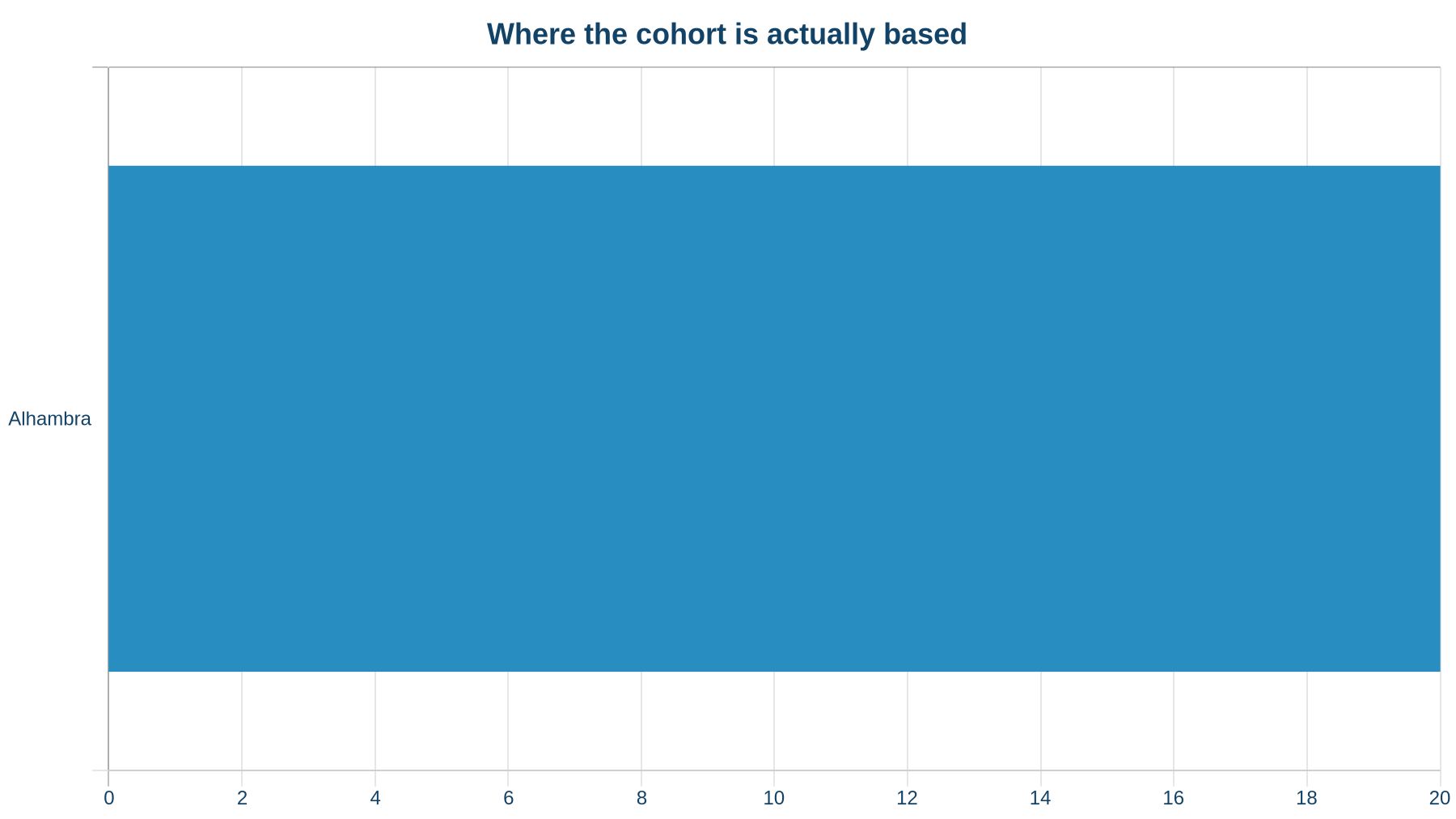
We ran our own audit of 20 general contractor profiles competing for searches in Alhambra. Every single profile in the cohort is physically based in Alhambra — no interlopers from Pasadena or San Gabriel bleeding into the map pack here. This is a tight, local competition.
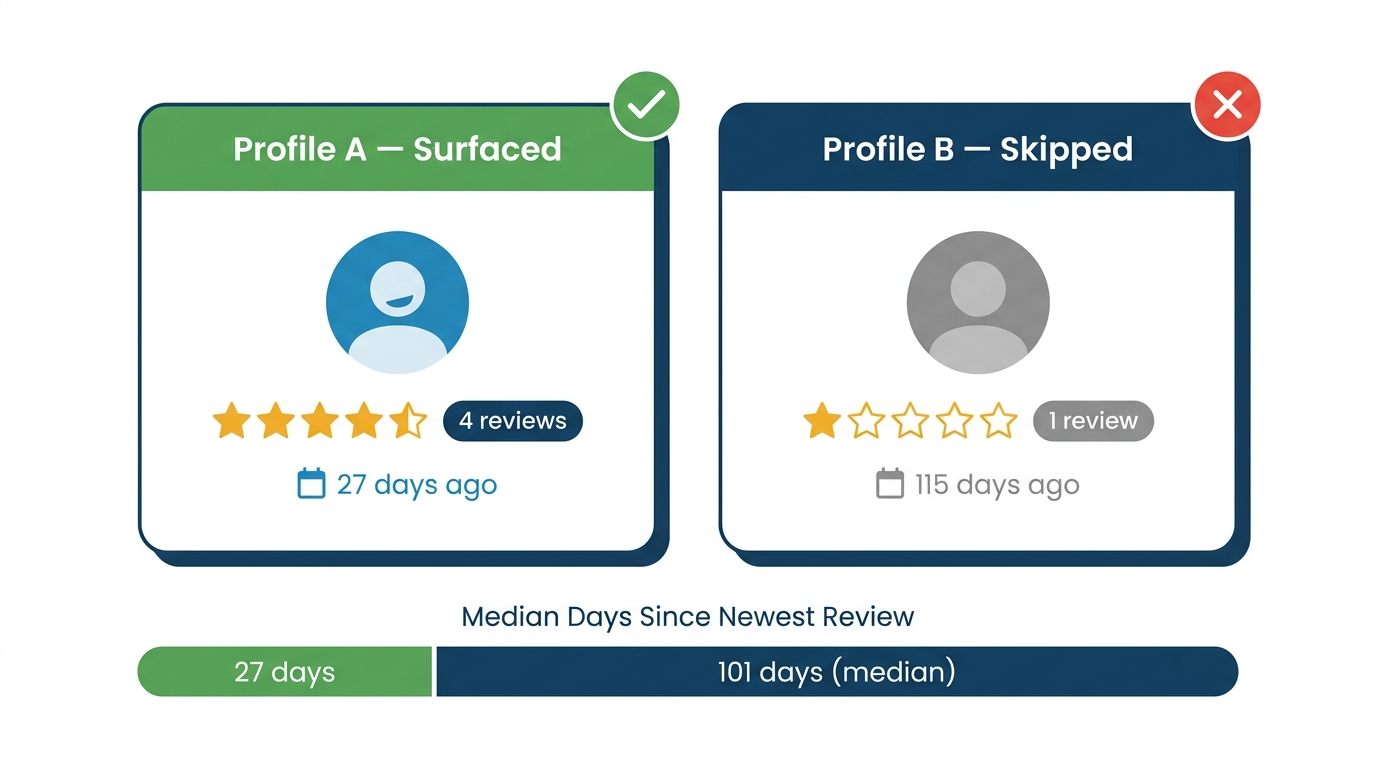
When we asked Google’s Maps-grounded AI for a general contractor in Alhambra, three profiles surfaced. The other 17 were skipped entirely.
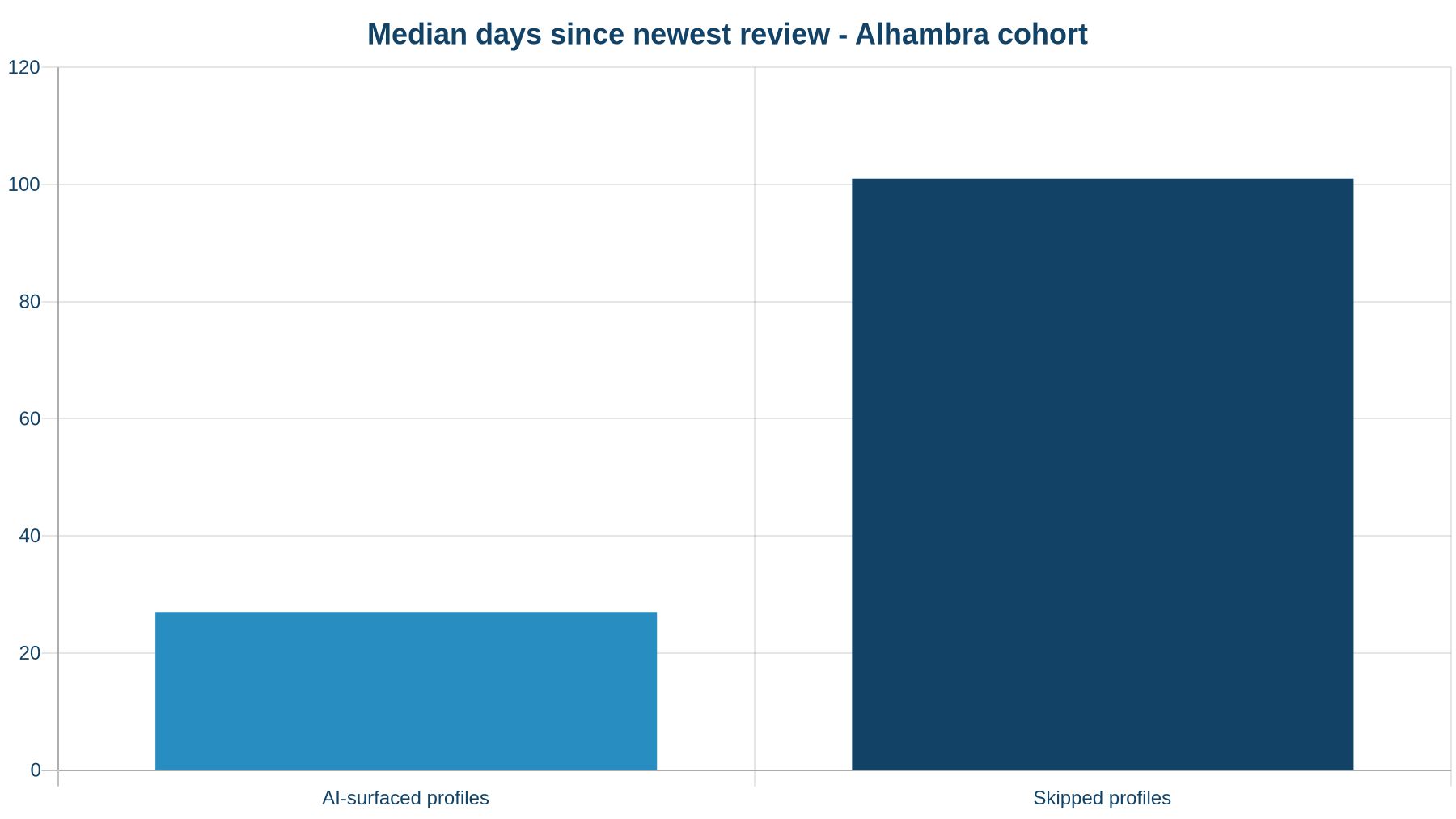
The gap between those two groups came down to one thing more than any other: how recently they had a review.
- Surfaced profiles: median newest review was 27 days old
- Skipped profiles: median newest review was 101 days old
That’s a 74-day gap. Not 74 days of better work or better service — 74 days of a customer either leaving a review or not. Profile A (one of the surfaced profiles) had just 4 total reviews, with the newest 27 days ago. Profile B (skipped) had 1 review, newest 115 days ago. Profile A won. Not because of more reviews. Because of a fresher one.
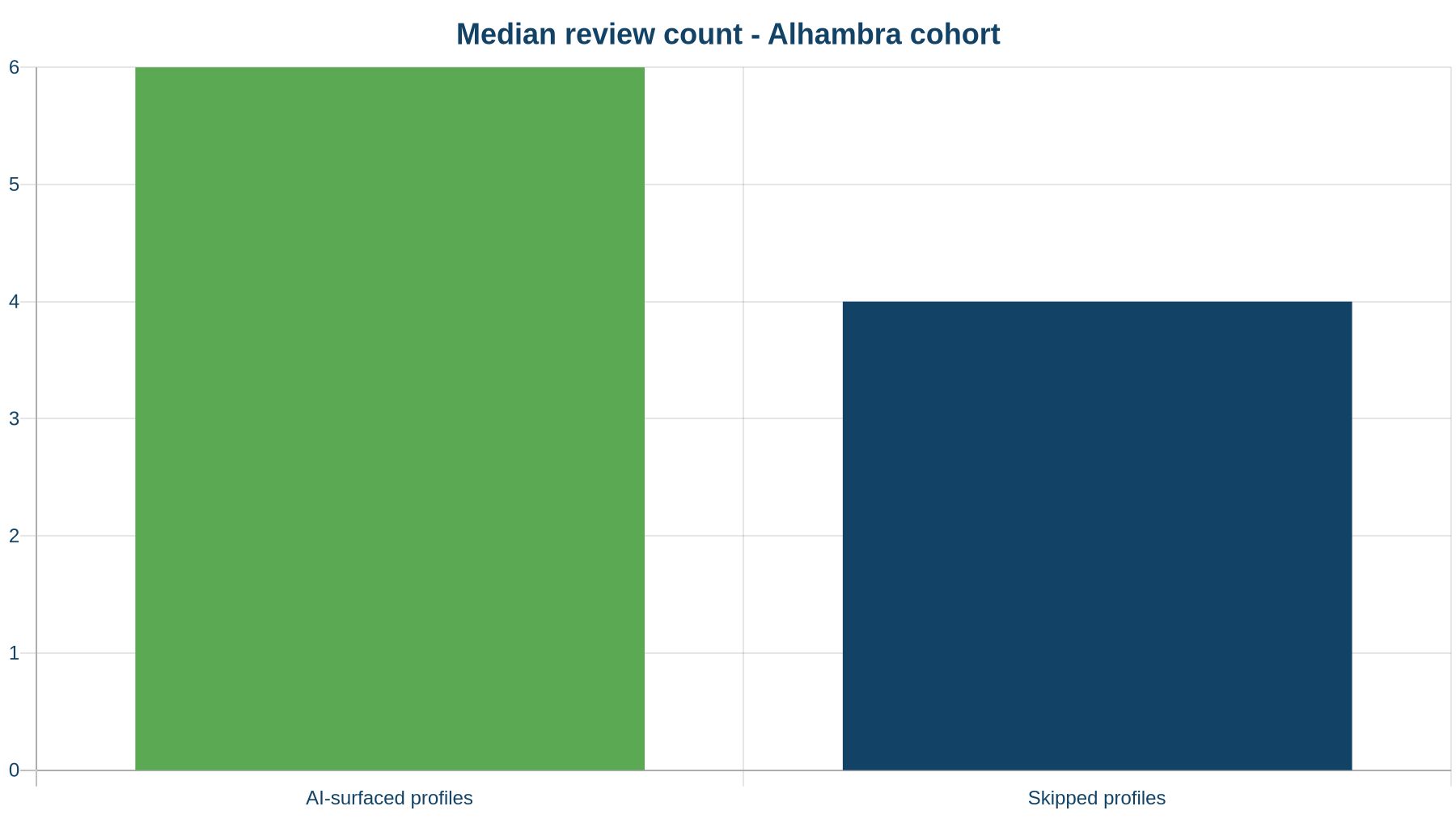
Review count mattered too, but less than you’d expect. Surfaced profiles had a median of 6 reviews; skipped profiles had a median of 4. The delta is real but small. Freshness crushed volume.
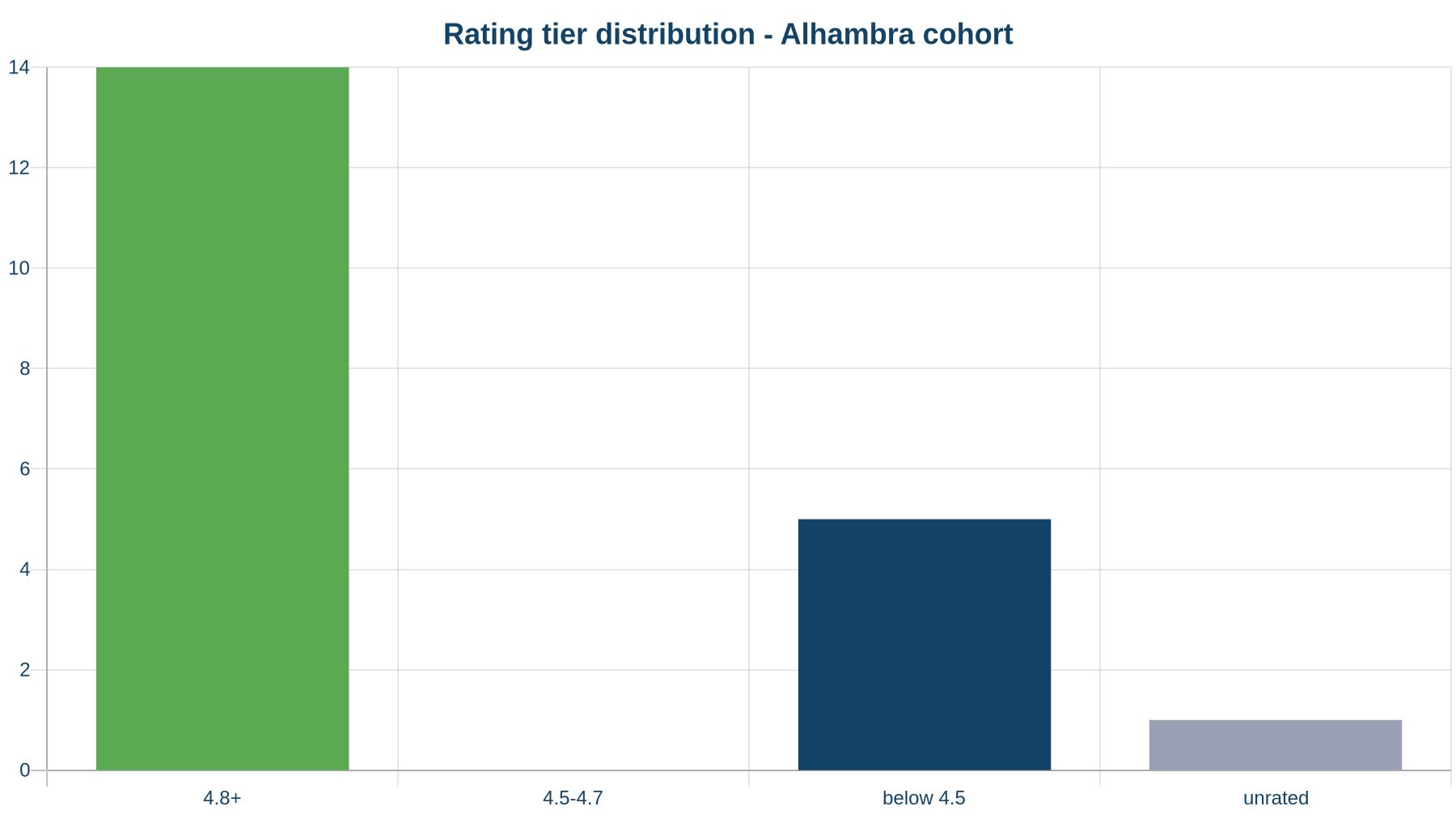
The rating distribution across the full cohort: 14 of 20 profiles were rated 4.8 or above. Five were below 4.5. One had no rating at all. So nearly everyone in this market has a strong average rating — which means rating alone doesn’t separate winners from losers. Recency does.
What This Means for Your Service Area
The dynamic SERP update made proximity and hyper-local signals matter more, not less. If your Google Business Profile lists a service area that covers half of LA County but your physical address is in one city, Google now has more reason to show you to people near your address and less reason to show you to people at the edges of that claimed territory.
That doesn’t mean you should shrink your service area. It means you need to earn visibility in each sub-market through signals that are actually local — reviews that mention specific neighborhoods, posts that reference the cities you serve, and a profile that’s clearly active and maintained.
Our local SEO service for contractors is built around exactly this kind of market-by-market work, because the Alhambra search and the Long Beach search are genuinely different competitions now.
The May 2026 update didn’t create a new game. It accelerated a game that was already being played. The businesses winning in Alhambra’s contractor market aren’t doing anything exotic. They have recent reviews. Their hours are set. Their profiles are complete. They’re showing up because they’ve been treating their Google Business Profile like the asset it is, not an afterthought.
One Thing to Do Monday Morning
Pull up your Google Business Profile and look at your most recent review. Check the date.
If it’s more than 60 days ago, that’s your problem — not your keyword strategy, not your website, not the update. Go ask your last three happy customers to leave a review this week. One sentence is enough. A specific mention of the city where you did the work is better.
The search results are different for everyone now. But the businesses that show up consistently are the ones with proof — recent, real, local proof — that they’re still in business and still doing good work.