TL;DR
Do my Google reviews and social posts actually affect whether AI tools like ChatGPT recommend my business?
Yes — AI models pull from reviews, social mentions, and business data signals across the web, not just traditional search rankings. Businesses with higher review counts, recent reviews, and active social presence get surfaced far more often. The gap between active and inactive profiles is significant and growing.
Your competitor two cities over doesn’t have a better website than you. They might not even have better reviews. But when someone asks Google’s AI or ChatGPT for a garage door repair company near Commerce, that competitor keeps showing up — and you don’t.
Here’s what’s actually happening.
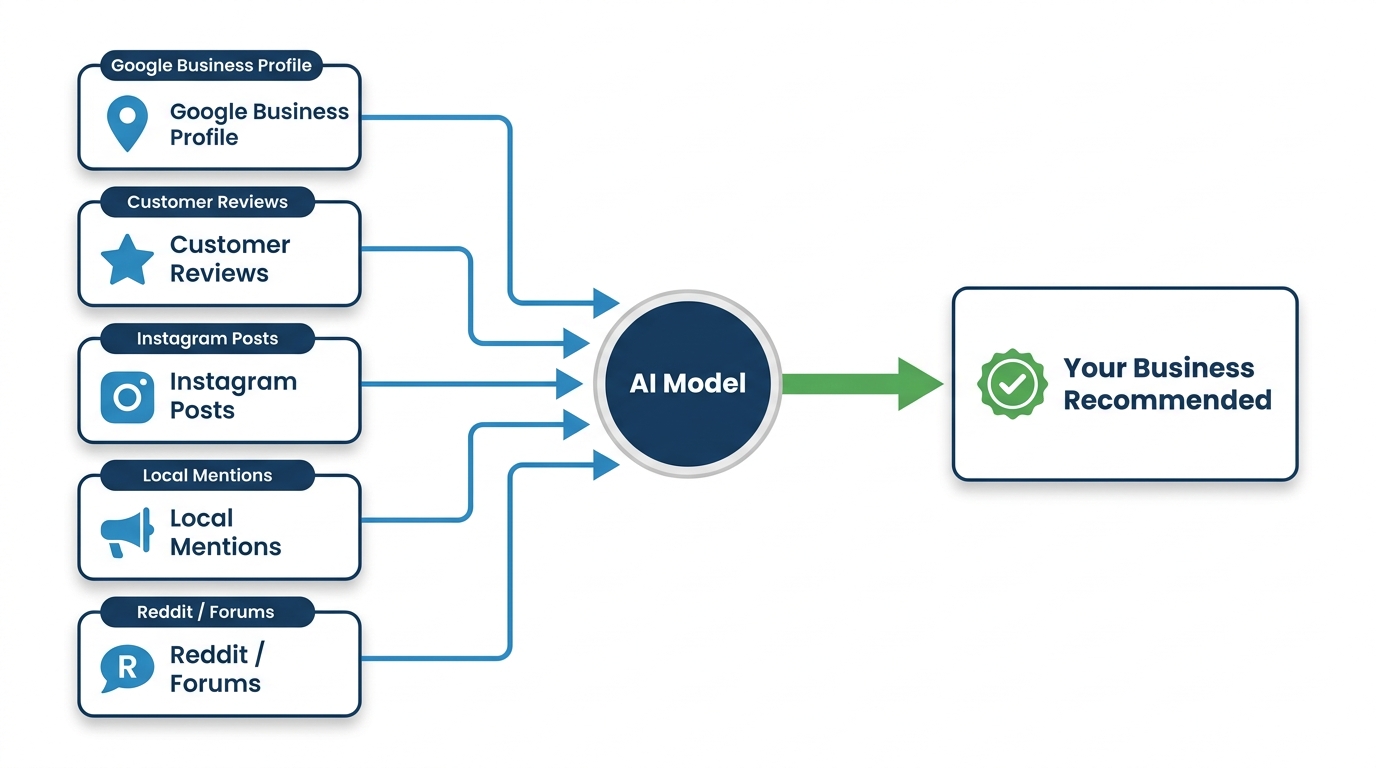
AI tools — Google’s Maps-grounded AI, ChatGPT, Gemini, Perplexity — are no longer just reading your website and ranking signals. They’re pulling from a much wider net: review platforms, social posts, Reddit threads, local city forums, hotel “best of” lists, and anywhere else your business name appears. According to Moz’s Jonathan Berthold, speaking at SEJ Live, the models can now cite a mention from a hotel website’s list of local vendors just as easily as a Google Business Profile. The work of being findable has roughly tripled since the early days of local SEO.
If your business is sitting still — same review count it had a year ago, no social presence, GBP filled out halfway — you’re not holding steady. You’re falling behind.
What We Found When We Asked AI About Garage Door Repair in Commerce
We asked Google’s Maps-grounded AI for the best-rated garage door repair in Commerce, California. We then pulled the full cohort of 17 profiles competing for that search.
Five profiles got surfaced. Twelve got skipped.
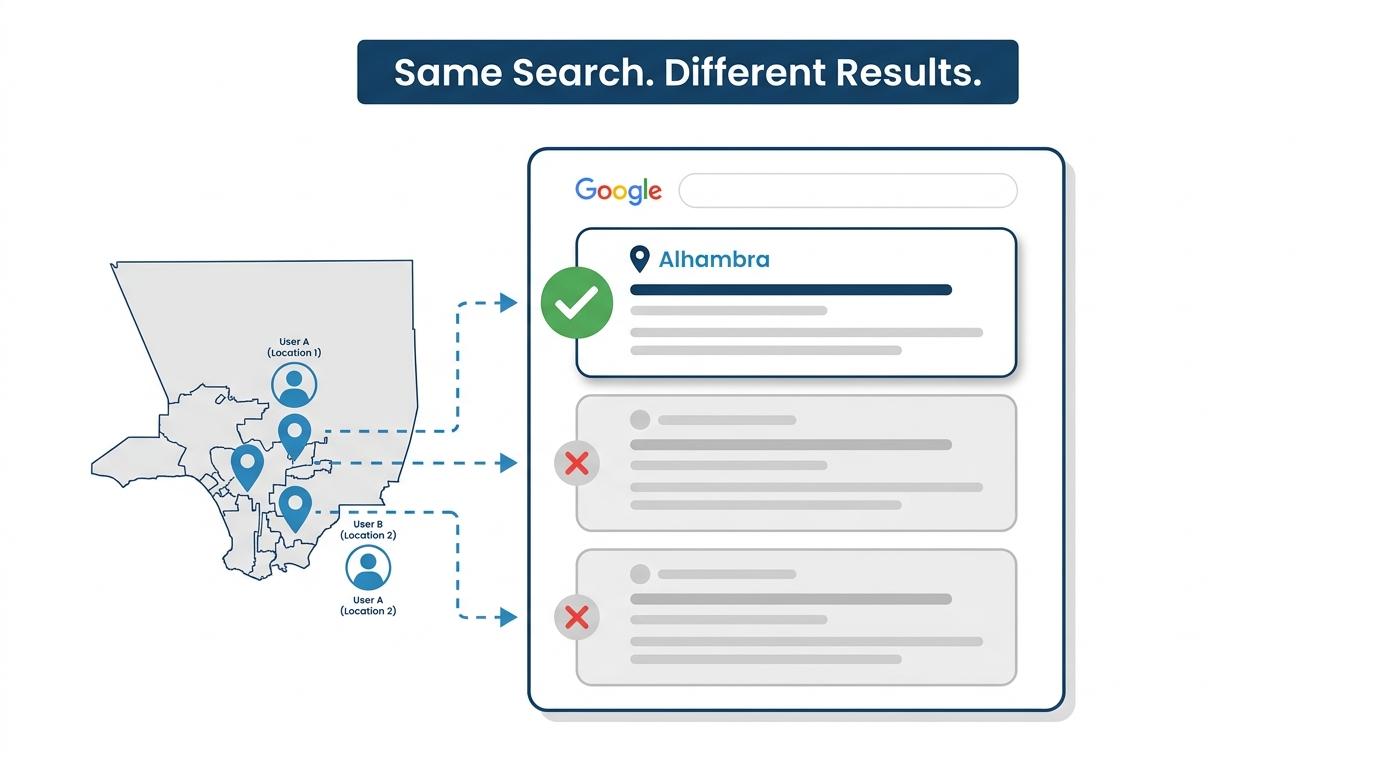
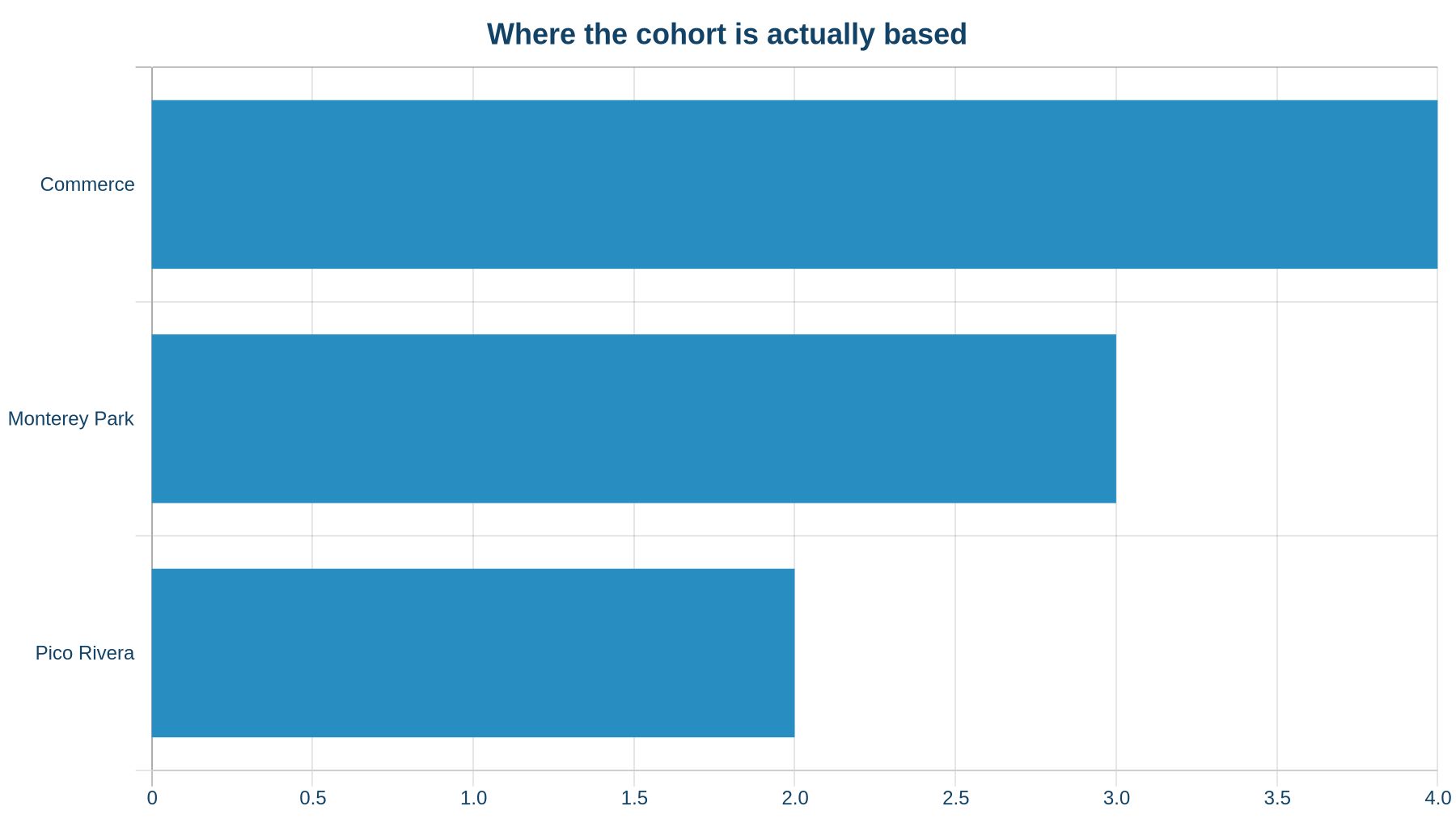
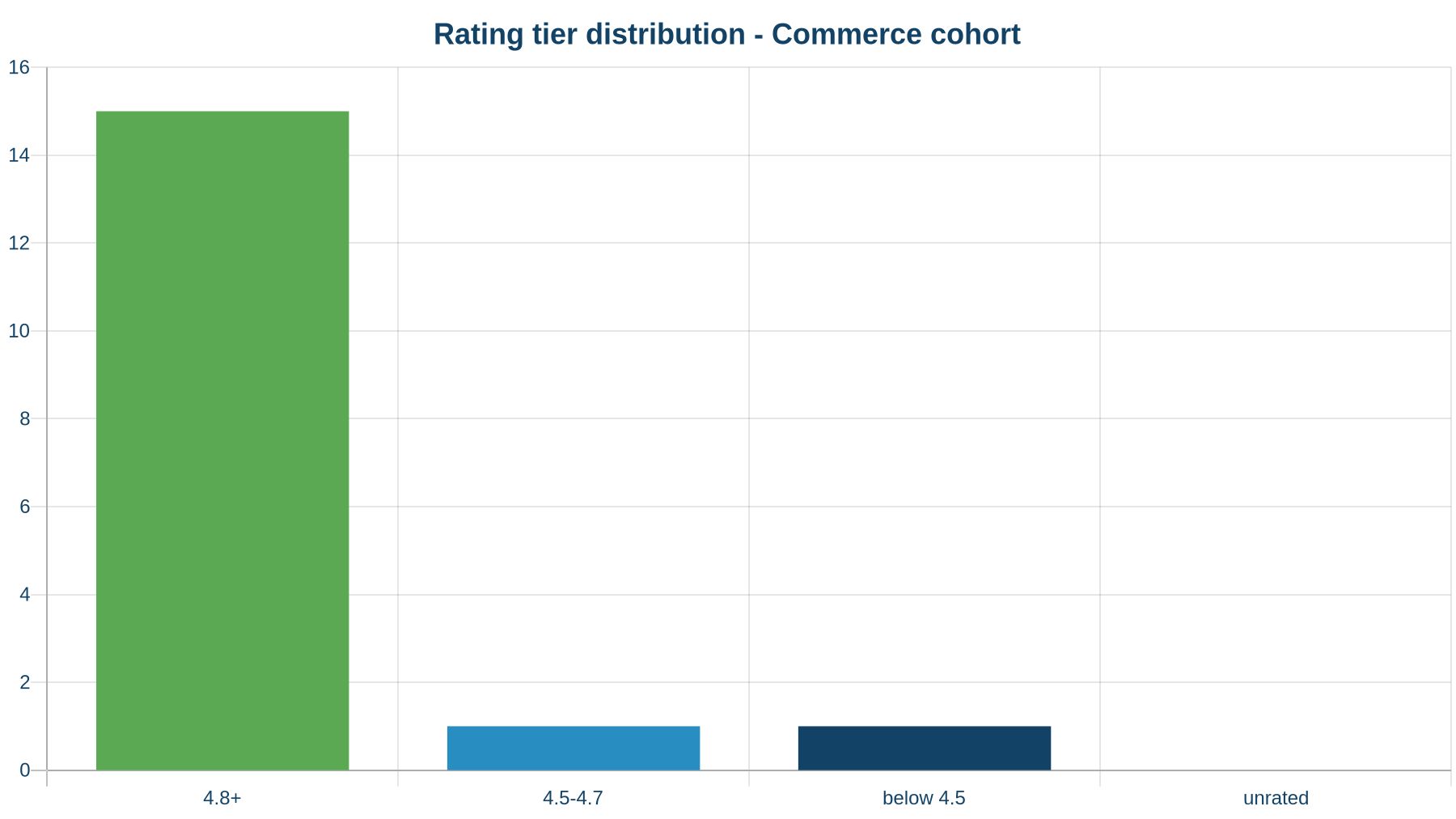
The difference wasn’t star rating — 15 of the 17 profiles in the cohort sat at 4.8 stars or above. It wasn’t hours (zero skipped profiles were missing hours). It wasn’t even proximity: only 4 of the 17 businesses are physically based in Commerce. The top host cities in the cohort are Commerce (4 profiles), Monterey Park (3), and Pico Rivera (2) — meaning businesses from neighboring cities are regularly beating Commerce-based operators for Commerce searches.
What separated surfaced from skipped was review volume and review recency.
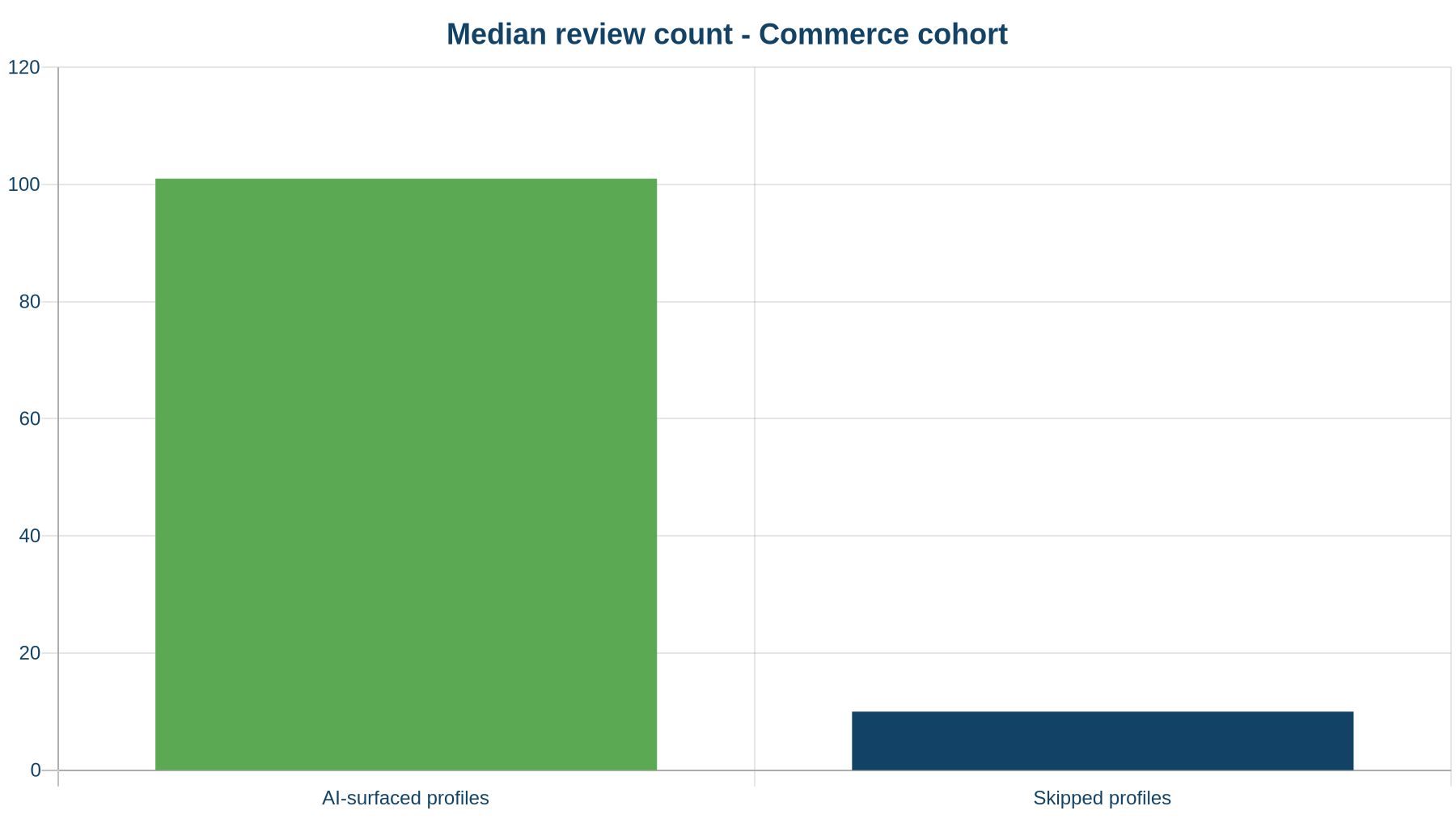
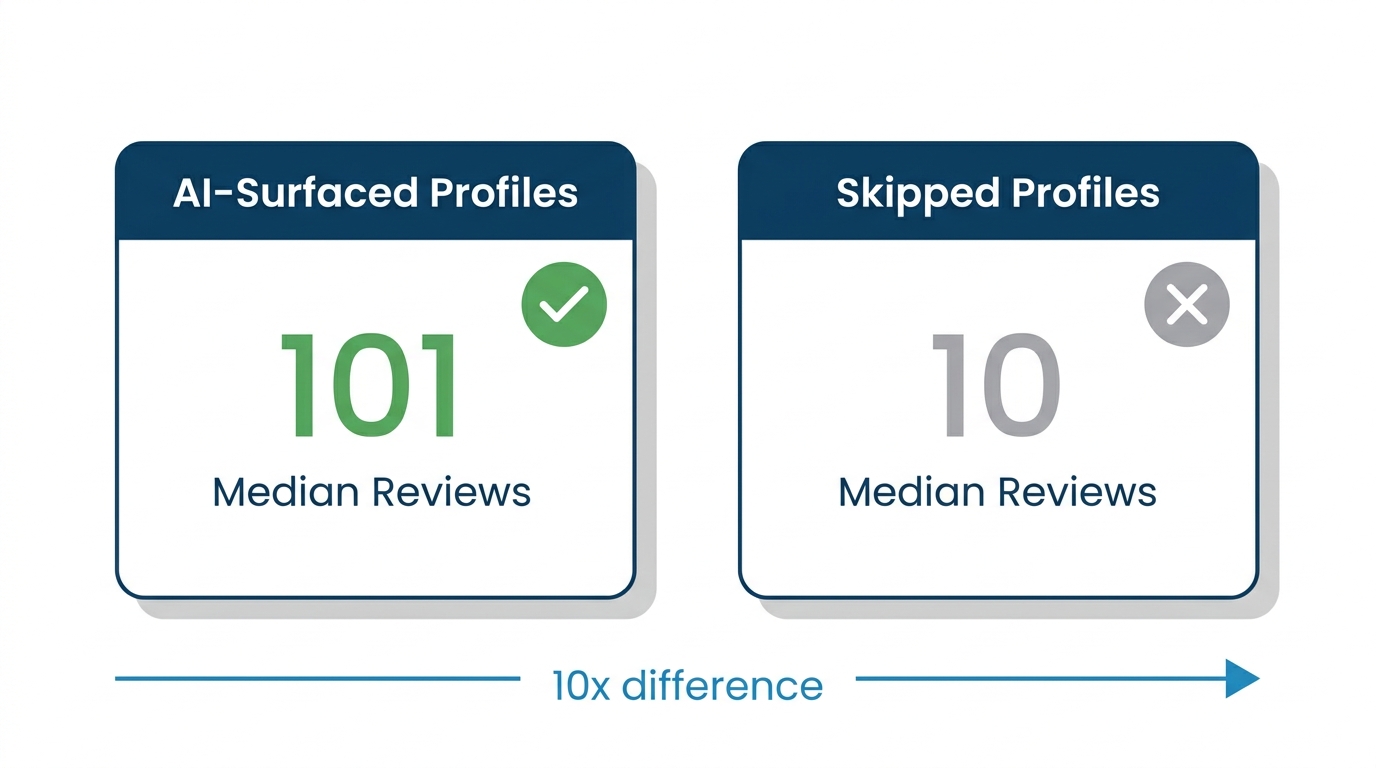
The median review count for surfaced profiles: 101 reviews. For skipped profiles: 10 reviews. That’s a 10x gap.
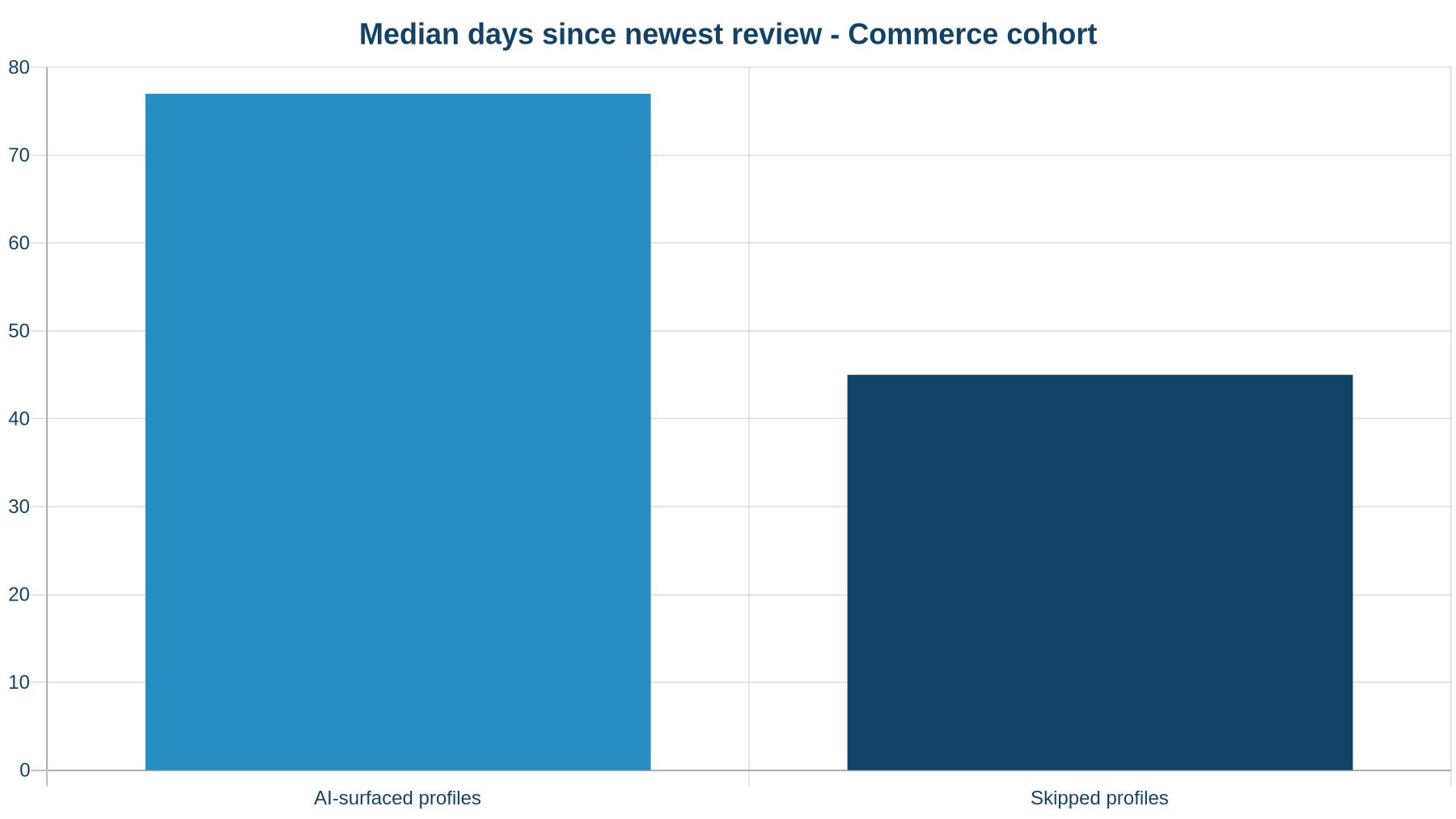
Take Profile A and Profile B from our audit as a concrete example. Profile A — surfaced — had 163 reviews, with the newest coming in 77 days ago. Profile B — skipped — had 110 reviews and a newest review just 46 days ago. Profile B had fresher reviews and more than 10x the count of a typical skipped profile, yet still didn’t make the cut. Profile A won on volume.
That’s not a fluke. Uberall’s analysis of 120,000+ AI mentions across 3,793 locations found that review signals are one of four consistent factors — they call them BARS: Business data, Authority, Review, and Social — that drive AI visibility across every model they tested. Review volume and recency aren’t nice-to-haves in AI search. They’re structural requirements.
The Four Signals AI Models Actually Care About
The Uberall research is the most rigorous look at this question published so far, and it’s worth walking through what they found.
Business data. GBP completeness determines whether a profile is even eligible to be surfaced — not how often it appears once it’s in the running. In the hotel category, going from 6–10 GBP attributes to 31–50 took mention probability from 22% to 94%. A filled-out GBP description alone produced a threefold increase in mention rates for grocery stores. This is the floor. If your profile is half-empty, the rest of this doesn’t matter.
Authority. This is the breadth of your mentions across the web — not just Google. The AI isn’t reading your GBP in isolation. It’s reading everywhere your business name appears: Yelp, Nextdoor, Angi, local news sites, neighborhood Facebook groups, city guides. Every legitimate mention is a vote. The Moz team put it plainly: a model can pull a citation from anywhere your competitors are earning theirs.
Review. Volume and recency. Our Commerce cohort data confirms this at the local level — the surfaced profiles had 10x the review count of skipped ones. Kevin Chin from Moz noted that when he’s evaluating a business, he skips past reviews from three years ago and focuses on what’s recent. The AI models appear to do the same.
Social. This is where most home-service businesses are completely absent. Grok, in Uberall’s study, references Instagram content and chef qualifications more than any other model. Perplexity searches live and cites current web presence. If you have zero social activity, you’re invisible to the models that weight it — and that share is growing.
The Review Rules Changed in April — Don’t Get Caught Using Old Playbooks
One more thing worth flagging. Google updated its Maps content policy in April, and the old advice — “ask customers to mention the technician’s name” or “ask for a specific number of reviews” — is now a policy violation. Staff leaderboards, mention-me cards, scripted review requests: gone.
What works now is making the path frictionless. A QR code on the invoice that goes straight to your Google Business Profile. A link in the follow-up text. A simple, genuine ask at the end of a job — not a three-email sequence. Jonathan Berthold’s barber has a sign with a QR code at the register. That’s the model.
The ask has to be easy, and it has to happen consistently, because the AI models are watching your review velocity — not just your total count.
What This Means for a Restoration Company in Ventura County (or a Garage Door Shop in Commerce)
The brand hook here is simple. A restoration company posting weekly before-and-after photos on Instagram and consistently generating Google reviews is doing two things at once: building review velocity and building social signals. Both feed AI visibility. A competitor with a static website and no social presence is building neither.
This isn’t about going viral. It’s about showing up in enough places, consistently enough, that when an AI model assembles its recommendation for someone searching in your area, your name is the one with the evidence trail.
For the Commerce garage door cohort, the businesses winning AI recommendations aren’t even all based in Commerce. They’re based in Monterey Park and Pico Rivera — and they’re winning because their review counts are in triple digits. Proximity matters, but it’s not enough to overcome a 10x review gap.
The practical path forward isn’t complicated. Fill out your GBP completely — every attribute, a real description, current photos. Build a frictionless review request into your job-close process and run it on every single job. Post something real on social once a week: a before-and-after, a finished project, a quick tip. And look for legitimate ways to get your business mentioned in local places where your competitors aren’t: neighborhood associations, local news, city guides.
That’s the asset you’re building. Not a ranking. A reputation signal that compounds across every AI model that a potential customer might ask. You can check where it stands today: our free Does AI Recommend You? asks ChatGPT, Perplexity, and Gemini for the best garage door repair in Commerce and shows whether they name you or a shop from Monterey Park.
For a deeper look at how reputation and review management works as a system — not just a one-time push — that’s where to start.
One thing to do Monday morning: Pull up your Google Business Profile and count your reviews from the last 90 days — or let our free Map Pack Grader count them and score your profile against the garage door shops winning the map pack in Commerce. If the number is in single digits, your review velocity is too low to compete with the profiles AI tools are surfacing. Add a QR code to your invoice or follow-up text this week and make the ask on every job.