

TL;DR
Can a bad Yelp review or complaint article hurt me in ChatGPT results?
Yes. AI tools now pull negative content directly into their answers, bypassing your ability to respond or suppress it. Prevention is your only real defense: build a large enough review base that one bad review can't move your rating, monitor AI platforms regularly, and pursue actual removal of harmful content — not just suppression.
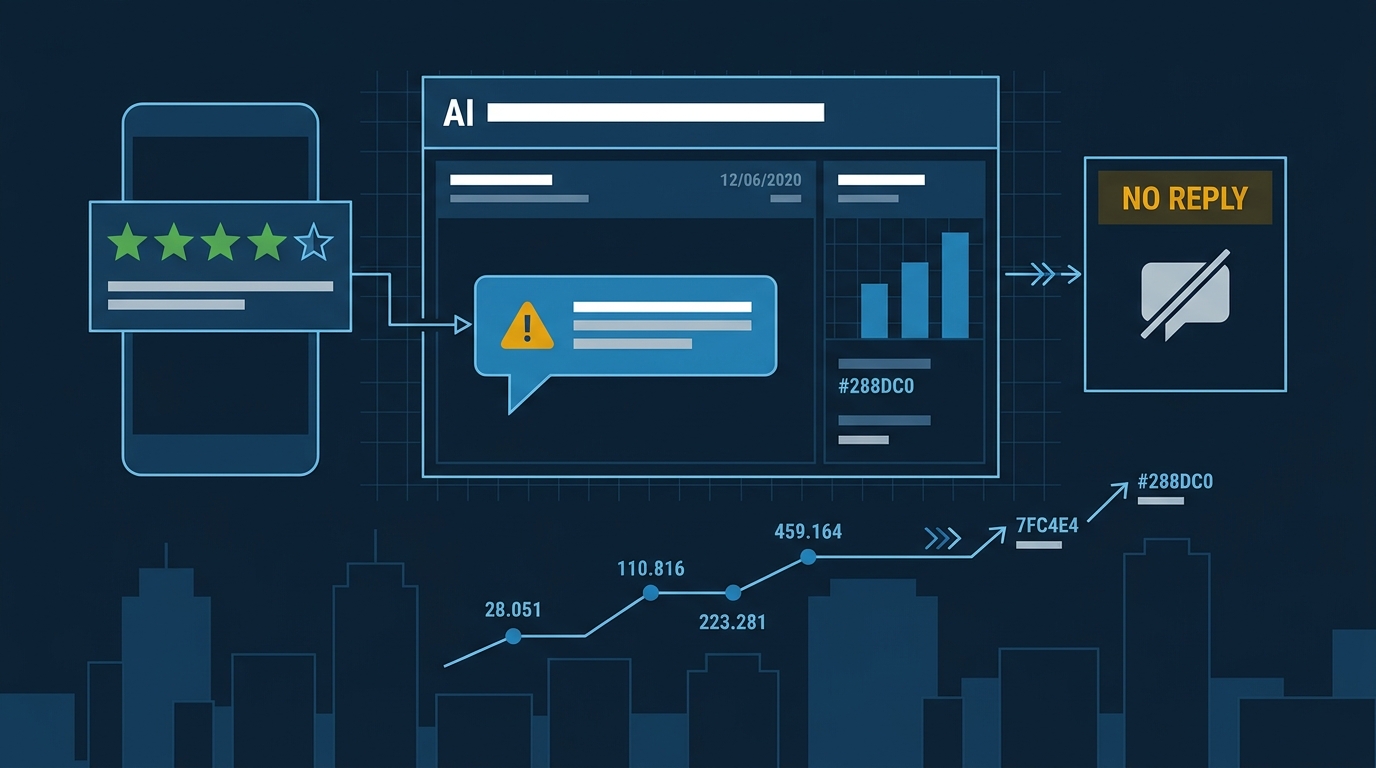
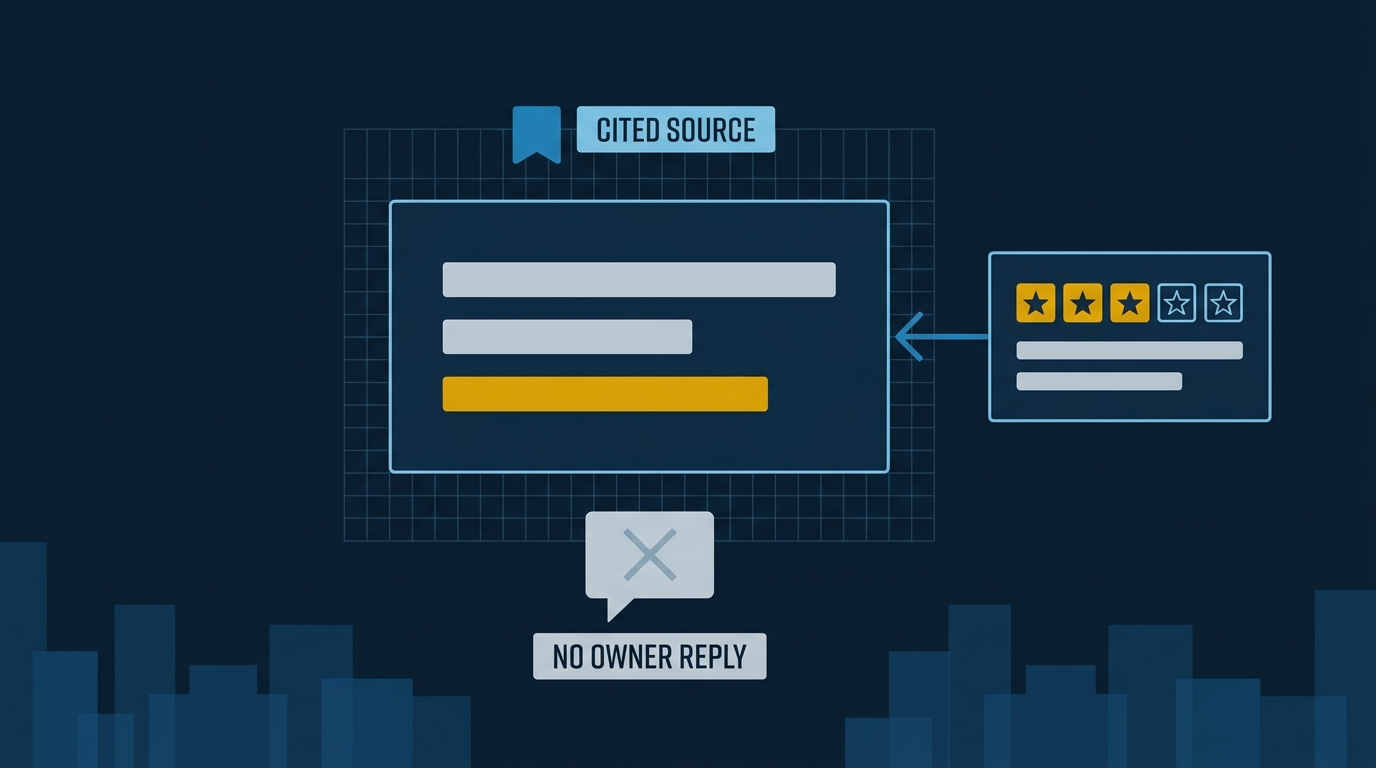
A homeowner in Whittier types “best-rated roofing contractor in Whittier” into ChatGPT. The AI doesn’t show her a list of blue links she has to click through. It gives her a paragraph — synthesized from whatever it found crawling the web — and if there’s a Yelp complaint, a Reddit thread, or a news article about a bad job your company did, that content can land directly in that paragraph. No ranking position. No chance to respond. No “owner reply” field.
That’s the shift most roofing, HVAC, and plumbing companies in Los Angeles County haven’t processed yet. Google reputation management had rules you could work with. AI reputation management has one: don’t have anything bad out there.
Most Agencies Are Still Selling You the Broken Playbook
Most agencies sell suppression and call it reputation management. That was defensible three years ago. It’s not anymore.
The old strategy was: push bad content down by publishing enough good content above it. Get the complaint article to page two, and most people never see it.
That still works — on traditional Google search. It does not work on AI.
According to Search Engine Journal’s analysis of AI Overviews, AI search surfaces negative reviews and criticism that traditional rankings used to keep off page one. The same piece draws a critical distinction: suppression is the weakest defense against AI surfaces, because a model retrieving from a corpus doesn’t care what position the source held. Position ten and position three carry the same weight when the AI is assembling its answer.
The same SEJ article reports that 45% of consumers now use AI tools like ChatGPT for local business recommendations, citing BrightLocal’s 2026 Local Consumer Review Survey — up from just 6% a year earlier. That’s not a trend. That’s a channel that already exists, already has your prospects on it, and already has whatever your unhappy customers wrote about you.
The suppression treadmill you’ve been running? You just found out it has a hole in the floor.
Three Outcomes That Get Confused for Each Other
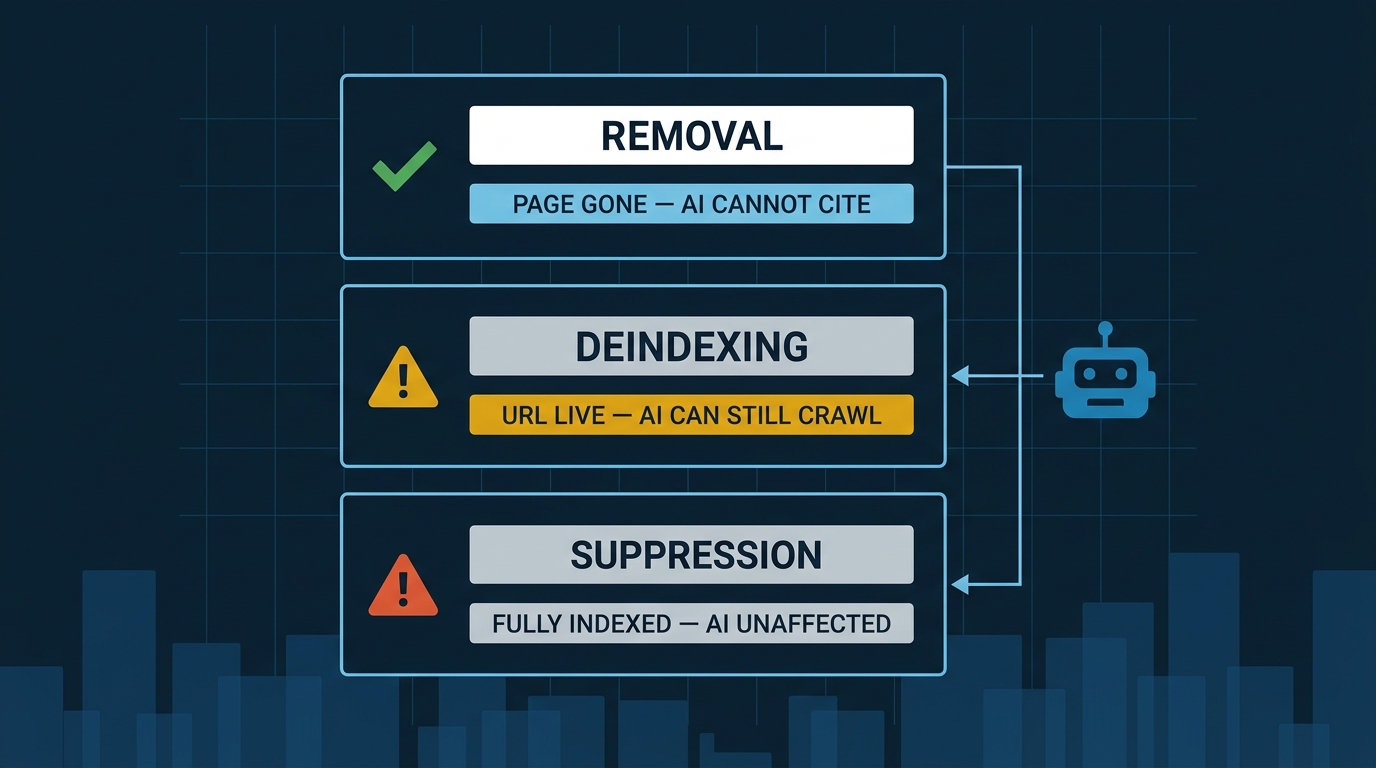
Removal — the source page is gone. The publisher deleted it, the platform took it down, or a legal process forced it. This is the only outcome that also stops the content from feeding AI answers. It’s the hardest to achieve and the only one that fully solves the problem.
Deindexing — the page still exists, but Google no longer returns it in search. The URL is live for anyone with a direct link, and AI crawlers can still reach it. SEJ’s analysis is explicit: deindexing does not stop the content from feeding AI answers.
Suppression — the page exists, stays indexed, and you’ve buried it with better content. Nothing was removed. You changed what people see first in traditional search — and you changed nothing in AI search.
What This Means for a Roofing Company in Whittier Right Now
We asked Google’s Maps-grounded AI for a roofing contractor in Whittier. We audited 19 profiles competing for that search. Four were surfaced in the AI response.
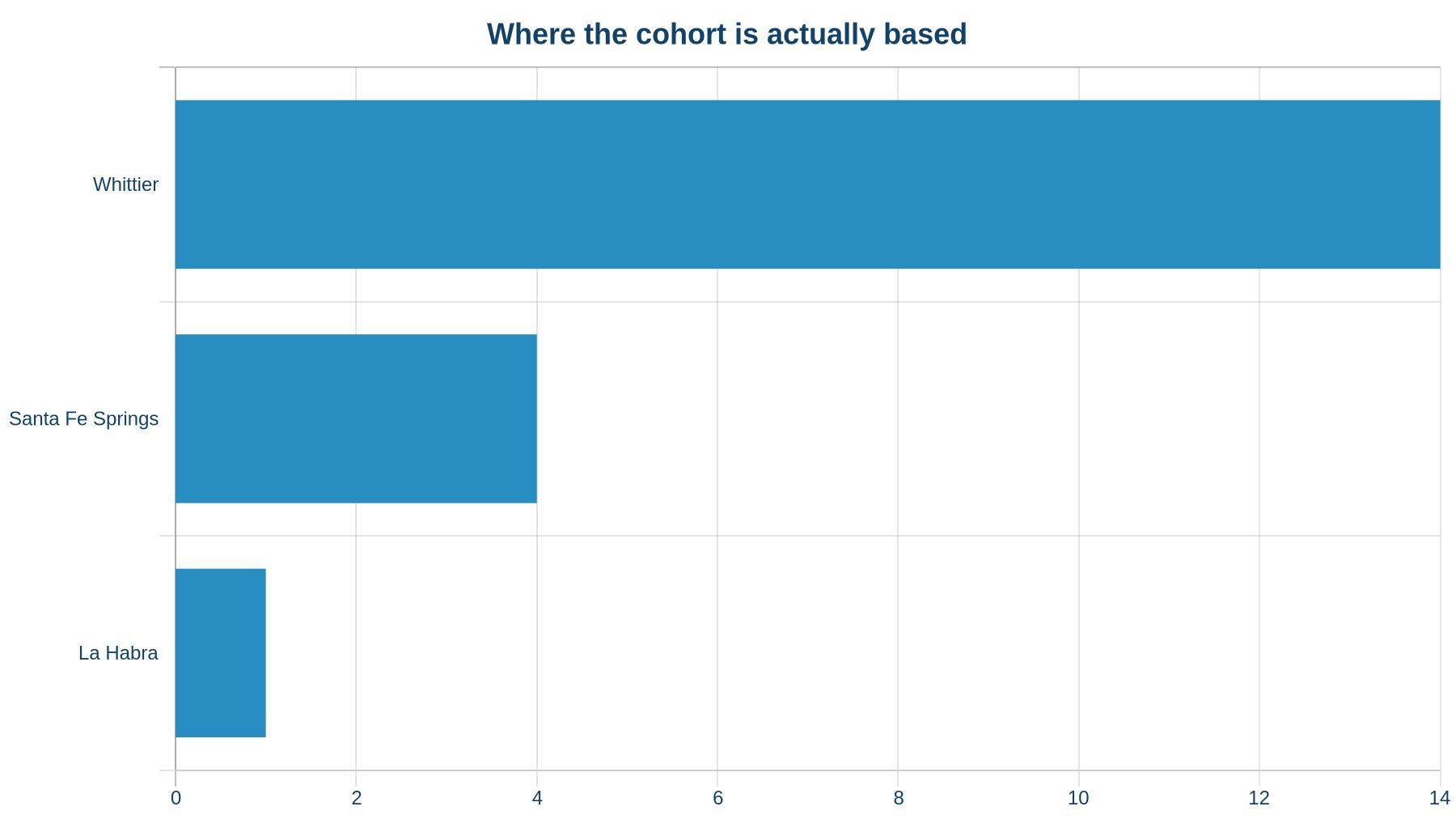
Here’s what stood out in that cohort: 14 of the 19 profiles are physically based in Whittier, with 4 from Santa Fe Springs and 1 from La Habra also competing for the same searches. At 0.24 profiles per square kilometre within 5 km of Whittier, this is a moderately dense cohort — dense enough that a clean profile stands out, not so crowded that a new entrant can’t break in. The AI doesn’t stay inside city limits — it pulls from a regional pool. Which means a complaint article about your Whittier business competes against clean profiles from neighboring cities every time someone asks an AI for a recommendation.
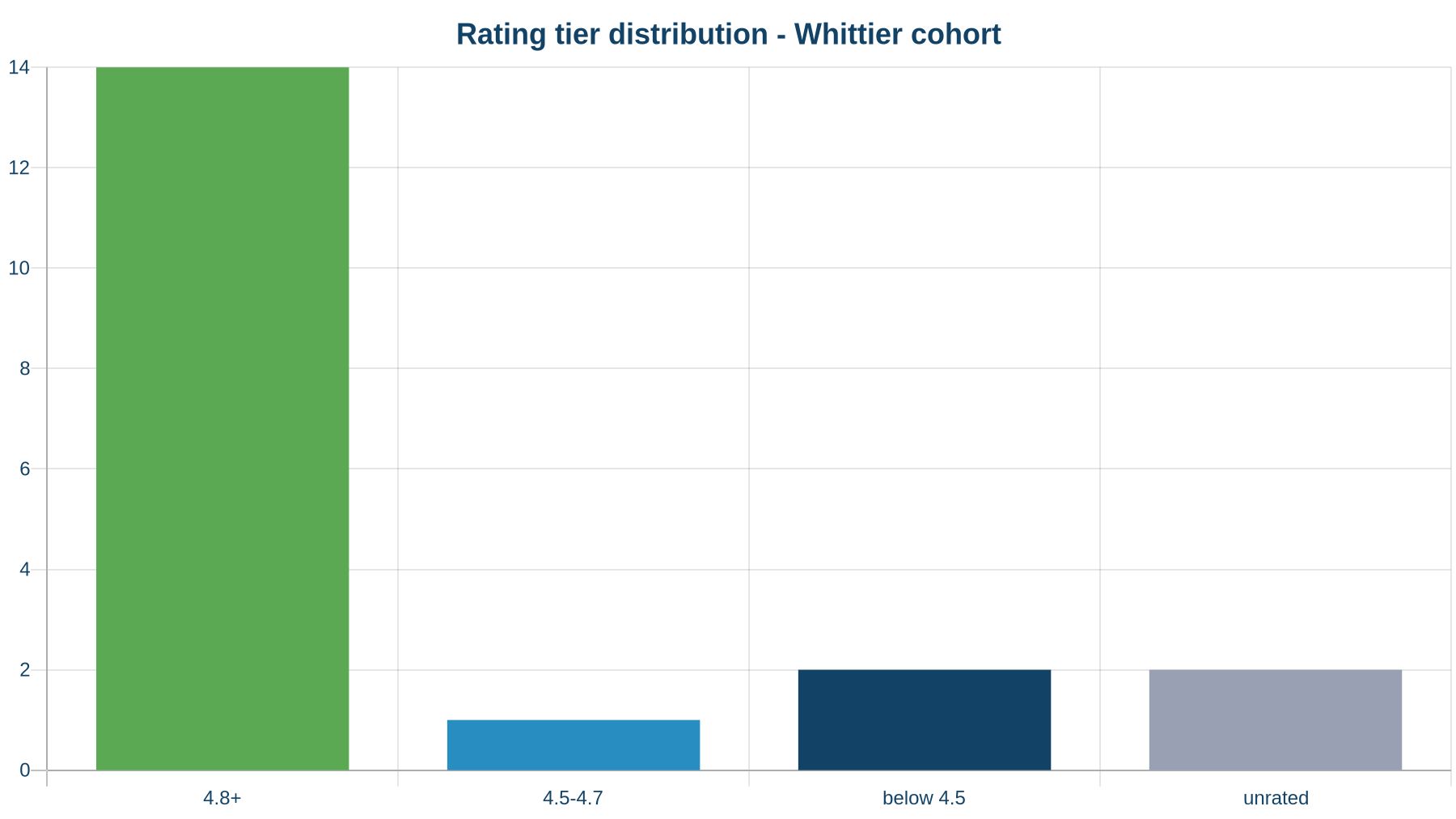
The rating picture is stark: 14 of the 19 profiles in this cohort hold a 4.8 or higher rating. Only 1 sits in the 4.5–4.7 range, 2 are below 4.5, and 2 carry no rating at all — effectively invisible to AI ranking signals. The floor for even being considered is high. One bad review that drops you from 4.9 to 4.6 doesn’t just hurt you on Yelp — it makes you a weaker candidate in a pool where almost everyone else is sitting above 4.8.
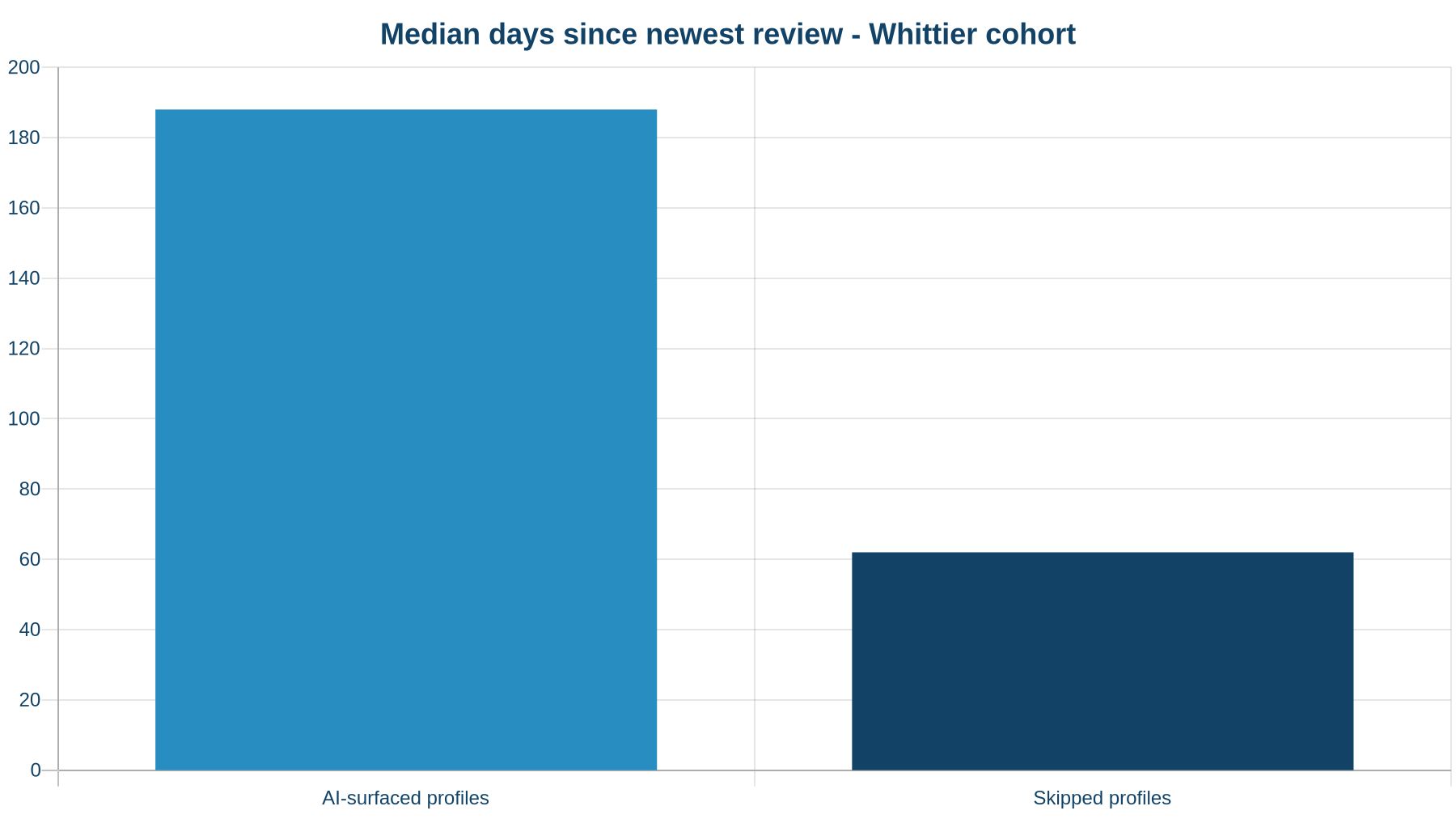
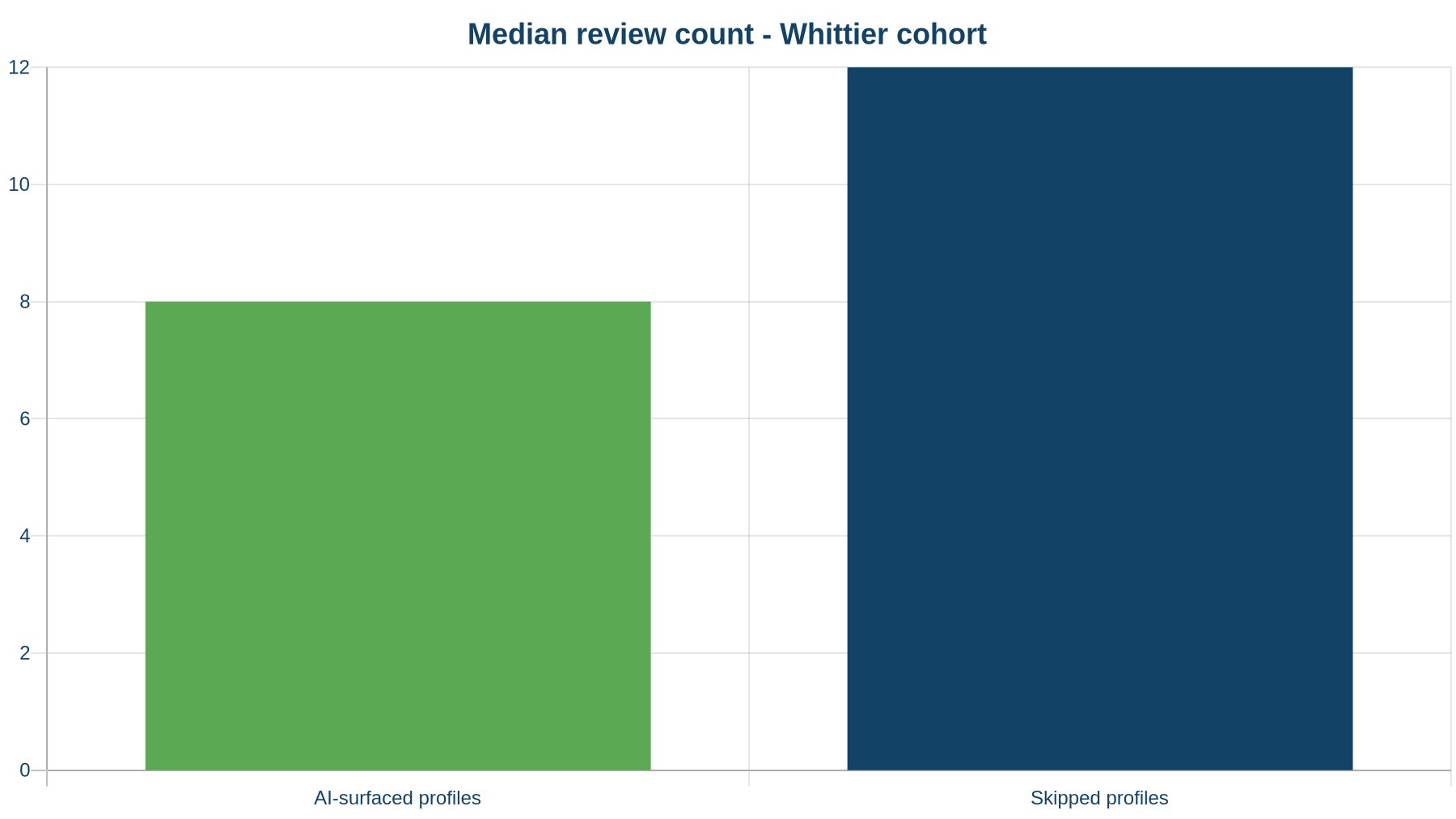
The review-count data is counterintuitive and worth sitting with. The four AI-surfaced profiles had a median review count of 8. The skipped profiles had a median of 12. More reviews did not predict surfacing. What this tells you is that the AI isn’t simply rewarding whoever has the biggest review pile — it’s weighing overall profile strength, rating tier, and the absence of negative signals. And the review-age data reinforces this: surfaced profiles had a median newest-review age of 188 days, while skipped profiles had a median of just 62 days. Fresher reviews didn’t predict surfacing either.
Profile A in our cohort had 8 reviews with its newest 264 days old — and got surfaced. Profile B had 12 reviews, newest just 65 days ago — and got skipped. More reviews, fresher activity, same city, same hours set. Still skipped. The difference comes down to signals we can’t fully see from the outside, which is exactly why keeping your public reputation clean matters more than any single volume metric.
Your Only Real Defense Is Prevention
Once a complaint article, a negative Yelp thread, or a bad Reddit post is indexed and crawled, you’re playing catch-up. You can try to get it removed — and sometimes that works, especially if there’s a factual error you can document. But the window between “content published” and “AI cites it” is shrinking fast. Search Engine Journal reports that inbound requests specifically to address negative AI Overview and assistant-answer content are up roughly 215% year over year, which tells you how many business owners are learning this the hard way.
Prevention has three parts:
1. Generate reviews fast enough that one bad one doesn’t move your average. A roofer with 8 reviews and a 4.9 is one angry customer away from a 4.7. A roofer with 80 reviews and a 4.9 can absorb three or four bad ones without moving the needle. Volume is protection. Our reputation and review management service automates review requests after every completed job, so you’re building that buffer continuously — not scrambling after a bad one lands.
2. Monitor what AI is actually saying about you. Not just Google. ChatGPT, Perplexity, Gemini. Run your business through our free Does AI Recommend You? tool — it asks those three AI platforms who the best contractors in your city are and shows you whether your name comes up or your competitor’s does. If something negative is being cited, you’ll see it there before a prospect does.
3. Act on negative content before it ages in. When you find a complaint article or a damaging forum thread, run three questions the SEJ analysis recommends: Is the page still live? Is there a specific factual error you can document? Is there a platform policy or legal basis for removal? If yes to any of those, pursue actual removal — not suppression. If no, you’re in suppression territory and you should know that going in.
The New Reputation Playbook
The old version of reputation management was reactive. Something bad appeared, you buried it. That worked when the goal was page-one real estate on Google.
The new version has to be proactive. Build a review base large enough that one bad actor can’t move your rating. Monitor AI channels — not just Google. Pursue actual removal of harmful content rather than accepting suppression as the finish line. And treat your Google Business Profile as a live signal — complete, current, and stacked with legitimate reviews — because that’s what AI pulls from when it’s assembling the answer your next prospect is about to read.
The Whittier roofing market has 14 profiles above 4.8 and 2 more with no rating at all. If yours isn’t solidly in that top tier, that’s where to start Monday morning: check your current rating, count your reviews, and figure out how many jobs you’ve completed without asking for one.
Check your AI Search Readiness Score for free — it shows how visible your profile is to ChatGPT, Google AI Overviews, and Gemini, and flags the specific gaps holding you back.