


TL;DR
How do I stop losing big jobs because I missed a lead?
Missed leads die fast — most homeowners call the next contractor within minutes. Automated missed-call text-back, instant follow-up sequences, and centralized lead routing mean every inquiry gets a response even when you're on a job site. Set up the automation once and it works around the clock.
You’re on a roof in Pasadena at 2pm on a Tuesday. Your phone rings, you can’t answer, and the homeowner hangs up after four rings. They needed a full replacement — storm damage, insurance job, $28,000. They called the next roofer on the list. That roofer picked up. That roofer got the job.
This is not a hypothetical. It’s the exact situation that pushed Ben Beckett, owner of Alpine Roofing, to build his entire business around automated lead capture. According to Zapier’s case study on Alpine Roofing, Beckett built his company on workflow automations specifically because a single missed roof inquiry can cost $30,000 — and manual handoffs between a web form, a phone call, and a job estimate are exactly where those leads disappear.
The problem isn’t that you’re bad at your job. It’s that your lead-handling process has gaps, and in Los Angeles County, where every neighborhood has six roofers, three HVAC companies, and two general contractors all bidding the same jobs, the gap is where your revenue goes.
The Gap Is Not Where You Think It Is
Most contractors assume they lose leads because their website is weak or their Google ranking isn’t high enough. Sometimes that’s true. But more often, the leads are arriving — and dying in the handoff.
Here’s what a typical gap looks like:
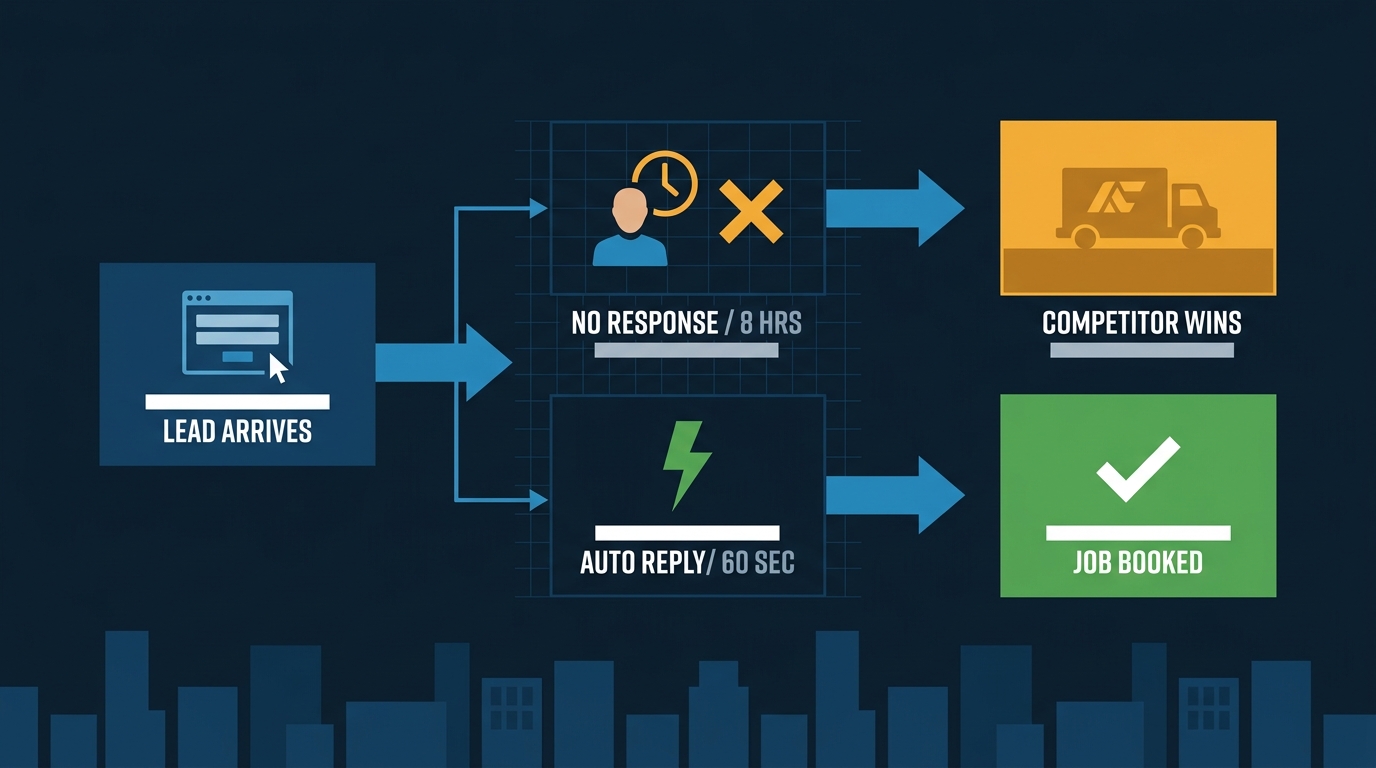
A homeowner in Whittier fills out your contact form at 7:45pm. Your form sends you an email. You’re finishing dinner, you’ll get to it in the morning. By 8:15pm, that homeowner has already texted two other contractors who had automated responses waiting. By morning, they’ve booked an estimate with someone else.
The form worked. The ranking worked. The follow-up failed.
Zapier’s research on lead management automation makes the same point in a business-tools context: the value of any system is only as good as the handoffs it automates. A tool that captures data but requires a human to act on it in real time is not a system — it’s a to-do list that grows while you’re on a job site.
What Alpine Roofing Actually Built
Ben Beckett didn’t hire more office staff. He built automated workflows — what Zapier calls “Zaps” — that connect his web forms, his CRM, and his communication tools so that every lead gets an immediate, personal-feeling response the moment it comes in, whether he’s on a roof or asleep.
The Zapier case study details how Beckett uses Next-Gen Zaps to handle conditional logic — meaning the automation doesn’t just fire a generic reply; it routes the lead based on what type of job was requested, what part of the service area it’s in, and what the urgency signals look like. A storm-damage inquiry gets treated differently than a routine inspection request.
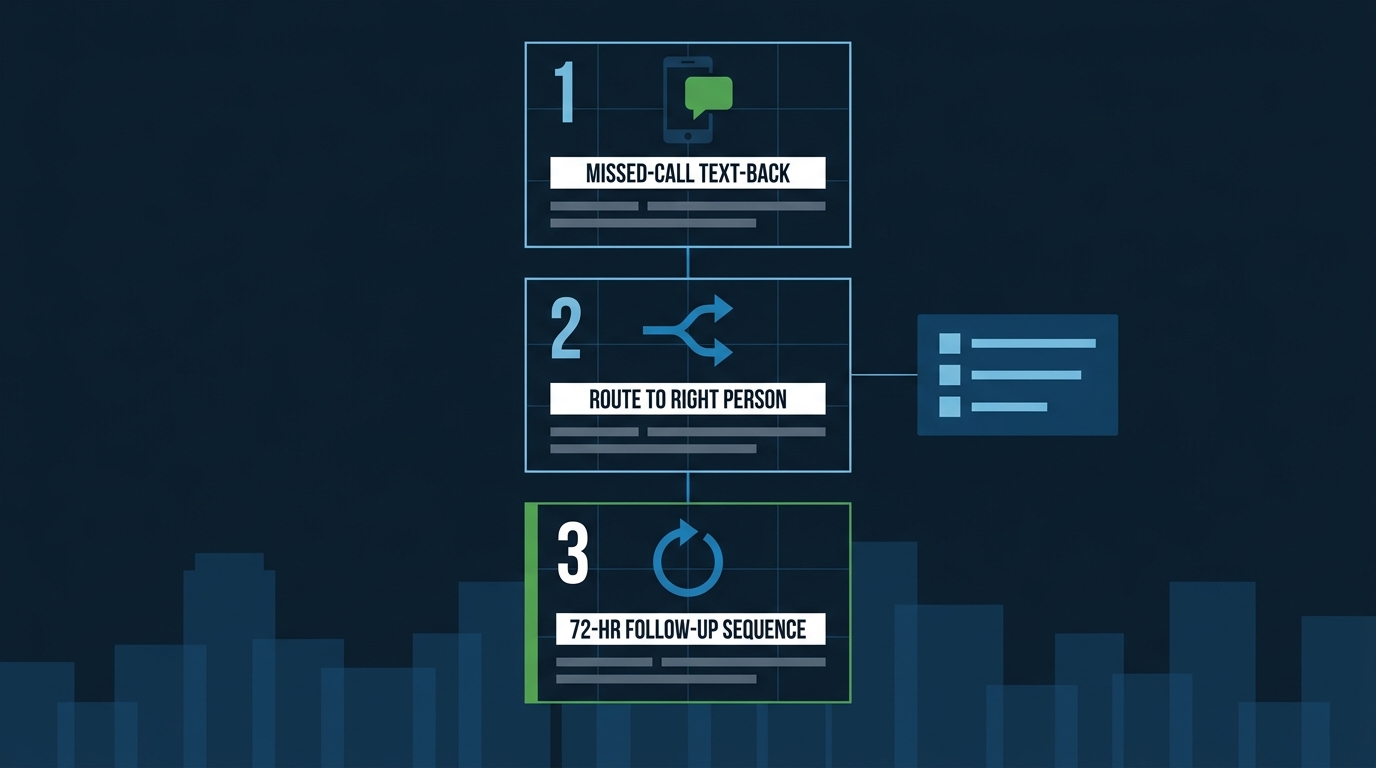
That’s the part most contractors miss when they hear “automation.” They picture an autoresponder that says “Thanks, we’ll be in touch!” That’s not what this is. The automation that wins jobs does three things:
1. Responds in under five minutes. Not because a human typed something — because the system fired before you even saw the notification. A text to the homeowner’s phone, confirming you got their request and giving them a rough timeframe. That alone keeps them from calling the next number.
2. Routes to the right person. If you run multiple crews or have an office manager, the lead doesn’t sit in a shared inbox waiting for someone to claim it. The automation assigns it, notifies the right person, and logs it in the CRM.
3. Follows up if there’s no response. If the homeowner doesn’t reply to the first text, the system sends a second one the next morning. If they still don’t respond, it flags the lead for a manual call. Nothing falls off the list.
What This Looks Like for an LA County Contractor
Say you’re a general contractor in Glendale. You run a crew of eight. Your average kitchen remodel is $55,000. You get maybe forty web leads a month. If your current process loses even two of those to slow follow-up, you’re leaving $110,000 on the table every month — not because you didn’t rank, not because your price was wrong, but because someone else responded first.
The fix isn’t complicated. It’s:
- A missed-call text-back that fires within 60 seconds of a missed call
- A form-submission sequence that sends an SMS and an email simultaneously
- A CRM that shows every open lead in one place, with timestamps, so nothing hides in an email thread
- A follow-up sequence that runs for 72 hours without anyone touching it
None of this requires a developer. It does require setting it up correctly once, connecting your tools, and testing it before you trust it with real leads.
Our lead management and automation service handles exactly this — missed-call text-back, instant follow-up, a unified inbox, and review automation built specifically for home-service businesses in LA County. If you want to see what the system looks like before committing to anything, the setup conversation is free.
The Monday Morning Version
If you’re not ready to overhaul the whole system this week, do one thing: set up missed-call text-back.
When a call goes unanswered, an automated text fires to the caller within 60 seconds: “Hey, this is [Your Name] at [Company]. Sorry I missed you — I’m on a job right now. What can I help you with?” That one message keeps the conversation alive. It signals you’re responsive. It buys you ten minutes to call them back before they’ve moved on.
That single automation, done right, recovers a meaningful percentage of the leads you’re currently losing to voicemail.
The rest of the system — routing, CRM logging, follow-up sequences, review requests after job completion — you can build out over time. But start there. It’s the gap that costs the most, and it’s the easiest one to close.
Ben Beckett built a roofing company on the principle that the lead that gets responded to first usually wins the job. In Pasadena, in Glendale, in Whittier — that’s as true for your business as it was for his.