

TL;DR
Does my Google Business Profile affect whether AI recommends my business?
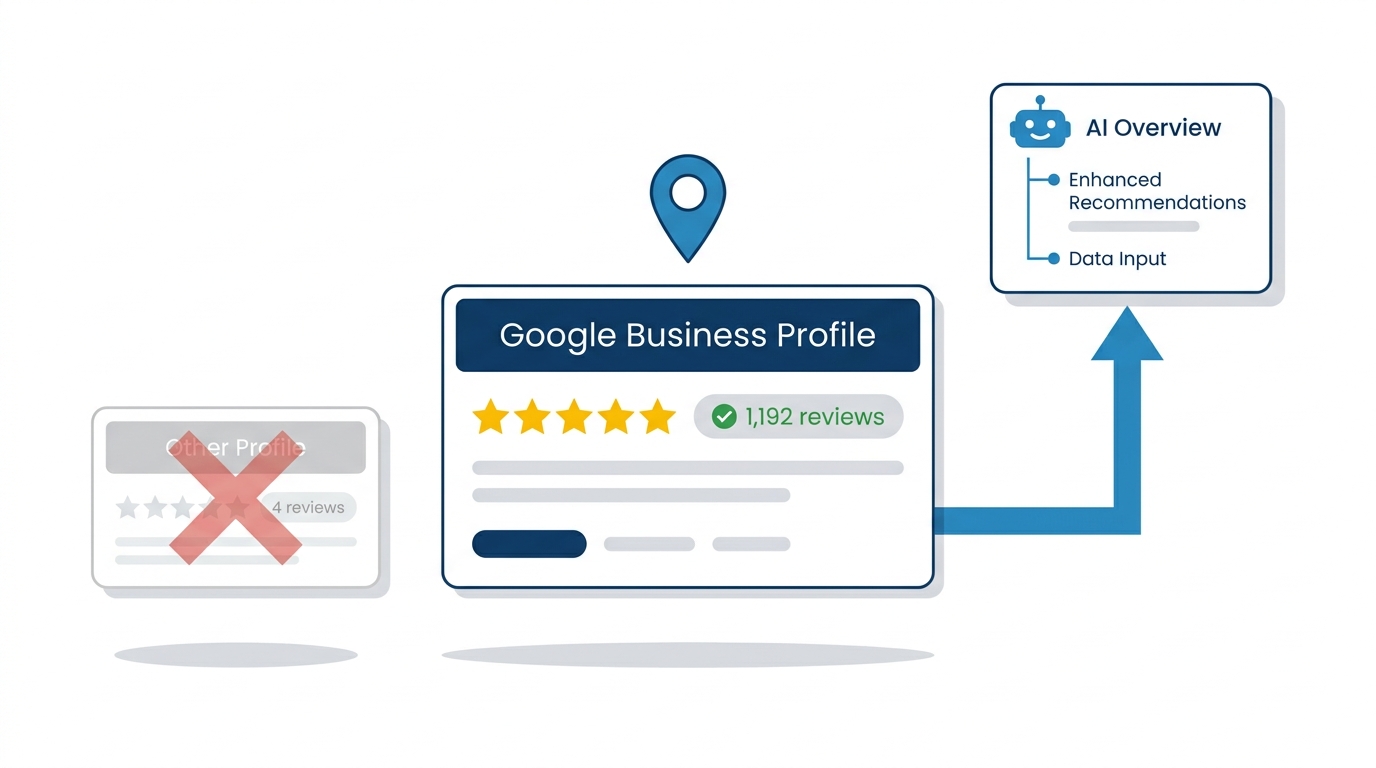
Yes, directly. AI systems build a shortlist from structured trust signals before they ever fetch a webpage. A complete, high-volume GBP gets you on that shortlist. An outdated or thin profile keeps you off it entirely, regardless of how good your work is.
Someone in San Gabriel types “best-rated garage door repair near me” into Google — or asks ChatGPT the same question. Before either system fetches a single webpage, it already has a shortlist. Your business is either on it or it isn’t.
That shortlist isn’t built from your website. It’s built from the trust signals that live in your Google Business Profile (GBP).
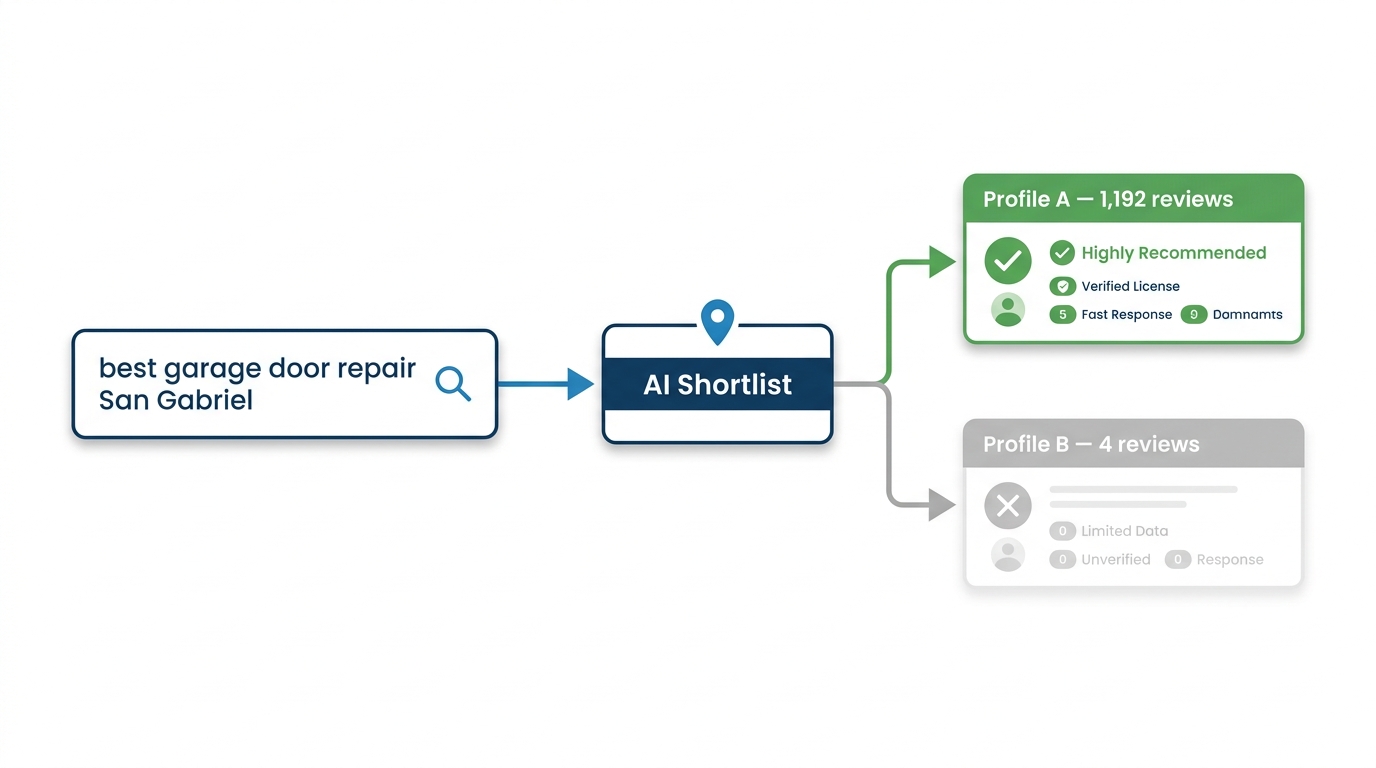
We ran a fresh audit of 19 garage door repair profiles competing in and around San Gabriel. One profile surfaced when we asked Google’s Maps-grounded AI for a recommendation. Eighteen didn’t. The gap between the one that made it and the ones that didn’t tells you exactly what to fix — and it’s not what most agencies are selling you.
The Decision Happens Before Your Website Gets Visited
Suganthan Mohanadasan at Search Engine Journal documented something important while analyzing hundreds of ChatGPT conversations: when someone asks for a recommendation — even with zero brand names mentioned — ChatGPT’s internally generated search query already contains a shortlist of names drawn from the model’s training data and structured signals. Those names appear before any web results come back.
He put it plainly: if your business isn’t on the shortlist, your website never gets visited. The decision happens before anything touches your server.
Google’s AI Overviews work the same way. As Search Engine Journal reported on the Freshpet case, a brand can hold the #1 organic ranking and still go unnamed when a buyer asks AI for a recommendation. Rankings prove relevance to a query. Citations require something more: trust signals the system can verify about the business itself.
For a home-service company in the SGV, those verifiable trust signals live almost entirely in your Google Business Profile.
There’s a second layer too. Giulia Panozzo at Search Engine Journal frames the broader shift precisely: AI systems aren’t measuring what happened after a decision — they’re making a decision before you ever see a search result. The signals they use exist before a customer clicks anything. Traditional SEO metrics tell you what happened. Your GBP signals determine whether you’re considered at all.
What the San Gabriel Audit Actually Showed
We looked at 19 garage door repair profiles competing within 5 km of San Gabriel. The cohort density was 0.24 profiles per square kilometer — tight competition for a small geography. Only 4 of the 19 profiles were physically based in San Gabriel itself. The rest came from neighboring cities: Alhambra contributed 3 profiles, Rosemead contributed 3 more. Being the local shop doesn’t automatically get you surfaced. The AI is pulling from the whole competitive radius.
The rating distribution was striking: 17 of the 19 profiles carried a 4.8-star rating or higher. One sat in the 4.5–4.7 range. None were below 4.5. Star rating alone is not the differentiator — almost everyone in this market has figured that part out.
What separated the one profile that surfaced from the eighteen that didn’t was review volume.
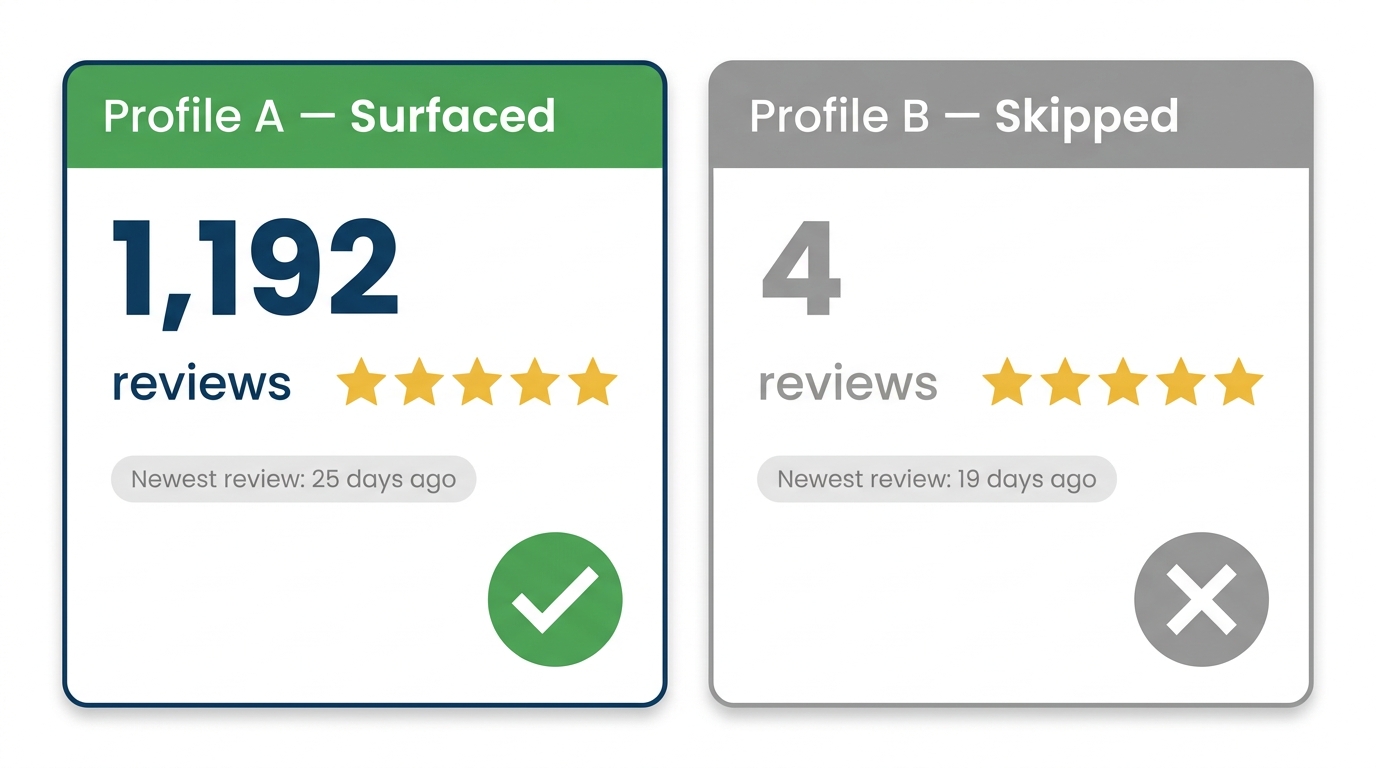
Profile A (surfaced): 1,192 reviews. Newest review 25 days old. Hours set. Based in Monterey Park — not even in San Gabriel.
Profile B (skipped): 4 reviews. Newest review 19 days old. Hours set. Based in Pasadena.
Profile B had a fresher most-recent review. Didn’t matter. The median review count for surfaced profiles in our cohort was 1,192. The median for skipped profiles was 5.
Read that again. Five reviews versus nearly twelve hundred. Proximity didn’t save Profile B. A recent review didn’t save it. The AI looked at the body of evidence and made a call.
What “Trust Signals” Actually Means for Your GBP
The San Gabriel audit makes the hierarchy clear. Here’s how to read it for your own profile:
Review volume is the loudest signal. Not star rating — everyone in this market has 4.8 stars. Volume. The AI is looking for a body of evidence that says this business has served a lot of real people. Twelve reviews doesn’t provide that. Twelve hundred does.
Review recency matters, but only after you have volume. Profile B had a newer review than Profile A. It still got skipped. Recency is a tiebreaker, not a trump card. Build the volume first.
Business hours must be set. Only 6% of the skipped profiles in our cohort were missing hours — so most had figured this out. But if yours isn’t set, fix it today. An AI that can’t confirm you’re open won’t recommend you for an emergency call.
Your service area and categories need to be accurate. If your GBP says you serve San Gabriel but your categories are vague or wrong, you’re not giving the system anything to match against a query. Be specific about what you do and where.
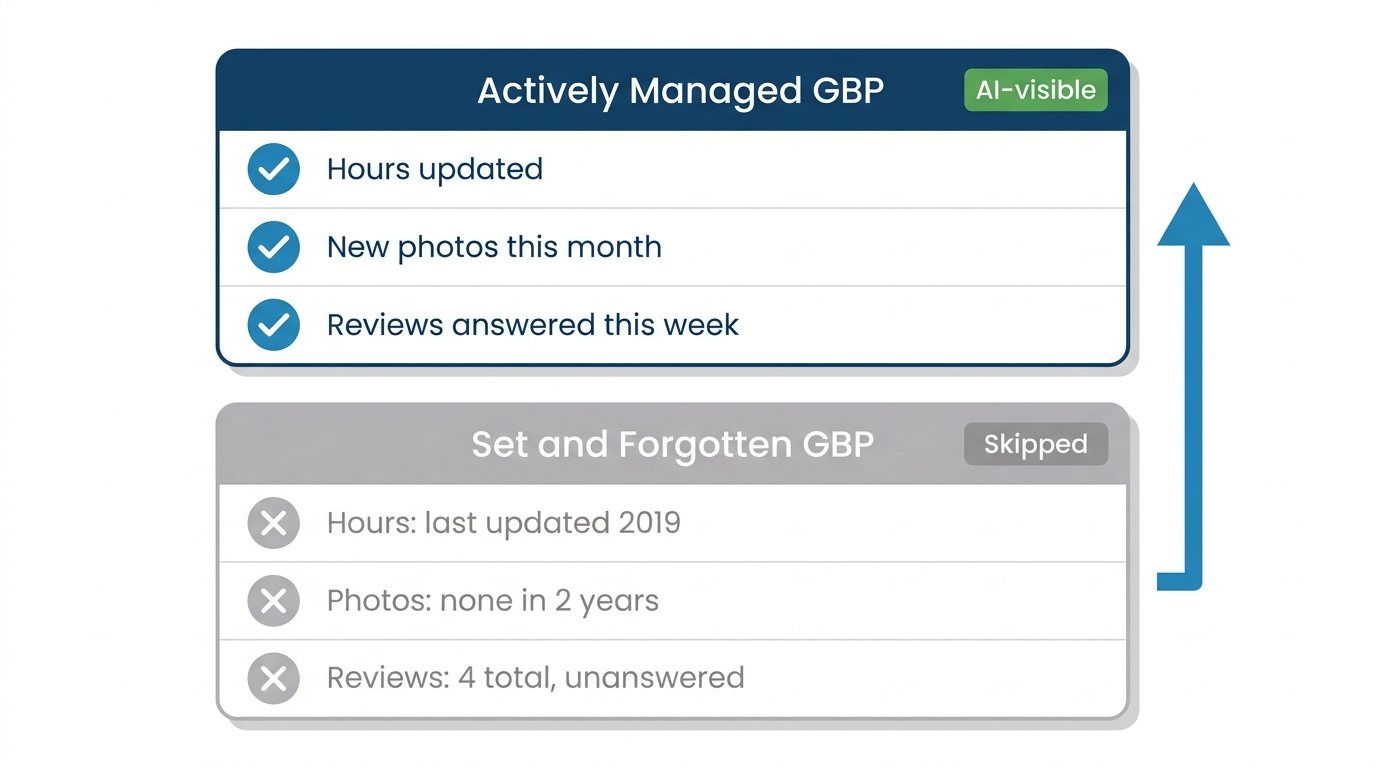
Photos and posts signal active management. A profile with no new photos in two years reads as abandoned — to Google’s systems and to the AI pulling from them. A few new photos a month costs nothing.
This is what our Google Business Profile management service is built around: the signals that actually move the needle for trades businesses in these specific cities, not a generic checklist written for a dentist in Ohio.
The Pattern We See Constantly in This Market
Across audits in Alhambra, Rosemead, and San Gabriel, the same situation repeats: a business with great field work, real customers, and a solid reputation — but a GBP that was set up in 2019 and touched twice since.
The owner did the right thing years ago. Got the profile claimed, got a few reviews, moved on. Meanwhile, a competitor two cities over has been quietly accumulating reviews every single month, updating hours for holidays, adding photos of completed jobs.
That competitor is Profile A. The business that set it and forgot it is Profile B.
The AI doesn’t know you’re better at the work. It knows who has the stronger body of evidence.
What to Do Monday Morning
You don’t need to overhaul everything at once. Start here:
1. Check your review count against your top local competitor. Pull up the top-ranked garage door, HVAC, or plumbing company in your city on Google Maps and count their reviews. If they have 10x yours, that gap is your most urgent problem — not your website, not your blog. Our free Map Pack Grader does the count for you and scores your profile against the winners in your city.
2. Build a review ask into every job close. Not a mass email blast — a direct, personal ask at the moment the customer is happiest. “Would you mind leaving us a quick Google review? It really helps.” Text them the link. Do this for every job, every time, starting this week.
3. Set or confirm your business hours, including holiday hours. Log into your Google Business Profile and verify every field is current. Hours, service area, phone number, categories. All of it.
4. Upload two or three photos from a recent job. Real photos from your phone, of actual work you did. Not stock images.
5. Ask Google’s AI about your own category in your city. Type “best [your trade] in [your city]” into Google and look at the AI Overview. Type the same into ChatGPT. If your business name doesn’t appear, you now know exactly what you’re up against — and why.
The businesses that show up in AI recommendations aren’t paying for an “AI SEO” package. They built a profile with real volume, real recency, and complete information. The shortlist is built from evidence, and evidence takes time to accumulate.
Start accumulating it now.