TL;DR
When a customer asks ChatGPT, Perplexity, or Gemini for a plumber, is my business one of the names?
Each AI picks differently — ChatGPT leans on the open web, Perplexity on live search results, Gemini on Google's Maps data — and asking ChatGPT yourself won't tell you (your history skews the answer). Our free AI Recommend check runs the real queries neutrally and shows which engines name you, which name competitors, and who you're being named alongside.
A homeowner in Alhambra picks up her phone and asks ChatGPT which plumber to call for her leaking water heater. She gets three names back. She calls one of them. Her day happens. You never hear about it. Your business either was or wasn’t one of those three names — and you have no way to know which.
You can’t check by asking ChatGPT yourself. Every session is personalized to who’s asking, where they’re standing, and what the AI happens to feel like generating that second. Your check tells you what YOU see. It doesn’t tell you what a customer in a different neighborhood, on a different device, with no history of clicking on you, sees.
The homeowner in Alhambra hangs up. The job goes to whoever was named. Whether you were on that list is the thing this post is about.
This is already happening — you just can’t see it
Home-service customer behavior is shifting. Some of your customers now open ChatGPT or Perplexity or Google’s Gemini before they open Google Maps. Not most of them yet. A growing share — and the share is bigger for the 30-something homeowners who make up more of the SGV calling audience every year.
The pipeline used to be: search → map pack → call. For a growing share of your customers, it’s now: ask AI → AI names two to four businesses → they pick one. Whether you’re in that named set determines whether the phone rings. Every time your name shows up, you get a shot. Every time it doesn’t, you don’t.
The old channels aren’t dead. Map pack still matters. GBP still matters. Local Service Ads still matter. The AI channel is layered on top of them — either you’re in it or you’re not.
The three AI engines that matter for home-service
Three engines account for most AI-driven local searches right now:
ChatGPT. The most-used general AI chatbot. When it answers a “who’s the best plumber near me” question, it pulls from Yelp, BBB, review platforms, local news, and industry directories — the places customers already trust for reviews.
Perplexity. A search-first AI with source citations. Pulls from a wider public web set than ChatGPT. Skews toward businesses with strong web presence beyond just their GBP — content marketing, industry publications, business profiles on niche directories.
Gemini. Google’s own AI. Sources heavily from Google’s own graph — GBP, Google Maps, reviews Google trusts, citations Google has already indexed.
Your business needs to show up in at least two of the three for most SGV cities. Missing from one is a gap. Missing from all three is invisibility.
How each AI actually decides who to name
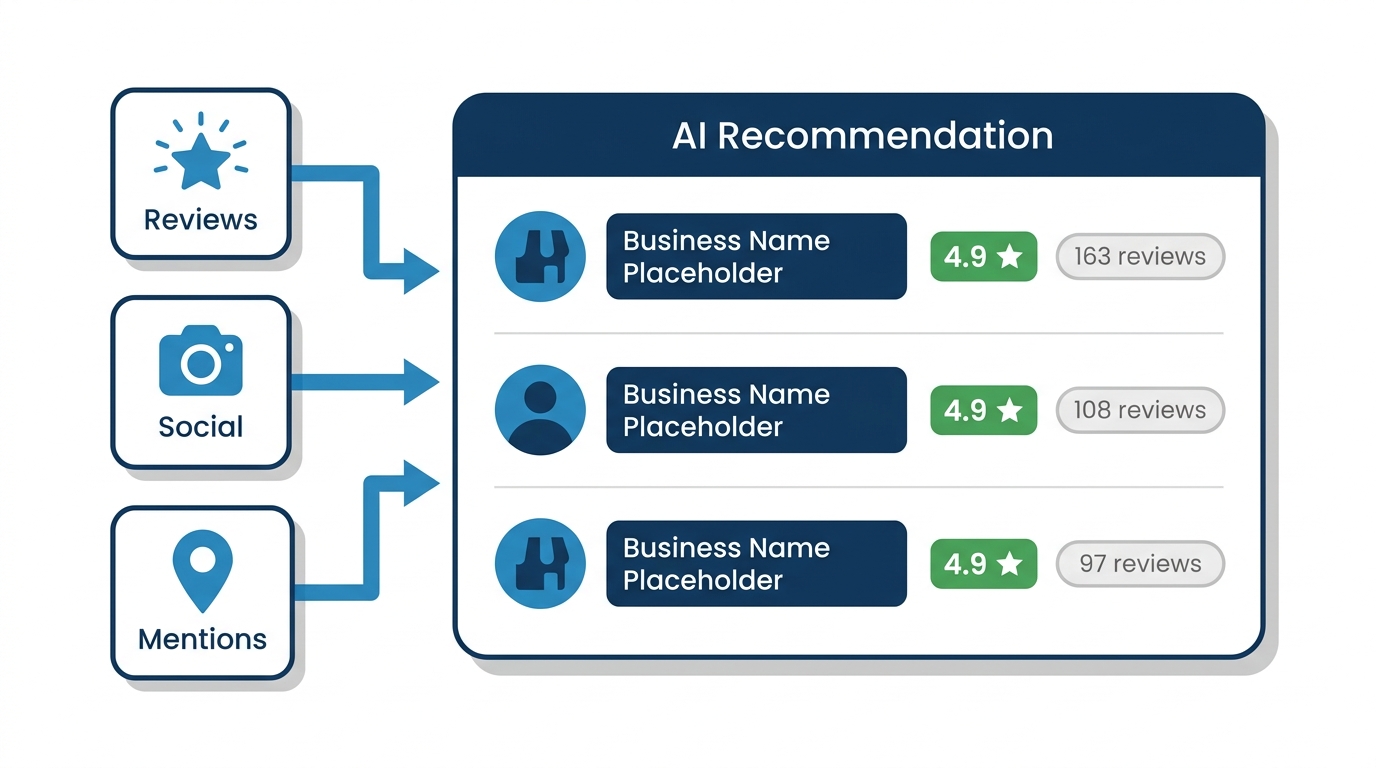
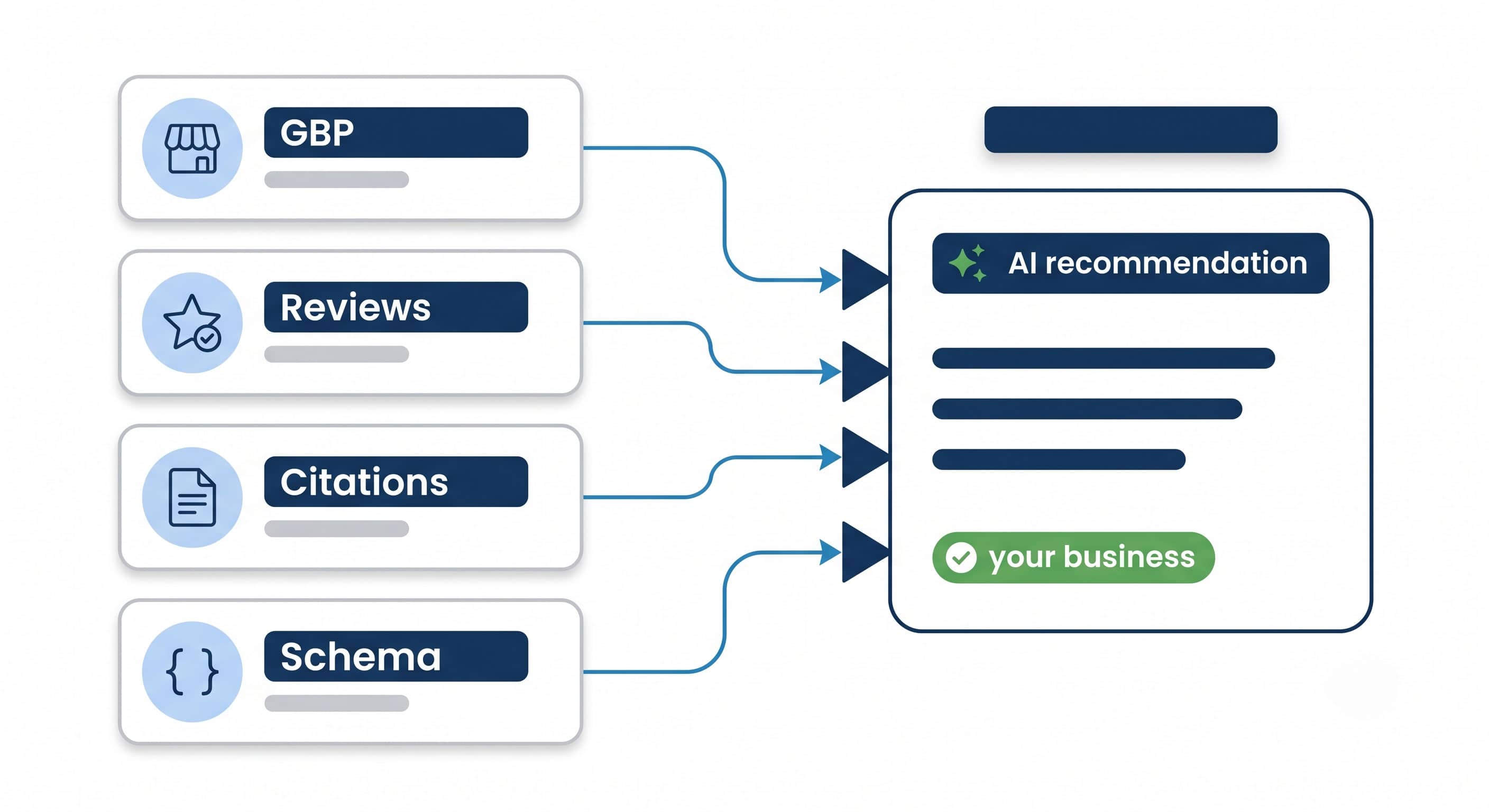
AI chatbots don’t pull local recommendations from a private database. They pull from the same public sources you already know about — Google Business Profile, Yelp, BBB, review platforms, local news, industry directories, and business websites with structured data. The AI reads a large set of sources related to a query, identifies which businesses come up repeatedly with strong signals — real reviews, consistent NAP, clean web presence — and names those.
The businesses that get named are the ones with the widest and cleanest signal footprint. Not the flashiest marketing. Not paid placement. The ones the AI can find in enough places with enough agreement to feel confident naming.
That’s a good thing. It means the same GBP + review + citation work that gets you into the map pack also gets you named by ChatGPT and Gemini. No separate “AI SEO” package to buy.
Why you can’t just check by asking ChatGPT yourself
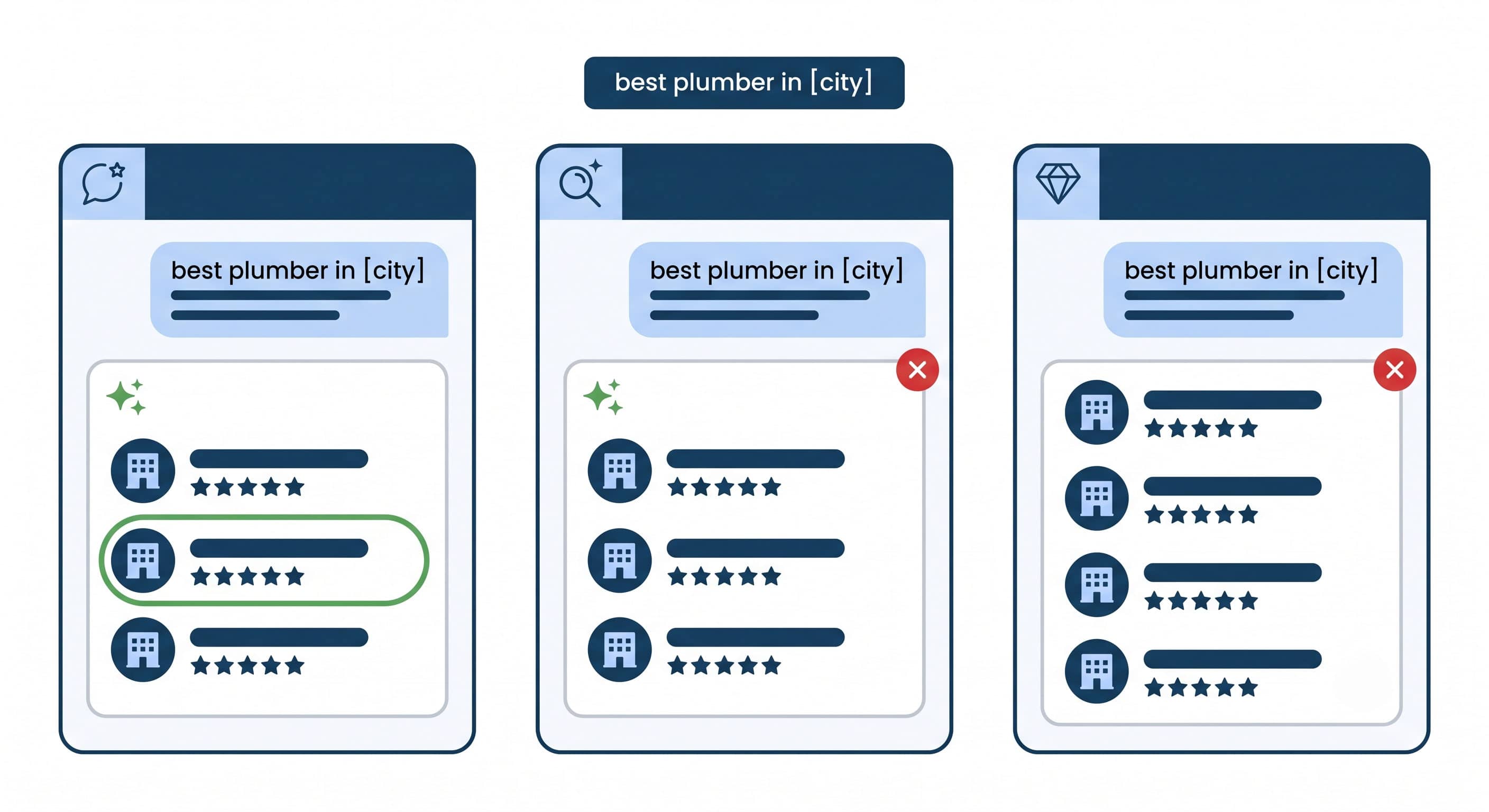
Every AI query is a little different. Your ChatGPT session knows your prior history. Your device knows your GPS coordinates. The AI’s underlying model adds a controlled amount of randomness so the same question doesn’t always produce the exact same answer.
Ask ChatGPT “best plumber in Alhambra” three times and you might get three different lists. Ask from your phone, then a laptop, then an incognito browser and you’ll get three more. None of those tests answer the real question, which is: on a stable, neutral query pattern, does ChatGPT reliably name your business?
You’d need to ask multiple AIs across multiple neutral queries under standardized conditions, then count how many times your business shows up. Doing that yourself for one city would take an afternoon. For three engines and every trade in your service area, it’s not going to happen.
What the tool actually shows
We built the AI Recommend tool to run that exact check. Enter your business name. Pick your trade. Pick your city. The tool asks ChatGPT, Perplexity, and Gemini “who’s the best [trade] in [city]” and reports back.
You’ll see three things in the result:
- A big score card at the top: N of 3 AI engines recommend you — the fast answer. Color-coded green if you’re in 2 or 3, amber if you’re in 1, red if you’re in 0.
- Three per-engine cards below the score: each engine gets its own card showing whether it mentioned you (green badge with your position, or red “doesn’t mention you”), and the list of businesses that engine DID name for the query.
- A strategy CTA at the bottom for booking a call if you want help closing the gaps.
Takes up to 30 seconds the first time we check your market. Faster on subsequent runs because we cache the AI answers per trade + city. Free — one name and email at the gate, then the tool asks the AIs and shows the result on the page. That’s the trade: you get the check, we get to know who to follow up with.
How to read your score
Three outcomes cover almost every business we run through the tool.
3 of 3 — you’re named everywhere. You have strong signals across the board: consistent NAP, healthy GBP with active reviews, citations on trusted directories, some kind of web presence beyond just your Google profile. The next question — one this tool doesn’t answer — is whether you’re the AI’s TOP pick or one of several. The tool shows your position on each engine when you’re named, which starts to hint at this.
1 or 2 of 3 — you have a signal gap. This is diagnostic. If ChatGPT names you but Gemini doesn’t, you probably have strong Yelp/BBB/directory presence but weaker Google-side signals — your GBP might need work or your Google reviews might be stale. If Perplexity names you but ChatGPT doesn’t, your broader web presence outpaces your directory presence. The engines you’re missing from tell you exactly where to focus.
0 of 3 — you’re not being recommended by AI at all. This isn’t a gap you fill by “creating AI content.” It’s a signal problem. Either you don’t have enough consistent signals across the web for the AIs to trust you as a business worth recommending, or your name isn’t associated strongly enough with your trade + city for any of the engines to surface you.
The named-alongside list is the strategic gold
Underneath the score, the per-engine cards show you the businesses each AI named. If you’re mentioned, your name gets highlighted in the list at the position the AI put you at. If you’re not mentioned, you still see the businesses that WERE named.
Look at the businesses that show up in the same position across all three engines. Those are the ones the AIs consistently treat as the leaders for your trade in your city. They’re your real competitors — not the whole map pack, not the top 20 in every directory, just the two or three names that keep coming up.
That list is more strategically useful than a raw map pack ranking. It tells you WHO to benchmark against — for review count, review velocity, GBP completeness, citation strength, and content — because those are the businesses the AIs treat as your peers.
If you’re not named — do this next
The AI Recommend tool tells you WHETHER you’re being named right now. Our companion tool, AI Readiness, tells you WHY not. Different question, different check. Readiness looks at your underlying signals — GBP completeness, review velocity, citation consistency, schema markup on your website — and grades whether you’re set up to be surfaced by AI in the first place.
If AI Recommend comes back at 0 or 1 of 3, run AI Readiness next. It’ll tell you which specific signals are weak. Then work the fixable ones — review velocity is usually the fastest lever — and re-check AI Recommend in four to six weeks to see if the needle moved.
How City Boost helps
We do Local SEO for home-service businesses across the SGV, and AI recommendation is now part of the standard work. The same underlying signals — GBP, reviews, citations, schema, consistent NAP — that get you into the map pack also get you named by ChatGPT, Perplexity, and Gemini. No separate “AI SEO” package. Just the fundamentals done right, applied to every place the AIs are looking.