TL;DR
Why isn't AI recommending my business, and what determines whether it will?
AI assistants check six signals before naming a business: structured data (schema), a complete Google Business Profile, crawler access to your site, FAQ-style content, consistent name-address-phone across the web, and reviews. Miss several and you're invisible to AI search regardless of how good your work is. Our free AI Readiness check grades you on all six in about 30 seconds.
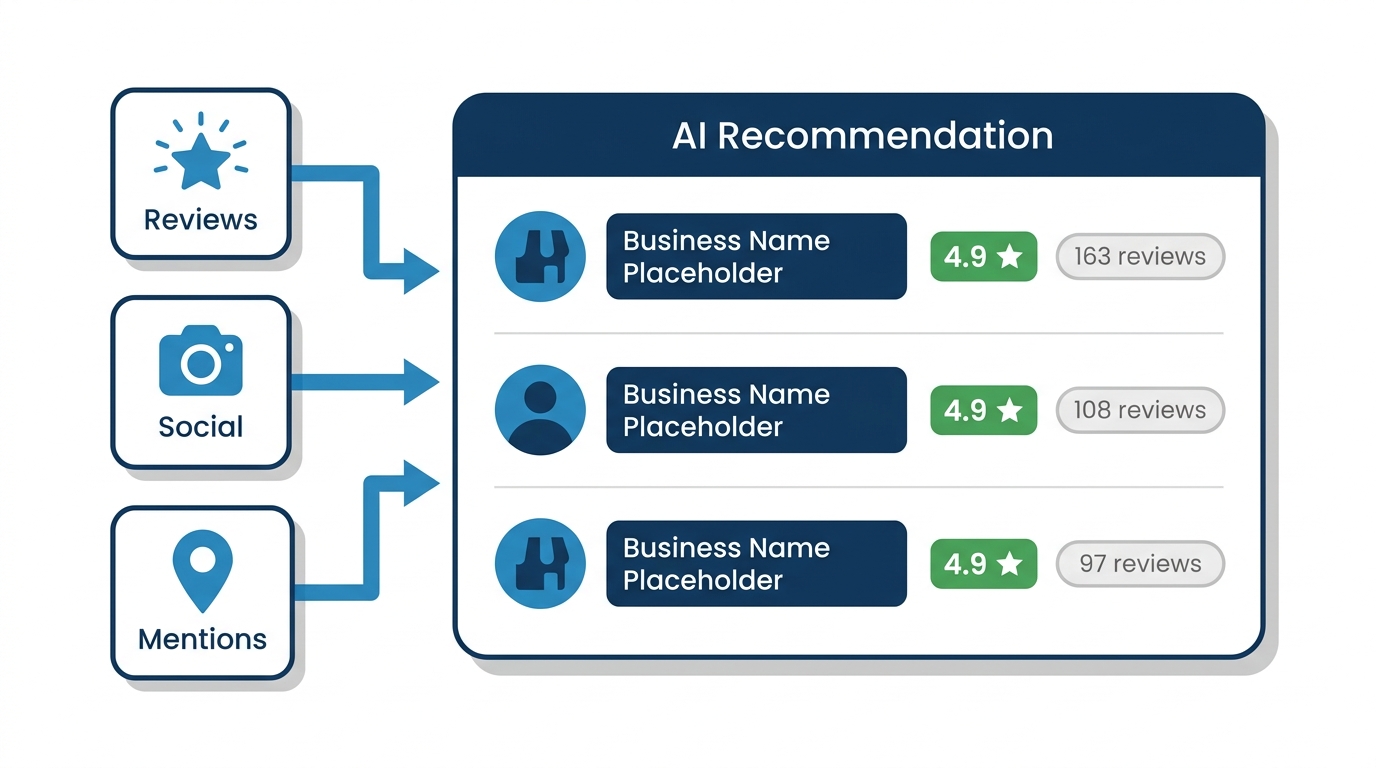
A homeowner in Alhambra asks ChatGPT “who’s the best plumber in Alhambra?” Three names come back. Yours isn’t one of them. Our other tool — AI Recommend — tells you exactly that: whether ChatGPT, Perplexity, and Gemini are currently naming your business. It doesn’t tell you WHY.
The reason is a specific set of six signals every major AI tool checks before deciding which local business to recommend. Some live on your Google Business Profile. Some live on your website. One lives in a file most home-service owners have never opened. If AI can’t verify enough of those signals, you don’t get named — regardless of how good your work is or how happy your customers are.
The AI Readiness tool audits your business against those six signals and hands you a letter grade. It’s the diagnostic companion to AI Recommend: one tells you whether AI is naming you right now, the other tells you why not.
Recommend vs Readiness — different questions
If you’ve run our AI Recommend tool, you’ve already seen the “whether” answer. It asks ChatGPT, Perplexity, and Gemini “who’s the best plumber in your city” and reports whether your business is one of the names each AI hands back.
AI Readiness asks the “why” question instead. It audits your business against the underlying signals AI actually uses to decide who to name. High readiness score means you’re set up to be nameable. Low score means you have signal gaps blocking you no matter how strong your reputation is offline.
Different tool, different check, different question. Together they give you the full picture: whether AI is currently surfacing you AND what specifically is or isn’t working.
The six signals AI uses to decide
The Readiness tool audits these six specific signals. All six are things AI tools can and do check when deciding which local businesses to recommend.
1. Google Business Profile. Is your GBP set up and complete — hours, categories, services, address, phone, and photos? AI tools cross-reference GBP data heavily because it’s the authoritative source Google itself uses. An incomplete GBP is a red flag every major AI reads.
2. Structured data (schema). Does your website have LocalBusiness schema markup — the machine-readable data that tells AI crawlers exactly what your business is, where it is, and what services you offer? Without schema, AI tools have to guess from the surrounding text. With it, they know.
3. Answer-ready content (FAQ). Do you have FAQ content on your website that answers the actual questions customers ask before booking? “How much does drain cleaning cost?” “Do you do emergency service?” “What areas do you cover?” AI tools pull these direct-answer snippets when responding to natural-language queries.
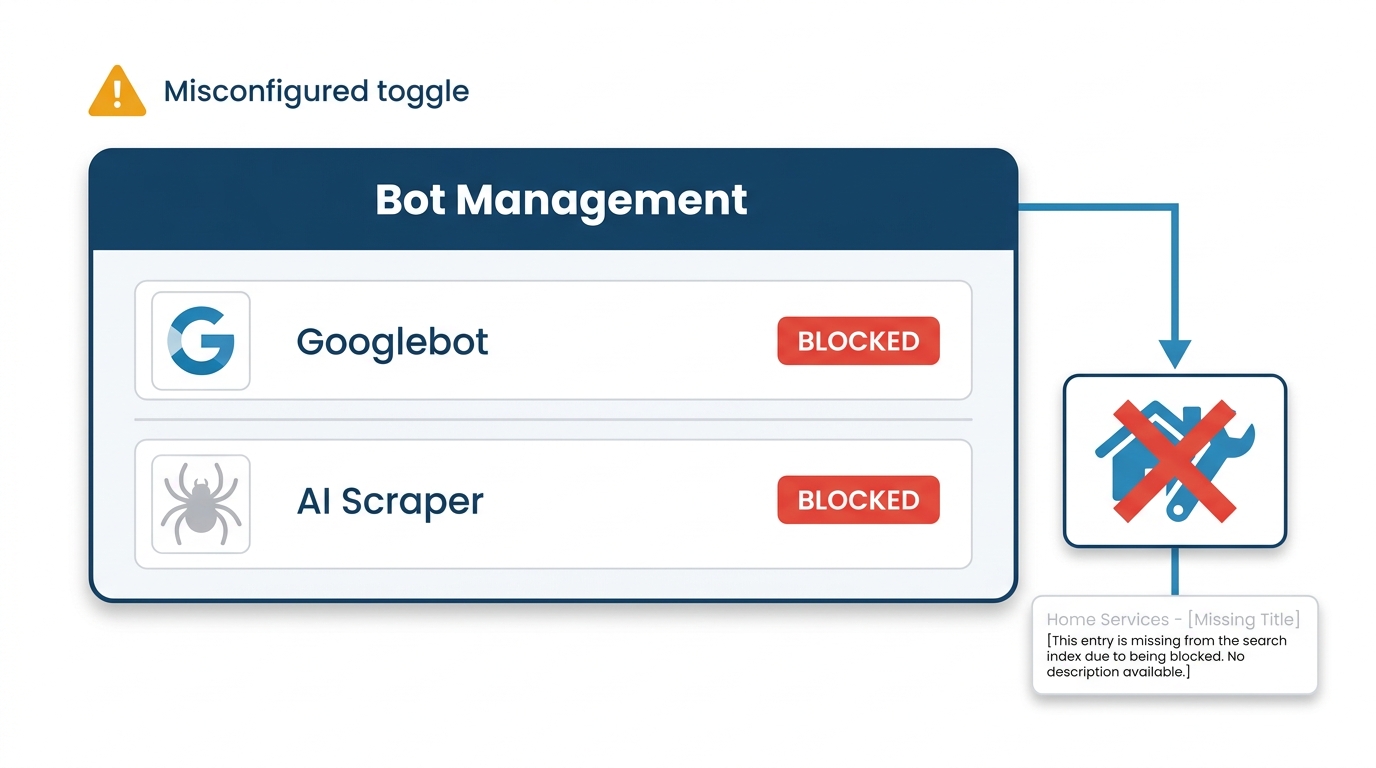
4. Accessible to AI crawlers. Does your robots.txt file allow the specific user agents AI tools use — GPTBot for ChatGPT, Google-Extended for Gemini, PerplexityBot for Perplexity? Many home-service sites accidentally block these, usually because of a plugin or a “block all bots” setting the previous website builder left in place. If AI can’t crawl your site, everything else on this list is invisible to it.
5. Consistent name & phone. Does your business name, address, and phone (NAP for short) appear identically across Google, Yelp, BBB, industry directories, and your own website? AI tools weigh consistency heavily — inconsistent NAP signals a business that might not be legitimate.
6. Reviews & reputation. Do you have enough reviews across the right platforms to be considered a legitimate business? Different from the review-count signal for map pack ranking — for AI readiness, it’s about breadth (multiple platforms) as much as volume.
That’s the full audit. Each of the six gets a score from the tool.
What the tool actually shows
Enter your business name, trade, and city. The tool pulls your GBP from Google Places, fetches your website’s robots.txt, scans your homepage for schema markup and FAQ content, and cross-references your NAP across the sources it can see.
You’ll get:
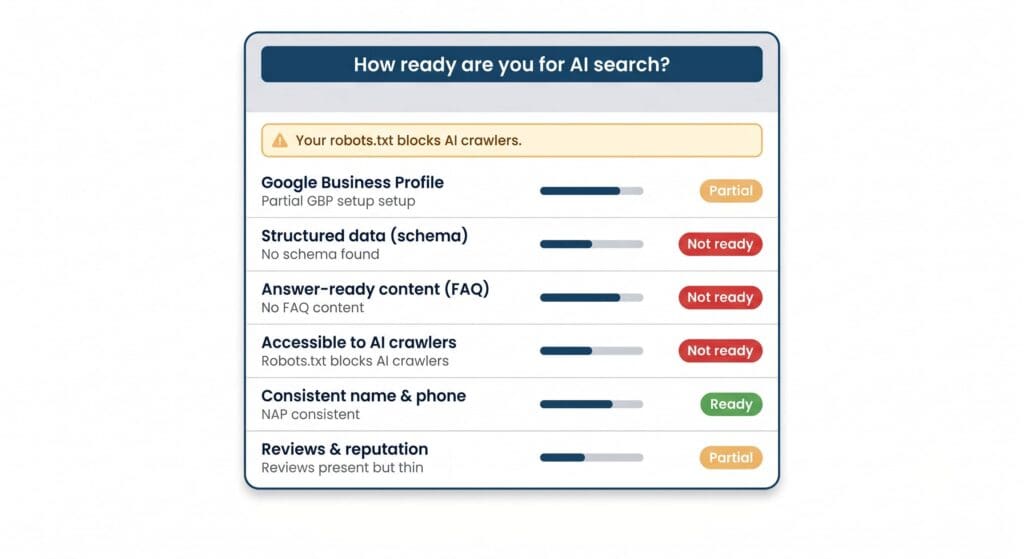
- A letter-grade card at the top: A, B, C, D, or F with a score out of 100. Green if you’re an A or B, amber for a C, red for D or F.
- A six-row signal table showing each pillar with a status badge — Ready in green, Partial in amber, Not ready in red, or Couldn’t check in gray for signals the tool couldn’t verify.
- Points per pillar (e.g., 15/20 for a Partial GBP setup) so you see exactly how much each gap is costing you.
- A takeaway line: “You’re leaving X of Y measurable AI-visibility signals on the table. Each one makes you easier for AI tools to find, trust, and recommend.”
- A critical note at the top of the table if the tool detected a hard blocker — for example, “Your robots.txt blocks AI crawlers” — because that specific problem tanks every other signal until you fix it.
- A strategy CTA for booking a call if you want help closing the gaps.
Takes about 30 seconds. Free — one name and email at the gate, then the tool runs live and the result appears on the page. That’s the trade: you get the audit, we get to know who to follow up with.
How to read your grade
Three outcomes cover almost every business we run through the tool.
A or B — you’re AI-ready. Most signals are Ready or Partial. Your website is set up correctly. Google can see you, AI can find you, your NAP is consistent. If AI Recommend still shows you as unnamed at this readiness level, that’s a proximity or reputation-weight issue, not a signal-configuration issue.
C — a few real gaps. You’re Partial or Not ready on two or three of the six signals. Usually schema markup and FAQ content — signals that require actual website work. Sometimes crawler accessibility if your site has a “block all bots” setting nobody remembered to fix.
D or F — multiple hard blockers. You’re Not ready on three or more signals. Your website is either brand-new and hasn’t been set up for AI visibility, or hasn’t been updated since before schema and AI crawlers became important. The fixes exist but they’re project-scale rather than “spend an afternoon.”
Not all six signals cost the same to fix
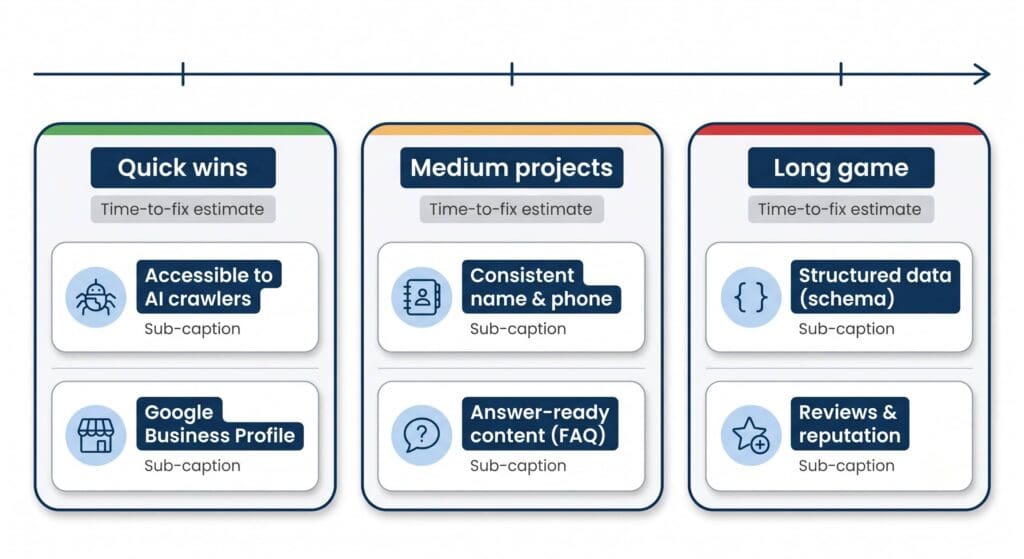
The signals live on different surfaces and take different amounts of work to close. Two are quick wins. Two are medium projects. Two are the long game.
Quick wins — same-day fixes:
Accessible to AI crawlers. If the tool flags your robots.txt as blocking AI, that’s usually a single-line fix. Log into your host or CMS, edit robots.txt to allow GPTBot, Google-Extended, and PerplexityBot user agents, save, done. Ten minutes. Do this one first — every other signal is invisible to AI until you unblock the crawlers.
Google Business Profile completeness. If your GBP is Partial because hours are blank, categories are wrong, or photos are missing, fix them in the GBP admin. One session, 30-45 minutes.
Medium projects — a week or two:
Consistent name & phone. If your NAP is inconsistent across directories, you need to audit every listing and fix the ones that don’t match. Yelp, BBB, Angi, Thumbtack, industry directories, your own website. Usually 15-30 listings for a home-service business. Do it once, keep it clean going forward.
Answer-ready FAQ content. If your website has no FAQ or thin FAQ, write one. Six to ten of the actual questions customers ask before booking, each with a clear one-paragraph answer. Real answers, in your voice, not generic filler. This is content work, not development work.
Long game — months:
Structured data (schema). Adding LocalBusiness schema to your website requires developer work — or a plugin if you’re on WordPress. If you’re on a custom-built site or a proprietary builder, it’s a real project. Get it right and you don’t touch it again.
Reviews & reputation. Same as the map pack review signal: building review count across multiple platforms is a month-over-month project, not an afternoon fix. Yelp, BBB, Facebook, and Google all count.
Working the quick wins first buys you an immediate grade bump before the harder projects even start. Most SGV owners we work with go from a D or C to a B within three months by hitting the two quick wins and starting the two medium projects.
Companion tool: check whether AI is actually naming you
The AI Readiness tool tells you whether your business is set up to be named by AI. Run the AI Recommend tool to find out whether AI is currently naming you. The gap between the two tells you something specific:
- High readiness, low recommend — you’re set up but haven’t been in market long enough for AI training data to catch up, or reputation-weighted signals are still light. Time will move the needle here.
- Low readiness, low recommend — the most common combination. Fix the readiness signals first, then re-check Recommend in four to six weeks to see if it moved.
- High readiness, high recommend — the outcome you’re building toward.
Running both takes about a minute total. You’ll come away knowing exactly where you stand and exactly what to work on.
Check yours in 30 seconds
Enter your business name, trade, and city into the AI Readiness tool. You’ll get the same score and signal breakdown we look at when we audit a new client. Free — name and email at the gate, then the tool runs live and the result appears on the page. No upsell inside the tool.
Two things to look for the moment your result loads:
- Your letter grade and score — that’s your baseline
- Any signal marked as Not ready and any critical note flagged at the top of the table — those are what to fix this week
How City Boost helps
We do Local SEO for home-service businesses across the SGV, and AI readiness is now part of the standard work. The same underlying signals — GBP, schema, FAQ content, NAP consistency, reviews, crawler access — that get you into the map pack also make you visible to AI. No separate “AI SEO” package. Just the fundamentals done right, applied to every place AI tools are looking.