

TL;DR
Why is AI recommending my competitor instead of my business?
When AI models lack consistent, authoritative data about your business, they substitute a nearby competitor who has more reviews, fresher activity, and cleaner information across the web. Fix it by cleaning up conflicting listings, building review volume, and ensuring your Google Business Profile is complete and current.
Someone in East Los Angeles types “best-rated garage door repair near me” into ChatGPT. Your shop has been serving that neighborhood for eight years. ChatGPT names three businesses. You’re not one of them.
That’s not a glitch. That’s what happens when AI has nothing solid to work with—and it’s already changed the competitive landscape for garage door shops across East LA and the surrounding cities right now.
The AI Doesn’t Blank Out. It Fills In.
Here’s the mechanism, and it matters that you understand it clearly.
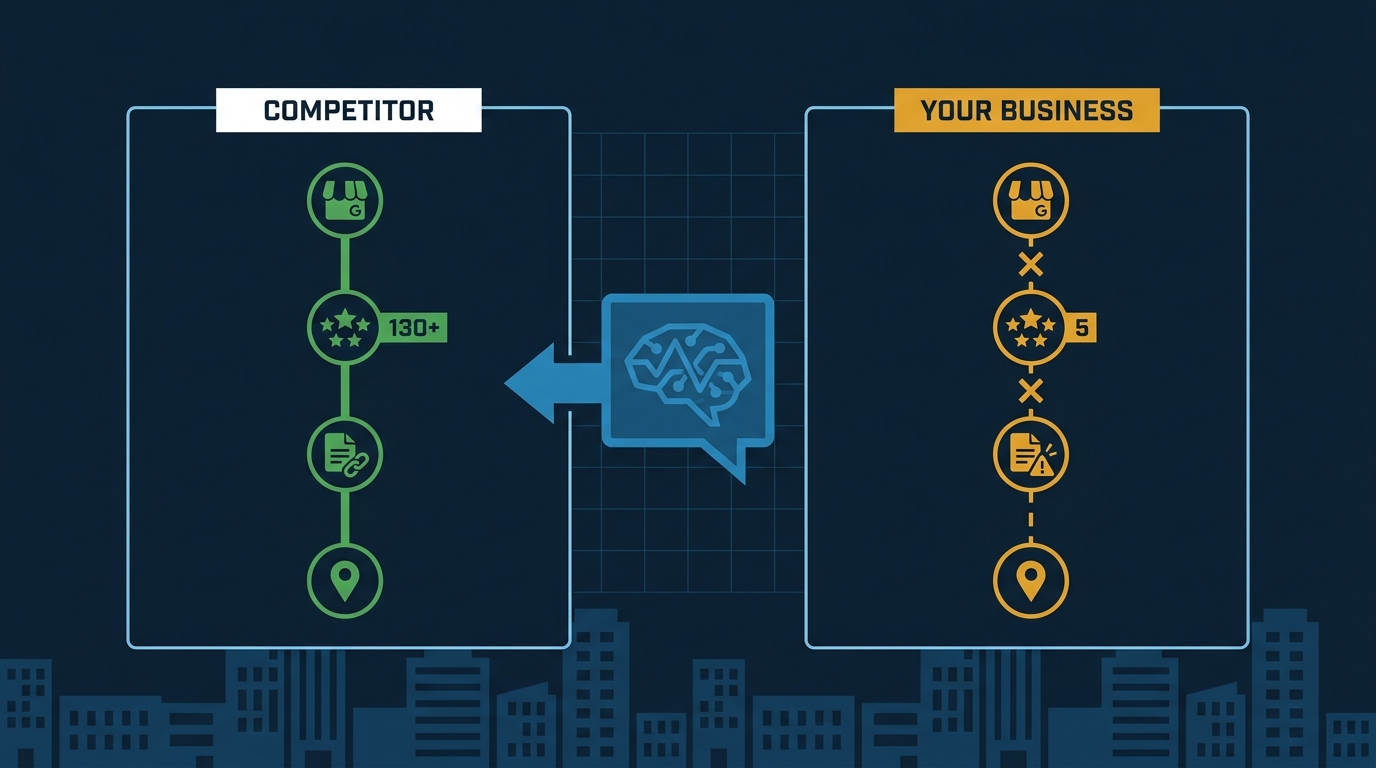
When an AI model doesn’t have enough reliable data on a business, it doesn’t say “I don’t know”. It reaches for the nearest well-documented entity—usually a competitor with more reviews, more citations, and more consistent information across the web—and delivers that substitution with the same confident tone it uses when it actually knows the answer.
This isn’t random hallucination. It’s systematic. The model drifts toward whoever has the denser, cleaner evidence trail. Your competitor didn’t do anything special to steal that mention. They just happened to have more to work with.
Conflicting or outdated information makes this worse. If your Google Business Profile says you’re in Montebello, your website footer says Commerce, and an old Yelp listing says East LA, the AI sees three versions of the same business and discounts all of them. The competitor with one clean address, consistent hours, and 130 reviews wins the citation by default.
What We Found When We Audited East Los Angeles Garage Door Repair
We ran a fresh audit on the “best-rated garage door repair in East Los Angeles” query—the kind of prompt a homeowner would type into Google’s AI or ChatGPT on a Saturday morning when the spring snaps.
Eleven profiles competed for that search. When we asked Google’s Maps-grounded AI for garage door repair in East Los Angeles, it surfaced 3 of those 11.
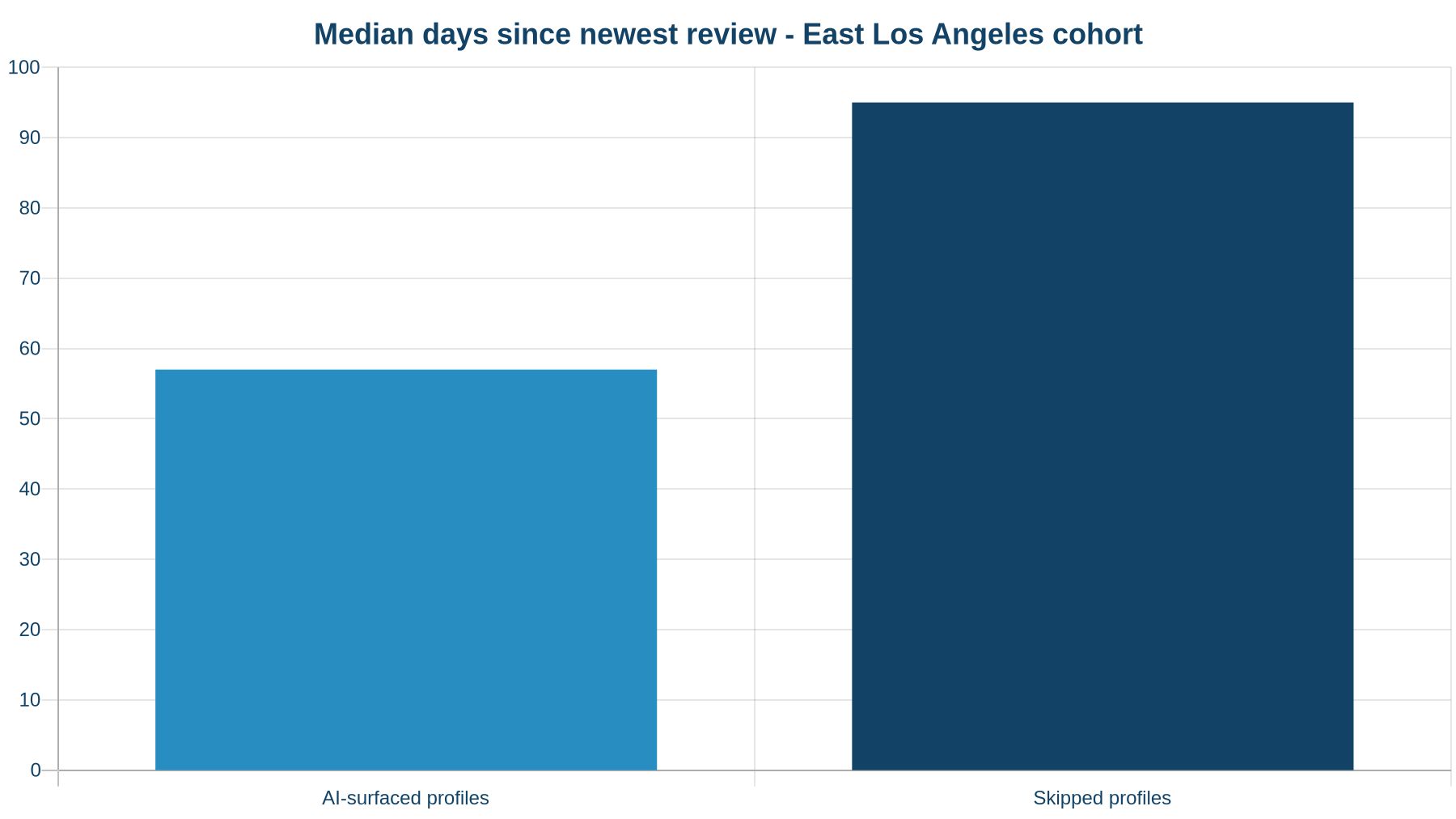
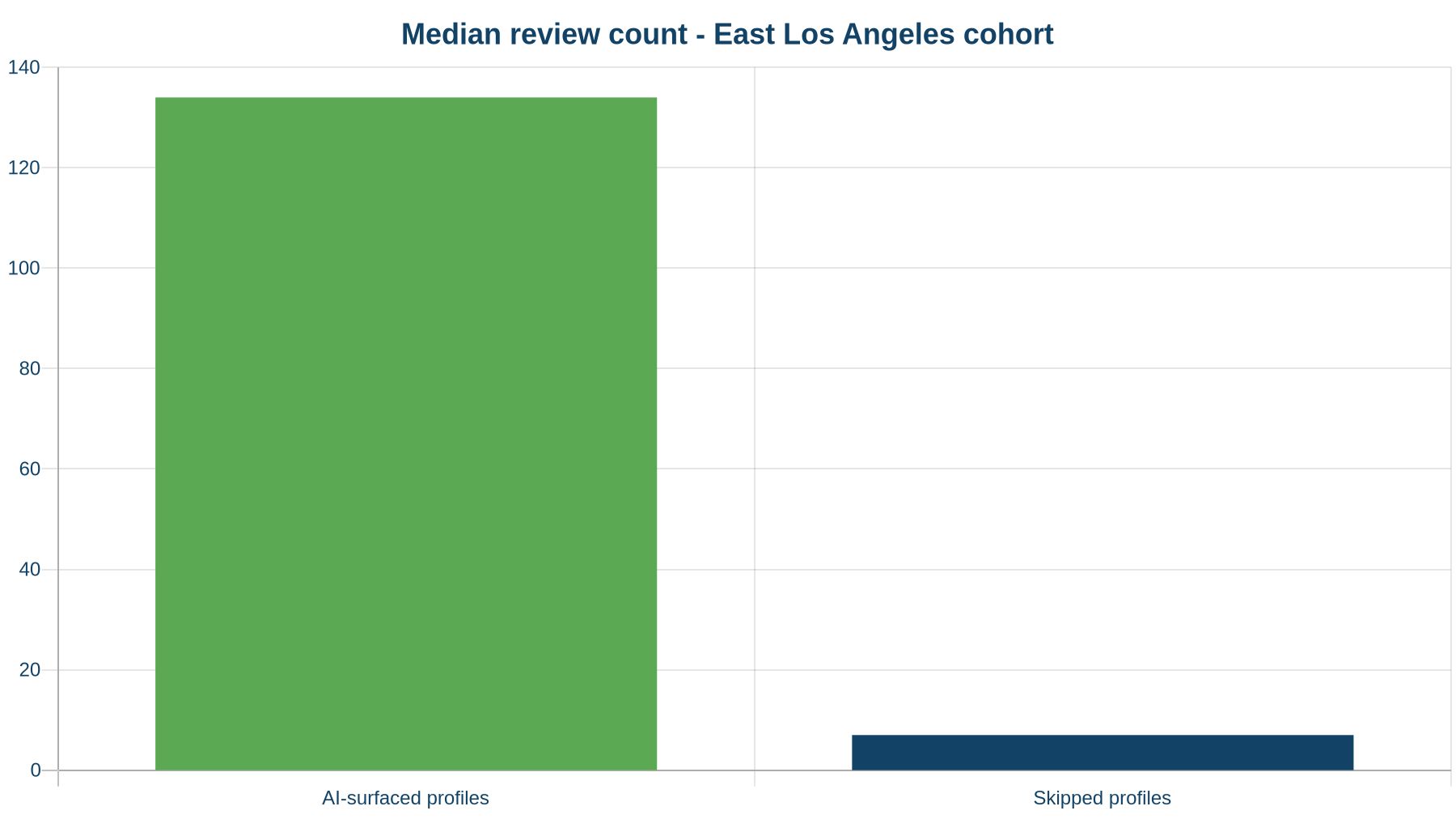
Here’s what separated the surfaced profiles from the skipped ones:
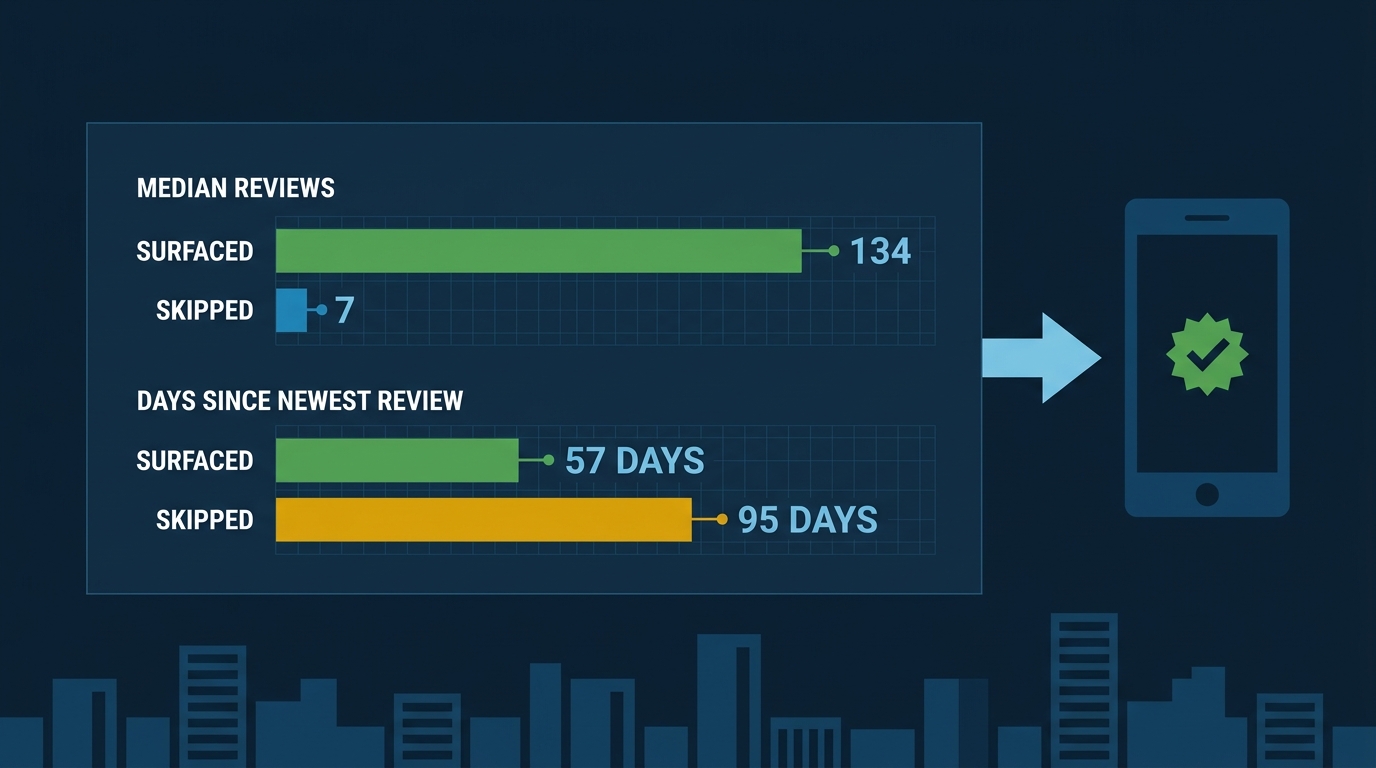
Review count: The profiles AI surfaced had a median of 134 reviews. The ones it skipped had a median of 7. That’s not a small gap—that’s a different category entirely. Profile A (surfaced) had 101 reviews (below the surfaced-profile median of 134, but still 20× the skipped-profile median of 7). Profile B (skipped) had 5. The AI isn’t making a judgment call about quality; it’s making a judgment about evidence density.
Review freshness: Surfaced profiles had a median newest review of 57 days ago. Skipped profiles: 95 days. A business that hasn’t been reviewed in three months looks dormant to a model trying to answer “who’s the best right now.”
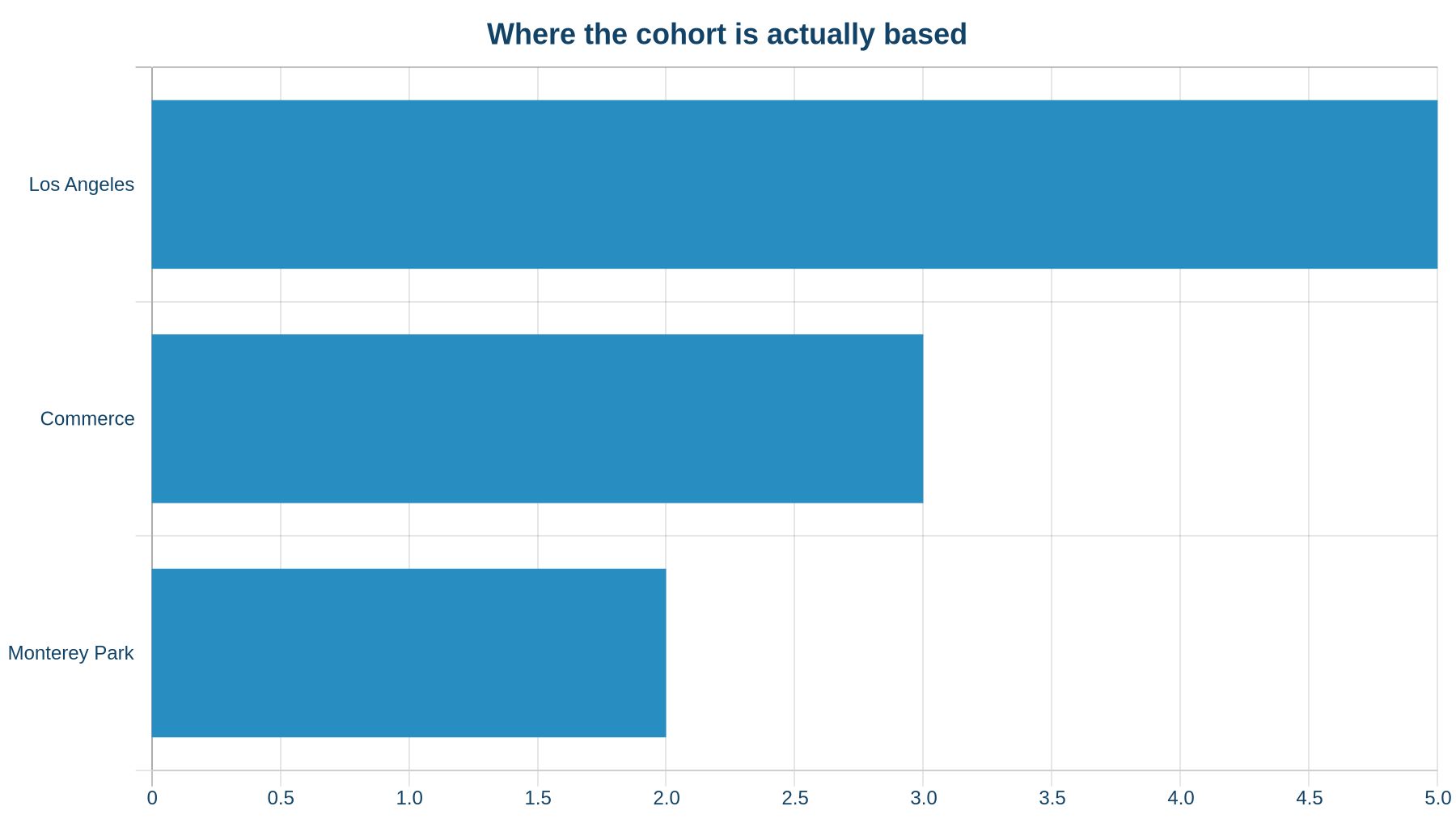
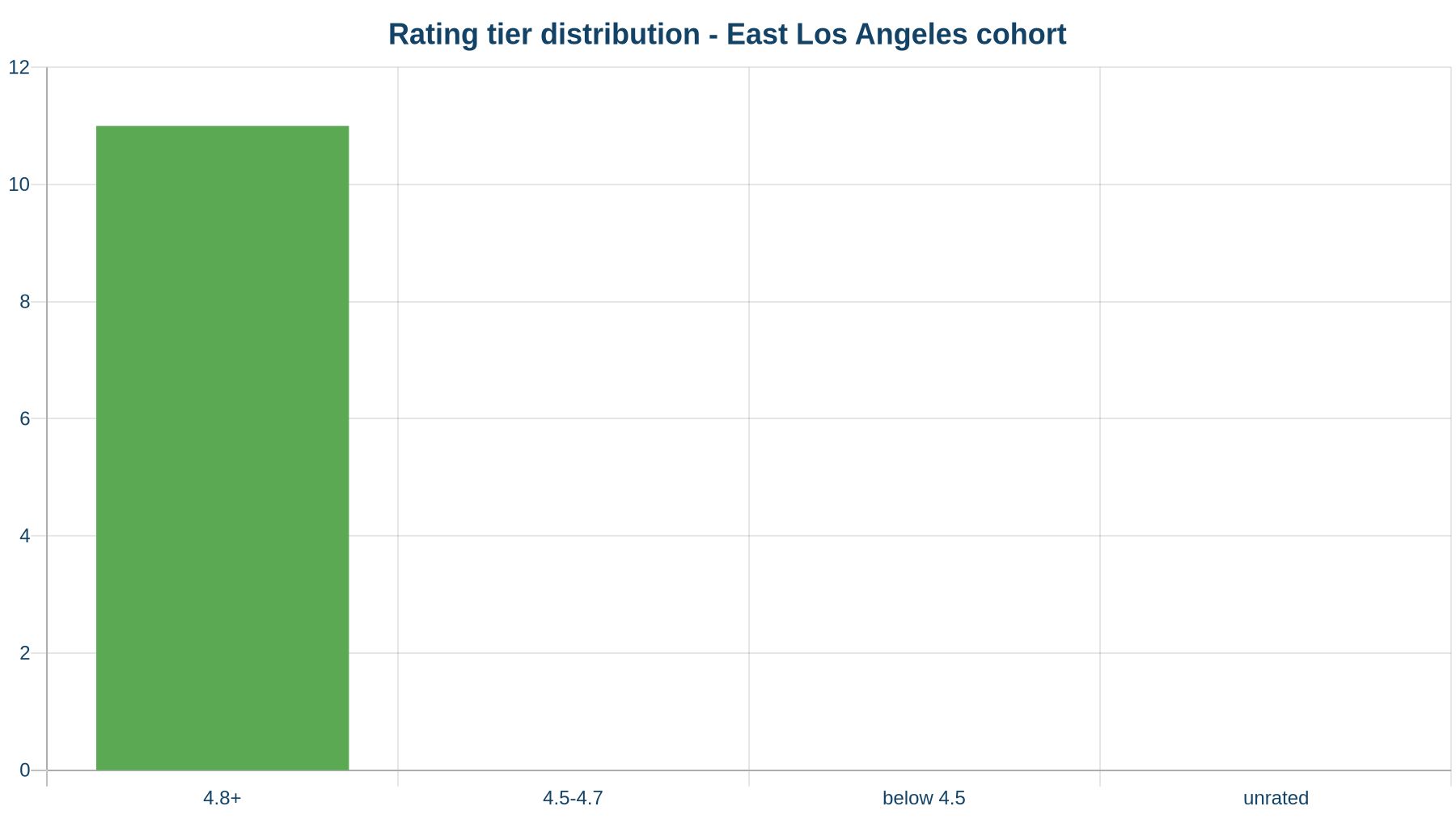
Location: Zero of the 11 competing profiles were physically based in East Los Angeles. The businesses winning those searches are headquartered in Los Angeles (5 profiles), Commerce (3), and Monterey Park (2). At 0.14 profiles per square kilometre within five kilometres of East Los Angeles, this is a thin market—which makes the AI’s substitution pattern even more consequential for any shop that does operate there. Proximity to the searched city mattered less than the quality of the evidence trail. Every single profile in the cohort carried a 4.8-star rating or higher—so ratings alone weren’t the differentiator. Reviews and recency were.
The lesson here isn’t that you need to move your shop. It’s that your GBP data, your review count, and your review velocity are the signals AI uses to decide whether you’re worth mentioning.
Why Publishing More Content Won’t Fix This
A lot of agencies will tell you the answer is more blog posts. It isn’t.
As Carolyn Shelby at Search Engine Journal explains, the problem isn’t usually a lack of content. It’s too many conflicting versions of the truth already on the web. Old directory listings with wrong phone numbers. A Facebook page that hasn’t been touched since 2021. A Yelp profile with a service area you stopped covering two years ago.
AI retrieves sources and constructs a single answer. When your evidence trail is contradictory, the answer it constructs looks unreliable—so it reaches for someone else’s cleaner trail instead.
Lauren Parker at HubSpot puts it plainly: AI search visibility and traditional SERP rankings run on separate systems. You can be ranking on page one in Google’s blue-link results and still be invisible—or worse, misrepresented—in AI answers. The fix isn’t more keyword-stuffed pages. It’s a consistent, authoritative evidence chain across the web.
Four Things to Fix This Week
1. Audit what AI actually says about you. Type your business name plus your city into ChatGPT, Perplexity, and Google’s AI Overview. Note what it says. Note what it gets wrong. Note whether it names you at all or slides in a competitor. Our free Does AI Recommend You? tool does this automatically—it queries ChatGPT, Perplexity, and Gemini and shows you whether they name your business or your competitor’s.
2. Clean up your conflicting data. One business name, one phone number, one address—everywhere. Your GBP, your website, Yelp, Angi, HomeAdvisor, the BBB, Apple Maps. They all need to match exactly. One stale listing with an old suite number is enough to introduce doubt into the evidence chain.
3. Get your review count up—and keep it moving. Profile B in our East LA audit had 5 reviews and the newest was 105 days old. That’s not a business AI is going to recommend to anyone. You need volume and you need velocity. A steady stream of recent reviews signals to AI that the business is active, trusted, and worth citing. If you’re not systematically asking every customer for a review after every job, you’re falling behind. Our reputation and review management service automates that request after each completed job so you’re not relying on anyone to remember.
4. Check your AI Search Readiness Score. Beyond reviews, AI models look at your schema markup, GBP completeness, and whether AI crawlers can even access your site. Our free AI Search Readiness Score checks all of it and tells you exactly what to fix.
The Substitution Is Already Happening
You won’t get an alert when AI starts recommending your competitor instead of you. There’s no notification. The homeowner just calls someone else, and you never know the search happened.
That’s already changed the competitive landscape—you just haven’t seen the searches you lost. In East Los Angeles, businesses based in Commerce and Monterey Park are already showing up in AI answers for searches that should belong to shops closer to the customer—because they have more reviews, fresher activity, and cleaner data.
The gap between Profile A (101 reviews, cited by AI) and Profile B (5 reviews, invisible to AI) didn’t happen overnight. It happened because one business treated reviews as a system and the other treated them as a nice-to-have.
Start treating them as a system. Monday morning, text your last five customers and ask for a review. That’s the move.