

TL;DR
Does review velocity really matter more than my star rating for local rankings?
Yes — once you're above the trust floor, a steady stream of recent reviews outranks a higher rating that's gone quiet. In a packed local market, velocity is often the separator, and an unanswered one-star does compounding damage the longer it sits. Ask after every job and monitor daily.
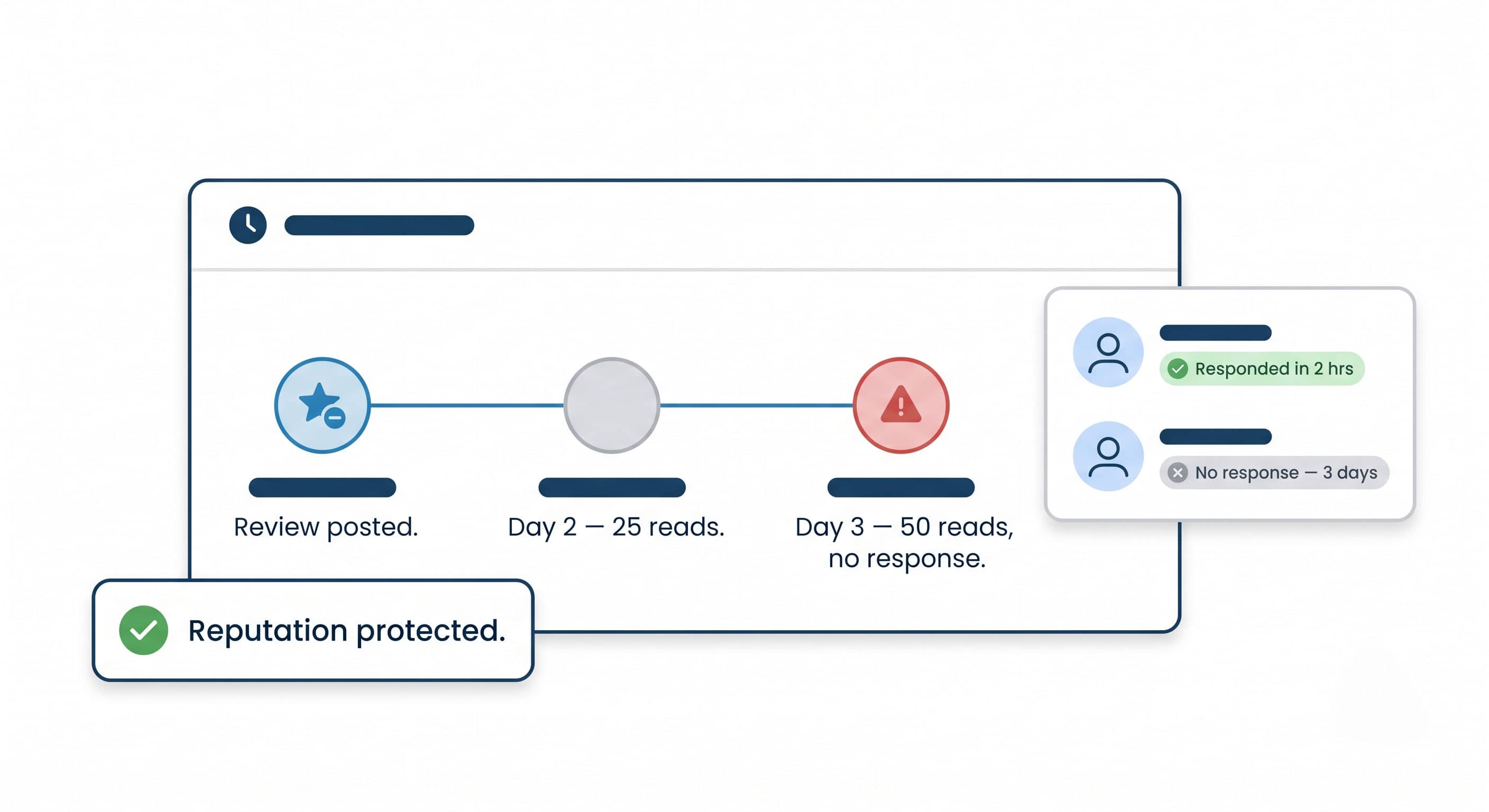
A plumber in Whittier gets a 1-star review on a Tuesday night. He doesn’t see it until Friday afternoon. By then, 50 people have read it and moved on to someone else. No response. No context. Just a one-star hanging there like a busted pipe.
That’s not a freak accident. That’s the default setting for most home-service businesses in this area — and it’s costing real jobs.
What review velocity actually means
Review velocity is simple: how recently and how often you’re getting new reviews. Google uses it as a ranking signal for local search results, including the map pack — the three businesses that show up when someone searches plumber near me or emergency plumber Whittier.
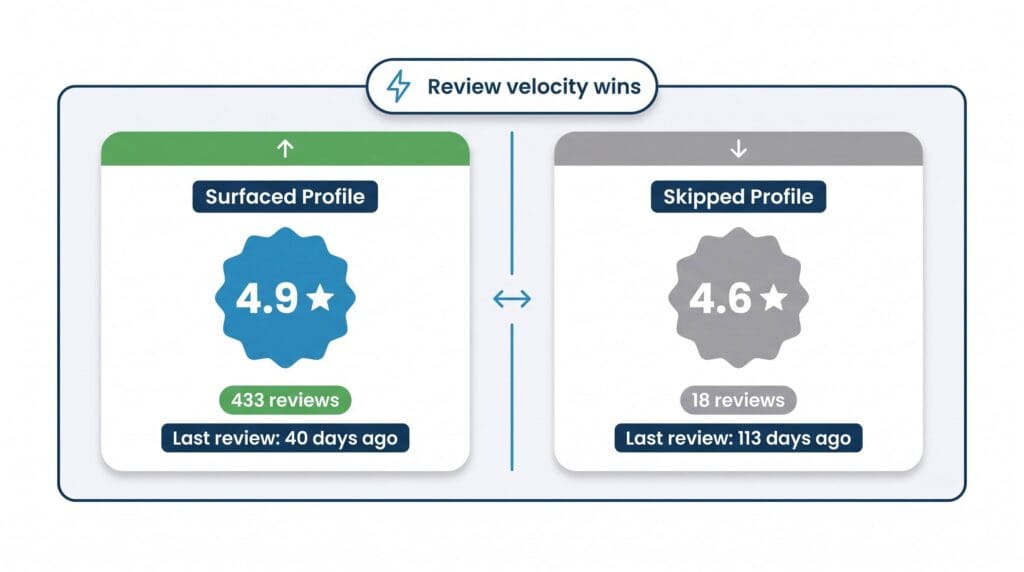
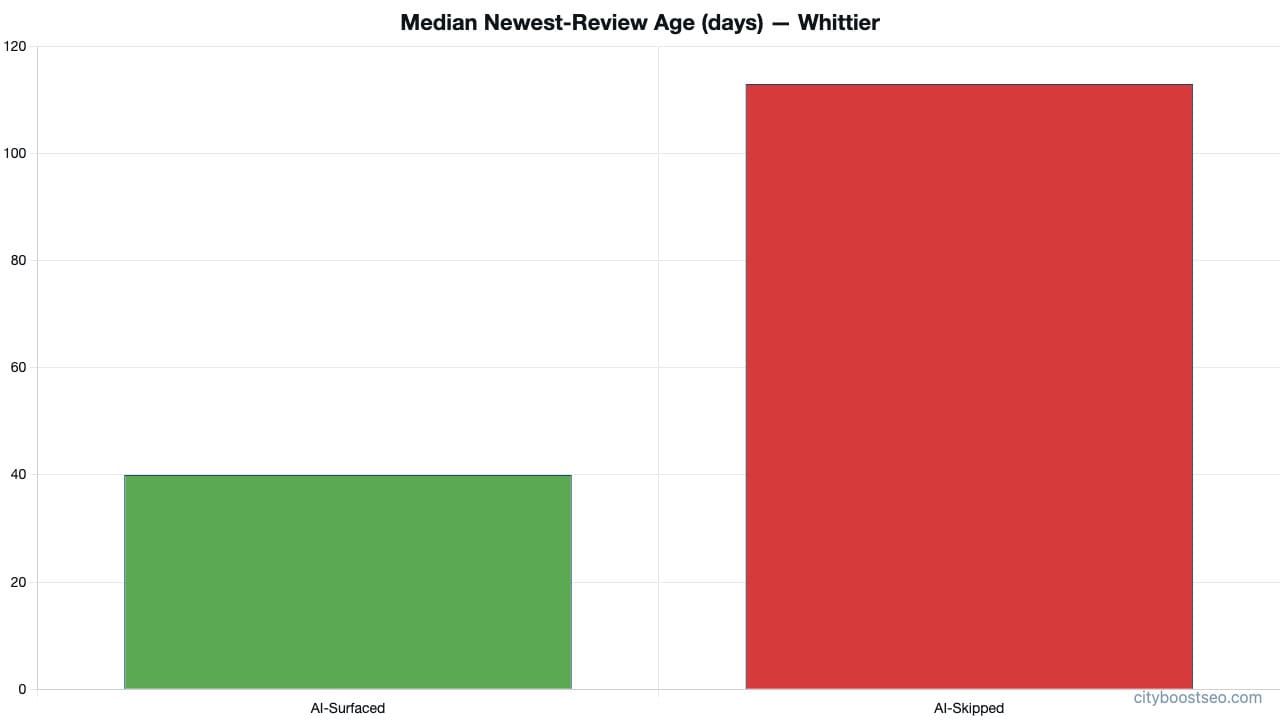
It’s not just about your star rating. A 4.9 with reviews that dried up four months ago loses to a 4.7 that got three reviews last week. In our Whittier cohort, surfaced profiles averaged 4.8+ — but the freshness gap was 40 vs. 113 days, suggesting recency compounds the rating advantage rather than overriding it. Freshness signals to Google that you’re still active, still working, still trusted by real customers right now.
The Whittier data — and what it tells you
We ran an audit of 20 plumbing profiles competing for searches in Whittier. Here’s what we found.
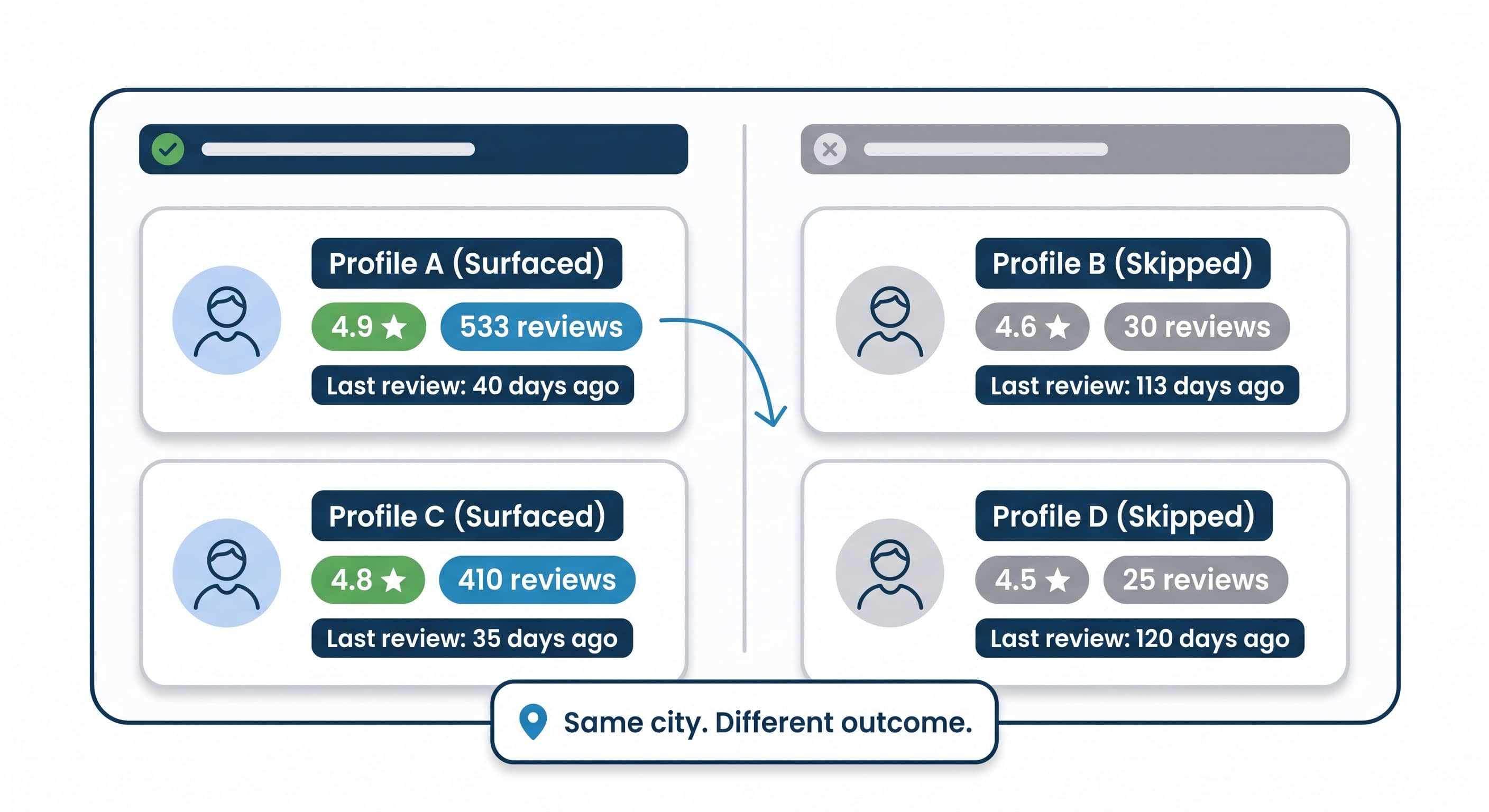
The profiles that Google’s AI surfaced for a “best-rated plumber in Whittier” query had a median newest-review age of 40 days. The profiles that got skipped had a median newest-review age of 113 days — nearly four months since their last review.
Read that again. The gap between showing up and getting skipped wasn’t star rating. It wasn’t website quality. It was whether a real customer had left a review in the last six weeks.
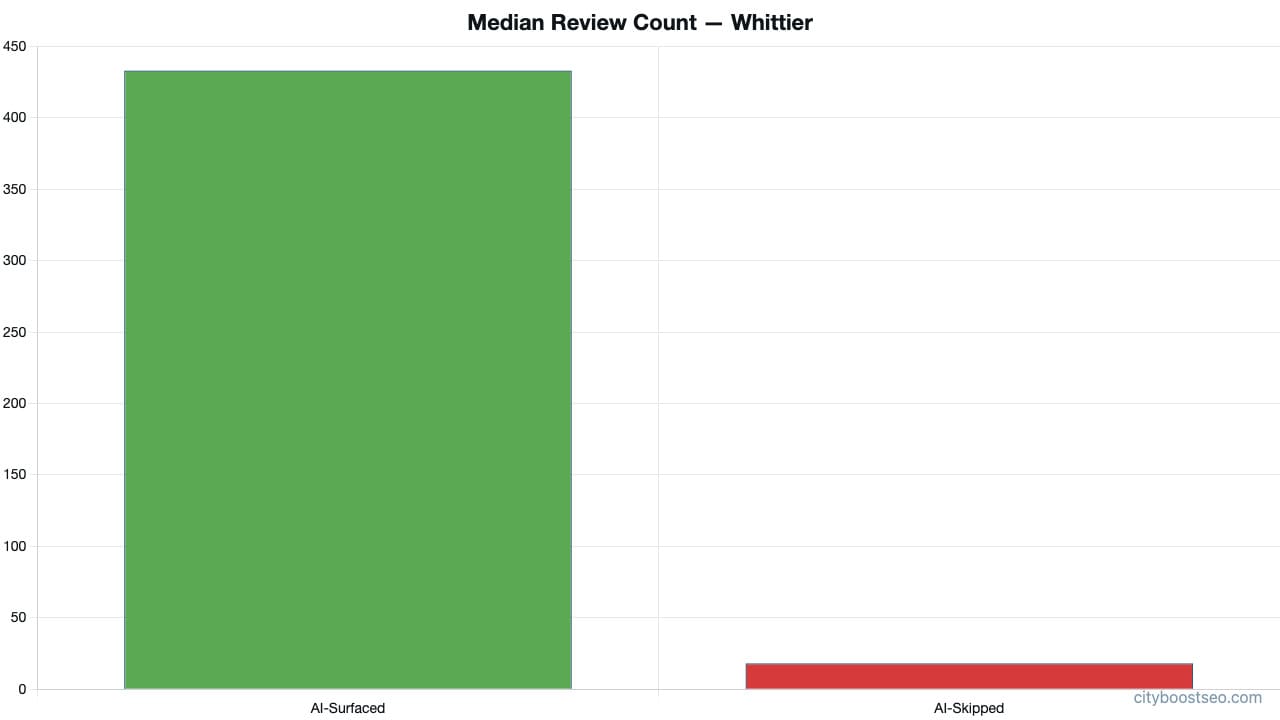
The review count gap was even starker. Surfaced profiles had a median of 433 reviews. Skipped profiles had a median of 18. That’s not a small edge — that’s a completely different tier of trust signal.
One specific comparison: Profile A (surfaced) had 533 reviews and its newest review was 40 days old. Profile B (skipped, also based in Whittier) had 30 reviews and its newest review was 113 days old. Same city. Same trade. Completely different outcome.
Who you’re actually competing against
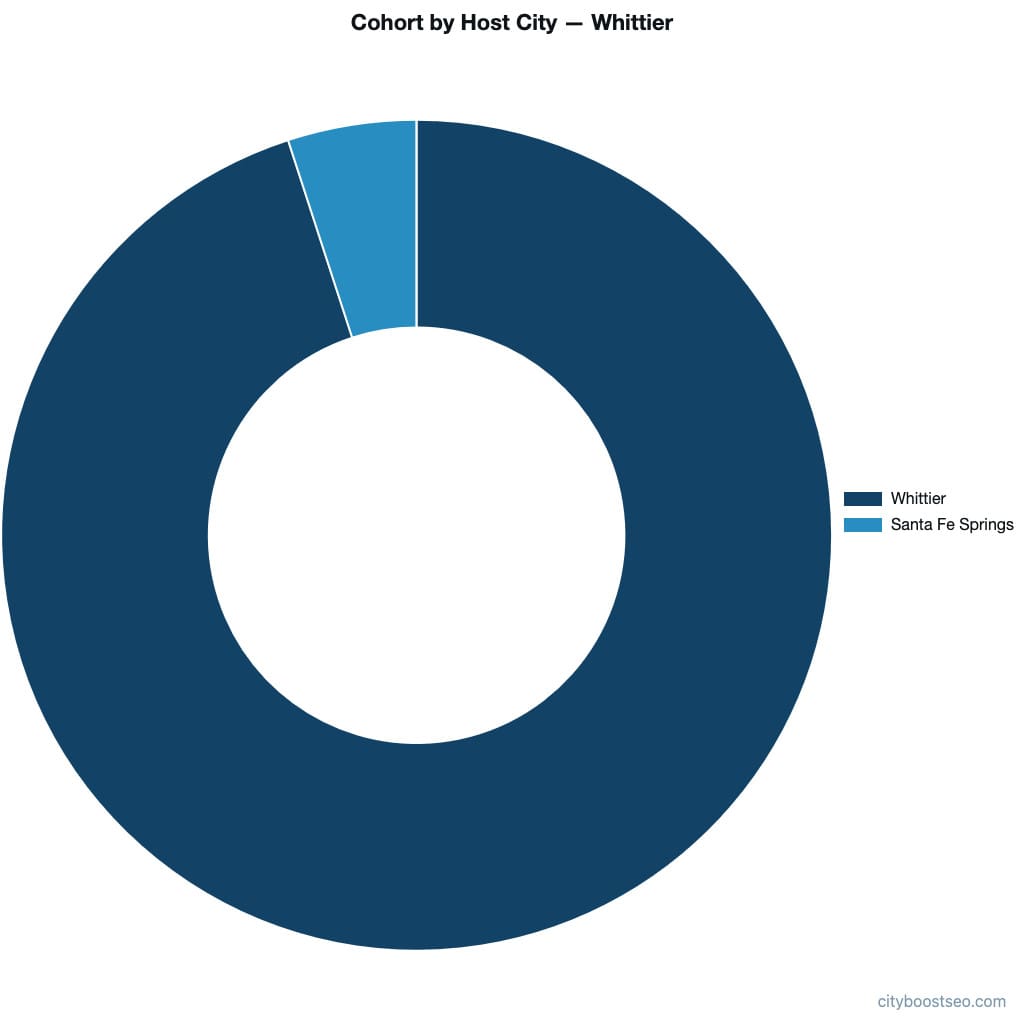
Here’s the part most people miss. Of the 20 profiles in this Whittier plumber cohort, 19 of the 20 are physically based in Whittier itself. One is based in Santa Fe Springs. That means you’re not losing searches to some big regional company operating from across the county — you’re losing them to your literal neighbors.
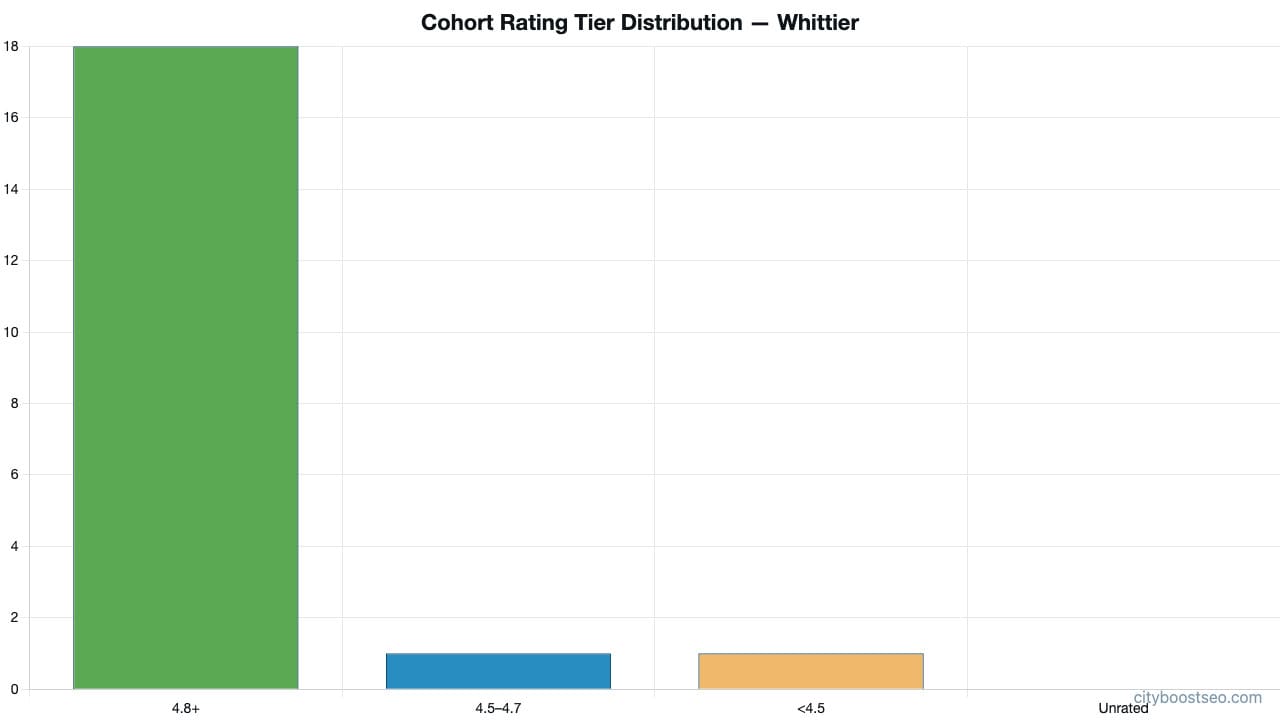
And the rating bar is high. Within 5km of central Whittier, there are 20 plumbing profiles all targeting the same map pack — that’s one competitor for roughly every 4 square kilometers, and all 20 are fighting for 3 spots. Of those 20 profiles, 18 out of 20 are rated 4.8 or above. One sits in the 4.5–4.7 range. One is below 4.5. If you’re sitting at a 4.4 thinking “that’s pretty good,” you’re in the bottom 5% of the competitive set for this market.
This is a tight, local fight. The density in this area is 0.25 profiles per square kilometer within 5km of Whittier. That sounds sparse until you realize every single one of them is gunning for the same map pack.
The monitoring problem nobody fixes
Most plumbers aren’t ignoring reviews on purpose. They just don’t have a system.
A new review comes in. It sits in a Gmail inbox that nobody checks. Or the notification goes to a phone number that belongs to a tech who’s elbow-deep in a water heater. Or the owner sees it three days later when he’s finally at his desk. Profile B in our audit had its last review sitting unanswered for 113 days — not because the owner didn’t care, but because nobody had a system.
By then, the damage is done. Not because one bad review destroys a business — it doesn’t — but because an unanswered 1-star tells every future reader: this company doesn’t care. A response, even a simple one, tells them the opposite.
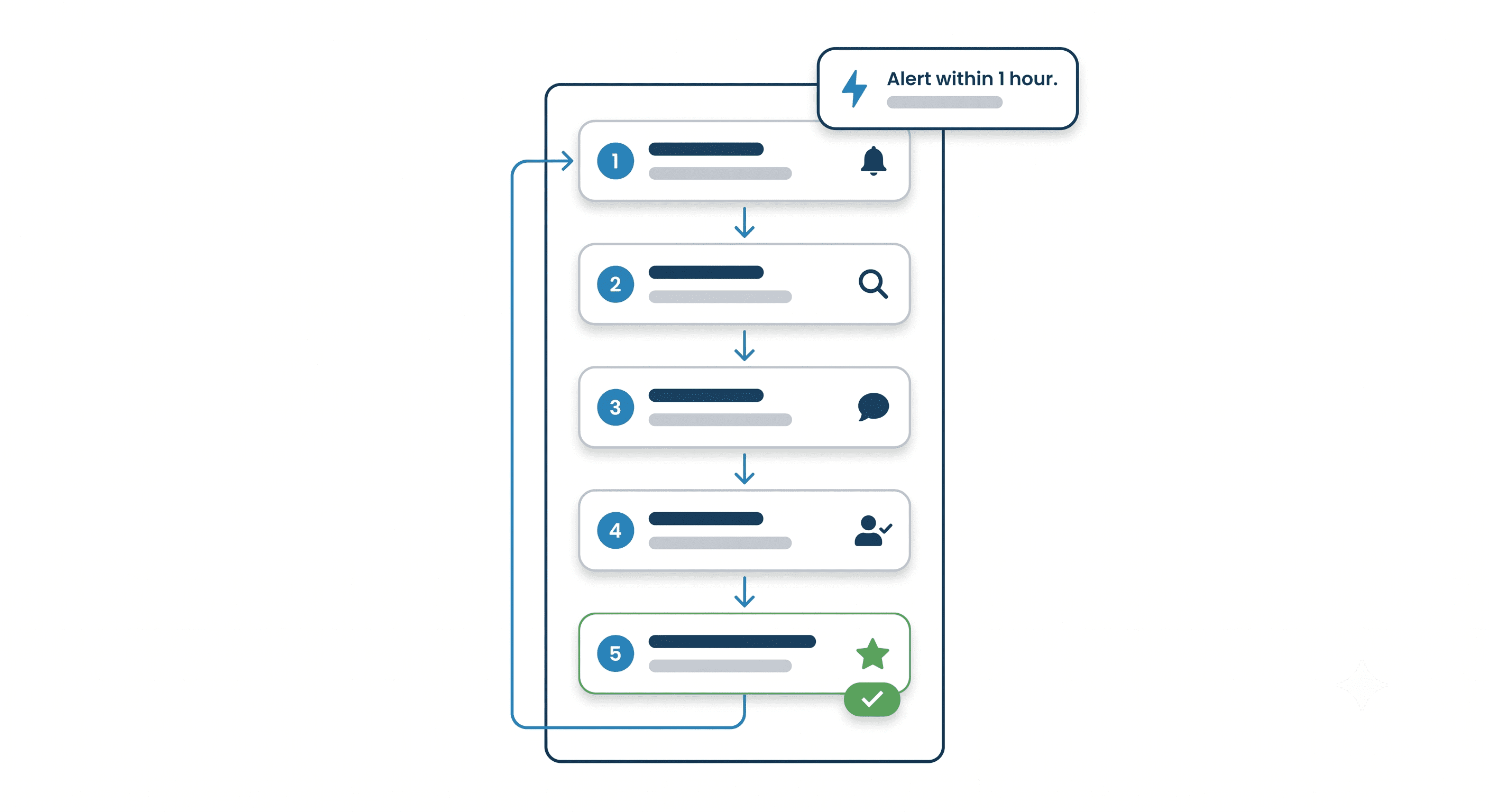
The fix is a monitoring setup that alerts the right person within the hour, not within the week.
How to set up a monitoring system that actually works
Here’s the practical version. You don’t need expensive software to get started.
Step 1: Own your Google Business Profile notifications. Log into your GBP, go to Settings, and make sure review notifications are turned on and going to an email address someone actually reads. This sounds obvious. Most businesses haven’t done it.
Step 2: Set up a Google Alert for your business name. Go to google.com/alerts. Enter your business name in quotes. Set delivery to “as it happens.” This catches reviews and mentions on platforms Google can index — Yelp, Facebook, news sites.
Step 3: Check Yelp and Facebook directly. Google Alerts won’t catch everything. Yelp and Facebook both have their own notification settings. Turn them on. Set them to email, not just app notifications — app notifications get buried.
Step 4: Assign a responder. Decide who responds to reviews and give them a simple script. Not a copy-paste template — a framework. For a positive review: thank them, mention the specific job or city if they did. For a negative review: acknowledge it, don’t get defensive, offer to take it offline. One sentence is better than a paragraph of excuses.
Step 5: Build a post-job ask into your process. Velocity doesn’t happen by accident. The businesses with 433 reviews aren’t getting lucky — they’re asking every customer, every time, right after the job. A text message with a direct link to your Google review page, sent the same day the job closes. That’s the whole system. If you’d rather not run the ask by hand, our review automation sends that text after every job without anyone having to remember.
The rating floor you have to clear
Given that 18 of the 20 Whittier plumbing profiles are rated 4.8 or above, a 4.4 or 4.5 isn’t a small disadvantage — it’s a structural one. You’re in the bottom tier of a market where nearly everyone is clustered at the top.
That doesn’t mean you need to panic. It means you need to be deliberate.
A consistent ask after every job from real customers can move your average meaningfully, especially if your total count is low. And a low count is actually an opportunity — each new review carries more weight when you only have 30 than when you have 300.
The trap is thinking you can fix a reputation problem by ignoring it and hoping the old bad reviews age out. They don’t age out fast enough. New good reviews dilute them. That’s the only math that works.
What to do Monday morning
Pick one thing from this list and do it before noon:
- Log into your Google Business Profile and confirm review notifications are on and going to an active email.
- Send a review request to the last three customers you completed work for. A direct link, a short text, done.
- Check your current Google rating and count how many reviews you have. If it’s under 50, that’s your number-one local SEO problem right now — not your website, not your keywords.
- Or let our free Map Pack Grader count them for you and score your profile against the other Whittier plumbers — reviews, rating, photos, and the gaps.
If you want a full picture of where you stand against the other 19 plumbers in this market, that’s exactly the kind of work we do as part of our reputation and review management service. We’ll map your profile against all 19 Whittier competitors and show you the exact review-count and recency gap you need to close.