

TL;DR
How does Google decide which three businesses appear in the map pack?
Three factors: proximity to the searcher (the one you can't control), relevance, and prominence — driven heavily by review count, recency, and profile completeness (the ones you can). Keywords on your website matter far less than owners assume. Your fastest levers are a steady stream of new reviews and a fully built-out Google Business Profile.
You search “AC repair Alhambra” from your truck. Three businesses show up in the boxed cluster at the top of Google. You’re not one of them. That box gets most of the clicks for the query you live or die by — and the three businesses inside it are taking the calls you should be getting.
Most agencies will tell you the map pack is a mystery and they have the secret formula. They don’t. Google has been open about how it works for years. The part most agencies won’t tell you is which part you can actually move and which part you can’t.
Here’s the real mechanic, owner to owner.
What the map pack actually is
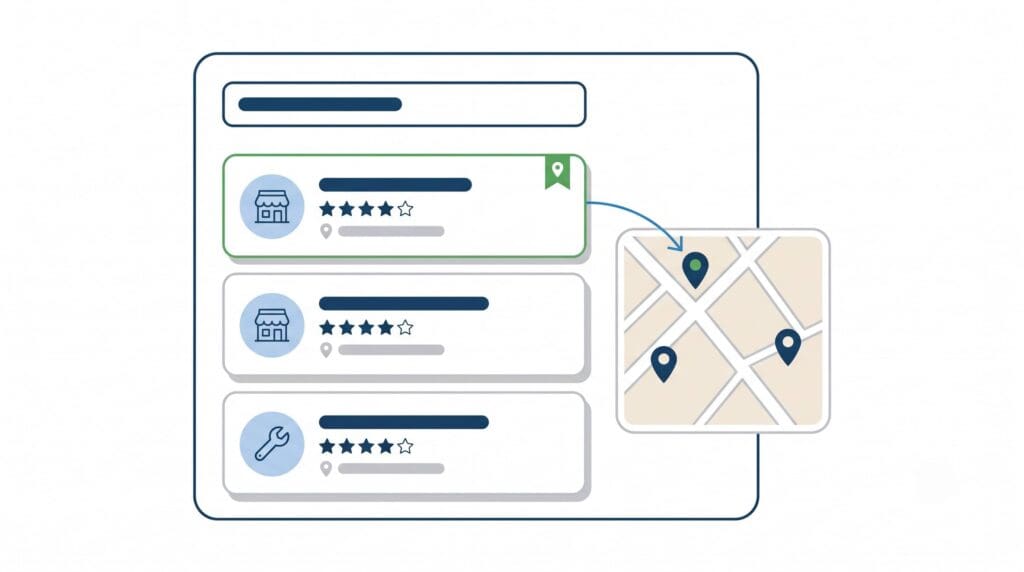
The map pack — sometimes called the “local pack” or the “3-pack” — is the boxed cluster of three Google Business Profiles that shows up above the regular blue links when Google thinks your query has local intent. “Plumber near me” is obviously local. “HVAC company” typed from a phone in Pico Rivera is also local, even though you didn’t say so. Google reads location from the device and decides.
That box gets clicked more than the rest of the page combined for most home-service queries. A #1 organic ranking below it might get a fraction of the traffic the third map pack listing pulls. The pack is the game.
How Google picks the three
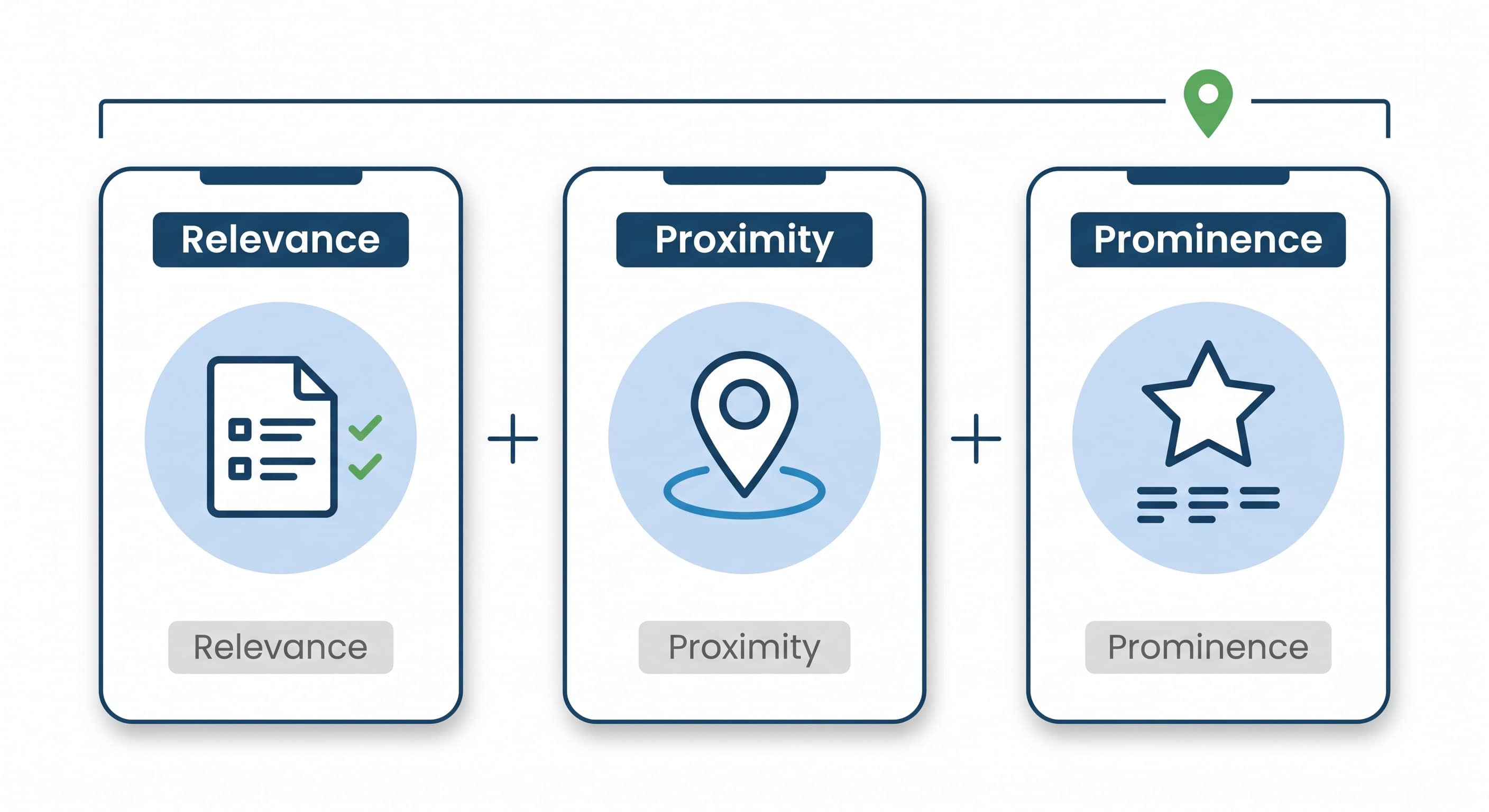
Google ranks the pack on three things: relevance, proximity, and prominence. They sound like agency-speak. They aren’t — they’re the only three levers.
Relevance is whether your Google Business Profile actually says you do the thing the searcher is looking for. The primary category on your GBP, the service list, the business description, the Google Posts you publish. If your primary category says “Air Conditioning Contractor” and the searcher typed “AC repair,” you’re relevant. If your primary category says “Heating Contractor,” you’re less relevant — even if you obviously do both.
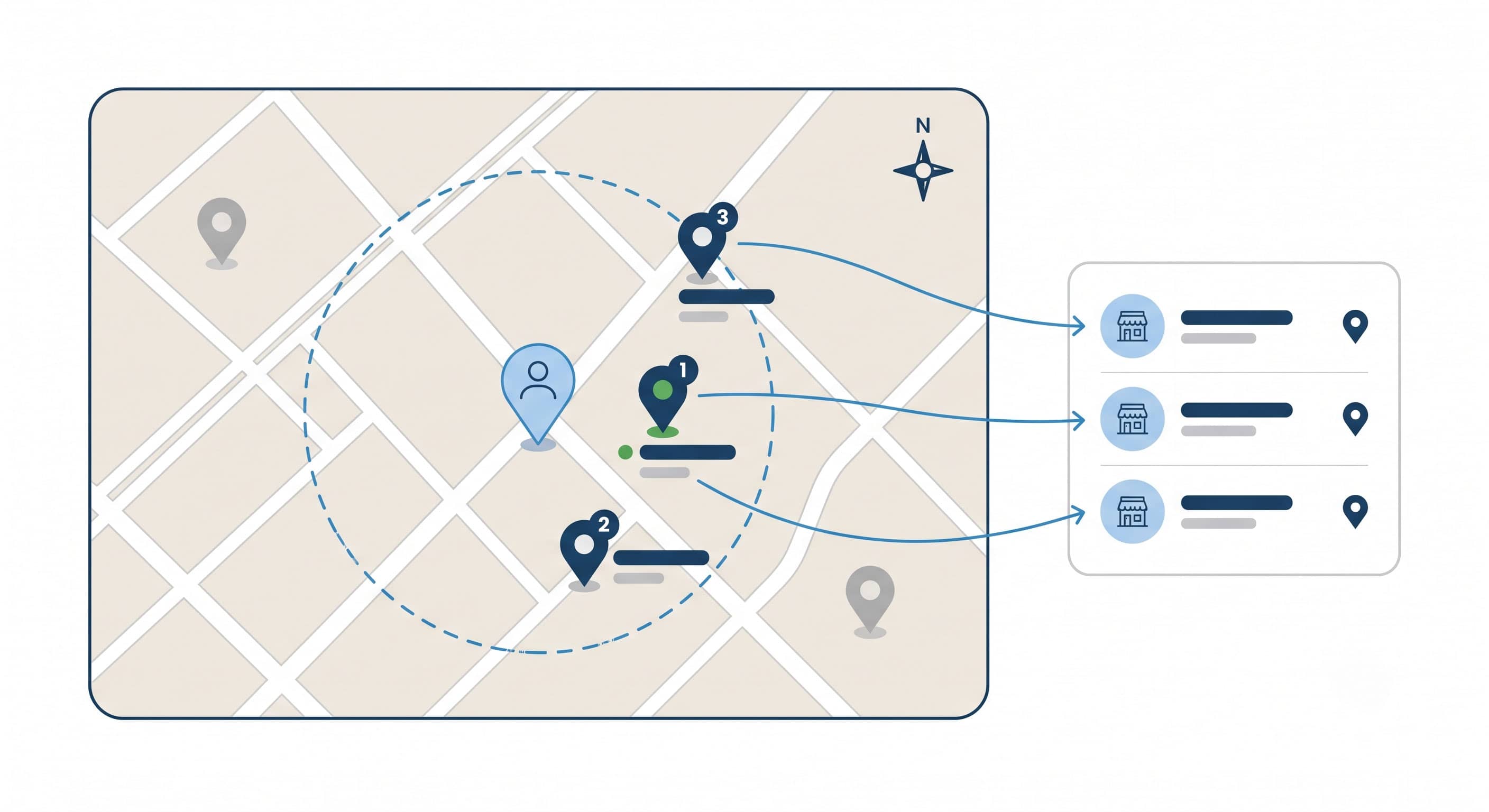
Proximity is the distance between the searcher and your verified business address — not your service area shape. Service areas tell Google where you operate. They do not tell Google to rank you for searches from inside the service area. Google ranks who is closest to the person searching. This is the part agencies won’t say out loud.
Prominence is everything Google has decided about how legitimate and active your business is across the web. Reviews. Owner responses. Recent photos. Citations on directories that Google trusts. A real website that loads. Schema markup. Whether anyone is actually clicking and calling.
These three are weighted differently depending on the query. Emergency-mode queries — “plumber now,” “AC not working” — lean almost entirely on proximity. Considered queries — “best electrician in Whittier” — lean more on prominence.
Proximity is the hard truth
An HVAC owner on the eastern side of Whittier searched his own service from the western edge of town and didn’t see himself in the pack. He saw the company over in La Habra Heights. He thought his SEO was broken.
His SEO wasn’t broken. The map pack was working exactly as Google designed it. The other company was closer to where the search happened, so it ranked higher for that location. The owner’s profile would have ranked first from his own driveway.
This breaks intuition for trades. You don’t rank “in Whittier.” You rank within a soft radius of your verified address. That radius stretches when your prominence is high and shrinks when it isn’t.
Two consequences for a home-service business:
One verified location can’t cover an entire trade area at top rank. If you want to land in the pack for searches happening seven miles from your address, you need either a second verified location (a real one, not a virtual office — Google catches those and suspends profiles), or prominence strong enough to stretch your radius.
You can’t out-keyword someone closer with fresher reviews. Cramming “plumber Whittier plumber” into your GBP description does nothing for proximity, and Google has been ignoring keyword-stuffed descriptions for a decade. The closer business with a recent review will beat keyword soup every time.
The SGV makes this especially competitive. Alhambra, Monterey Park, San Gabriel, and Rosemead all sit inside a six-mile box. A homeowner in Alhambra searching “plumber” can be inside the proximity radius of profiles based in three or four different cities at once. The business that wins the click is the one with the best combination of nearness and prominence at the exact moment of the search.
Where you actually have control: reviews and recency
You can’t move your business address (well — you can, but that’s a bigger conversation). You CAN move prominence. Specifically: reviews and how recent they are.
Across the audits we’ve run for HVAC, plumbing, and electrical companies in Alhambra, Whittier, Pasadena, and Rosemead, the pattern is the same. The profiles in the pack are getting reviews regularly. The profiles below the pack often have plenty of reviews — sometimes more total than the pack winners — but the most recent one is months old.
Google reads review recency as a freshness signal. A profile with a review from this month outranks a 200-review profile whose last review was eight months ago, all else equal. The math that matters: getting one real review every two weeks for six months is worth more in the pack than getting fifty reviews in a single push.
Three rules for review work that won’t get you in trouble:
Ask every job. Not every other. Not “when it feels right.” Every job, by text, with a direct Google review link. If you do twelve jobs a week and ask all twelve, you’ll get three or four. That’s the velocity you need.
Reply to every review. Five-star reviews get a one-sentence thank-you with the customer’s first name. Three-star reviews get a real reply that addresses what they said. One-star reviews get a calm, specific response — never an argument — and an offer to make it right offline. Owner responses are a signal Google reads.
Don’t buy review packages. Ever. Google’s spam detection catches velocity spikes and reviewer-location mismatches, and the penalty is profile-level. Months of legitimate work erased in a week.
This is the part of Local SEO we spend the most time on with home-service clients — not because reviews are the only lever, but because they’re the one with the highest ratio of effort to result.
The AI Overview is now sitting on top of the map pack
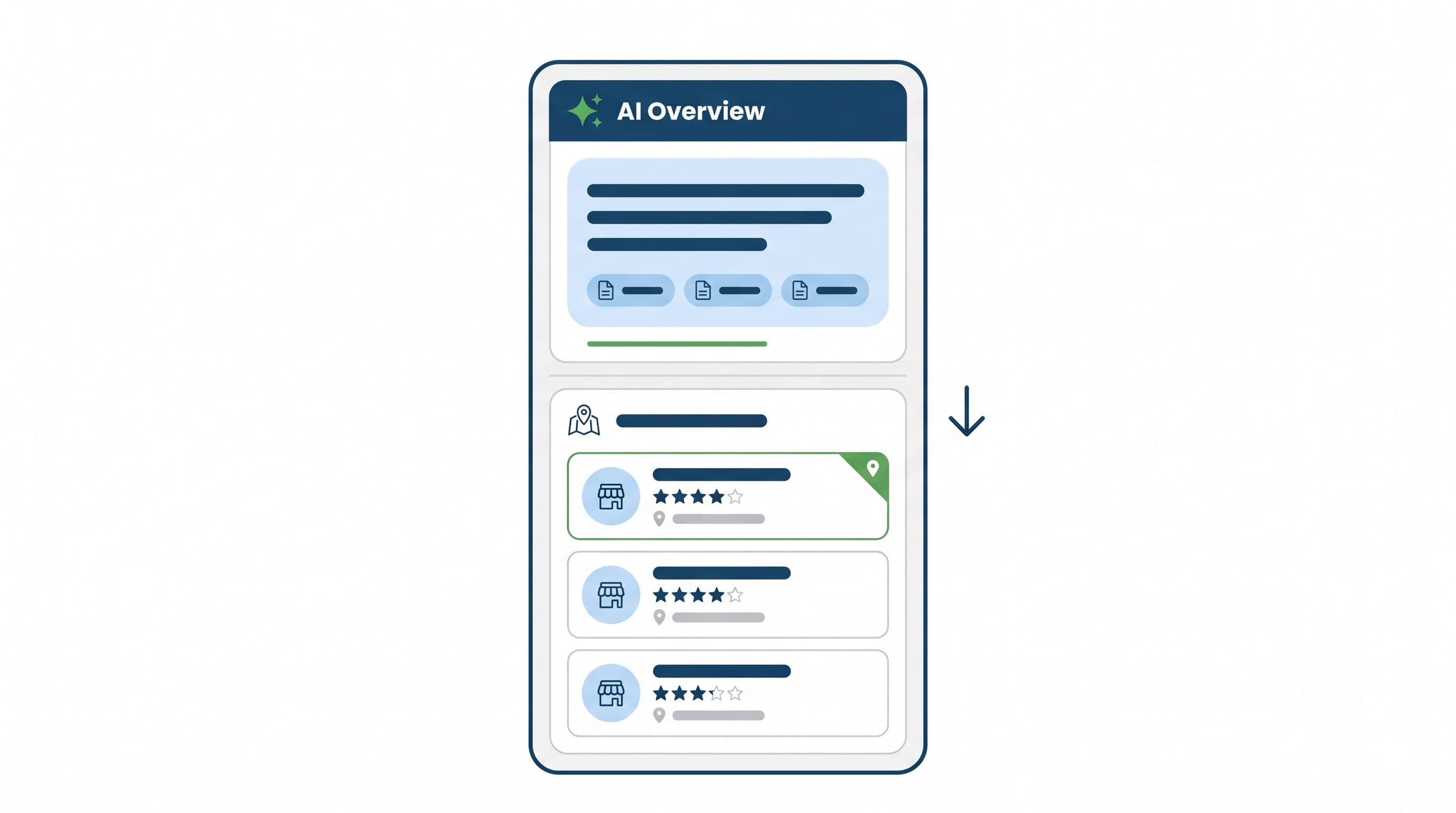
When someone in Pasadena asks ChatGPT for “a good plumber near me,” or when Google’s AI Overview answers a search for “best HVAC company in Alhambra,” the AI is pulling from the same signals that drive the map pack: GBP completeness, review velocity, citation consistency, schema, and a real website that loads. The AI answer often appears above the map pack now. For some queries it replaces it entirely.
Two things to understand:
AI surfacing is downstream of map pack work. There is no separate “AI SEO” package to buy. The profiles that win in AI Overviews and ChatGPT answers are the ones that have already been doing the boring fundamentals — fresh reviews, consistent NAP, a fast website that says what they do. Agencies selling “AI SEO” as a new product line are repackaging the work that wins the map pack.
The map pack is the second answer now. For “best electrician in Pasadena,” the AI answer appears first. The map pack appears second. For “electrician near me right now,” the map pack still leads because Google defers to proximity for emergency queries. Track both.
What to do this week
Forget the long roadmap. Three actions, Monday morning:
Audit your own GBP from a fresh phone. Open Google Maps from a phone that isn’t signed into your business account. Search the query that should bring you up. Note the three businesses in the pack. Search again from your shop location. Search a third time from a customer’s neighborhood. The gap between those three results is your real proximity range. Our free Local Rank Checker gives you the first of those three in seconds — your live Maps position for the searches that book jobs in your city.
Text your last five customers and ask for a review. Use a direct review link, not “leave us a review on Google.” Send it now. Half won’t reply. The other half will get it done in the next 48 hours and your review recency clock resets.
Reply to every unreplied review you’ve got. Today. Even ones from two years ago. Owner-response rate is a profile-level signal Google reads — it gets stronger when you bring an inactive profile back to life.
If you do those three things and nothing else for six weeks, you’ll move in the pack. We’ve watched it happen with the home-service businesses we work with across the SGV.
How City Boost helps
We run Local SEO for HVAC, plumbing, electrical, roofing, and other home-service businesses in Alhambra, Whittier, Pasadena, and the rest of the SGV. The work is the boring stuff: monthly review velocity, owner-response cadence, GBP setup for your actual primary category, citation cleanup, and a website that loads fast enough to support all of it. No “AI SEO” packages, no keyword-stuffed descriptions, no review buying. Just the parts of the map pack you can actually move.