

TL;DR
Why does AI skip my business even though my profile is up and my rating is fine?
Because your data disagrees with itself. When your hours, phone number, or service area differ across Google, Facebook, and your own website, AI reads the mismatch as unreliability and leaves you out of its answers. Make every listing say exactly the same thing and you remove the reason you're being skipped.
You haven’t changed anything. Your Google Business Profile is up. You’re getting reviews. You show up on the map — sometimes. But when someone asks Google’s AI for a roofer, a pest control company, or a plumber in your city, your name isn’t in the answer.
The agency you called said you need more backlinks. The other one said you need blog posts.
Neither of them asked whether your business address on Facebook matches your Google Business Profile. Neither of them checked whether your listed service area on your website matches what’s in your GBP. Neither of them noticed that your hours say “Open 24/7” on Yelp and “Mon–Fri 7am–5pm” on Google.
That’s the real problem. And it’s costing you calls.
The myth: AI skips you because your SEO is weak
Here’s what most people assume: if AI isn’t recommending you, you need more keywords, more content, more backlinks. Fix the SEO, fix the visibility.
That’s backwards for most home-service businesses.
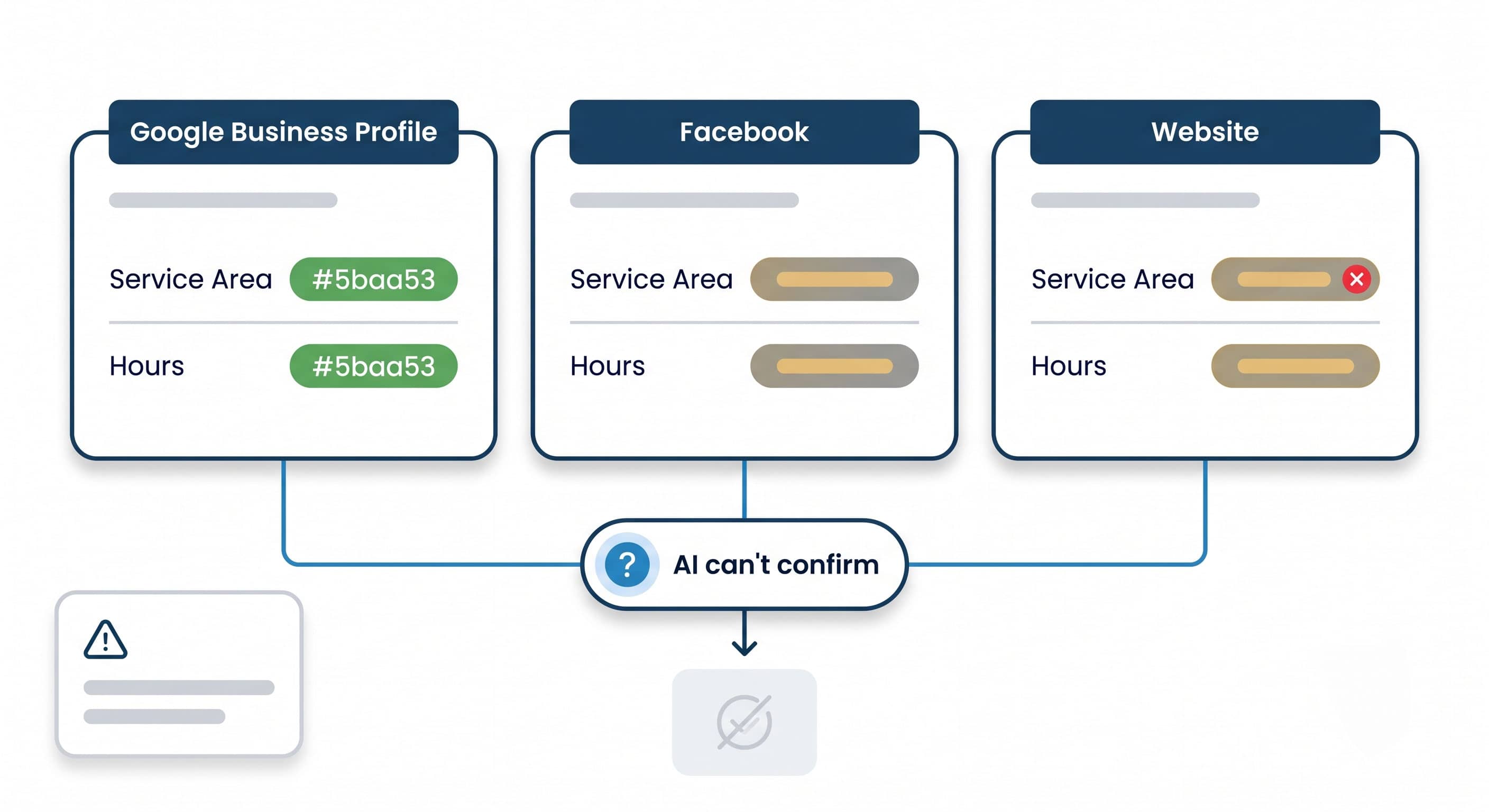
Language models — including the AI layer inside Google Maps and Google Search — don’t just read your website. They pull from your Google Business Profile, your reviews, third-party directories, your Facebook page, your Yelp listing, and whatever else they can find about you. When those sources agree, the AI builds a confident picture of your business. When they contradict each other, the AI does the rational thing: it hedges. It surfaces someone else instead.
Your business doesn’t get penalized. It just gets passed over. Quietly. Every time.
What we actually found in Pico Rivera
We ran a cohort audit on pest control businesses competing for Pico Rivera searches. Eighteen profiles were in the competitive set. When we asked Google’s Maps-grounded AI for the best-rated pest control in Pico Rivera, only four of those eighteen were surfaced.
Fourteen businesses — with real trucks, real customers, real reviews — got nothing.
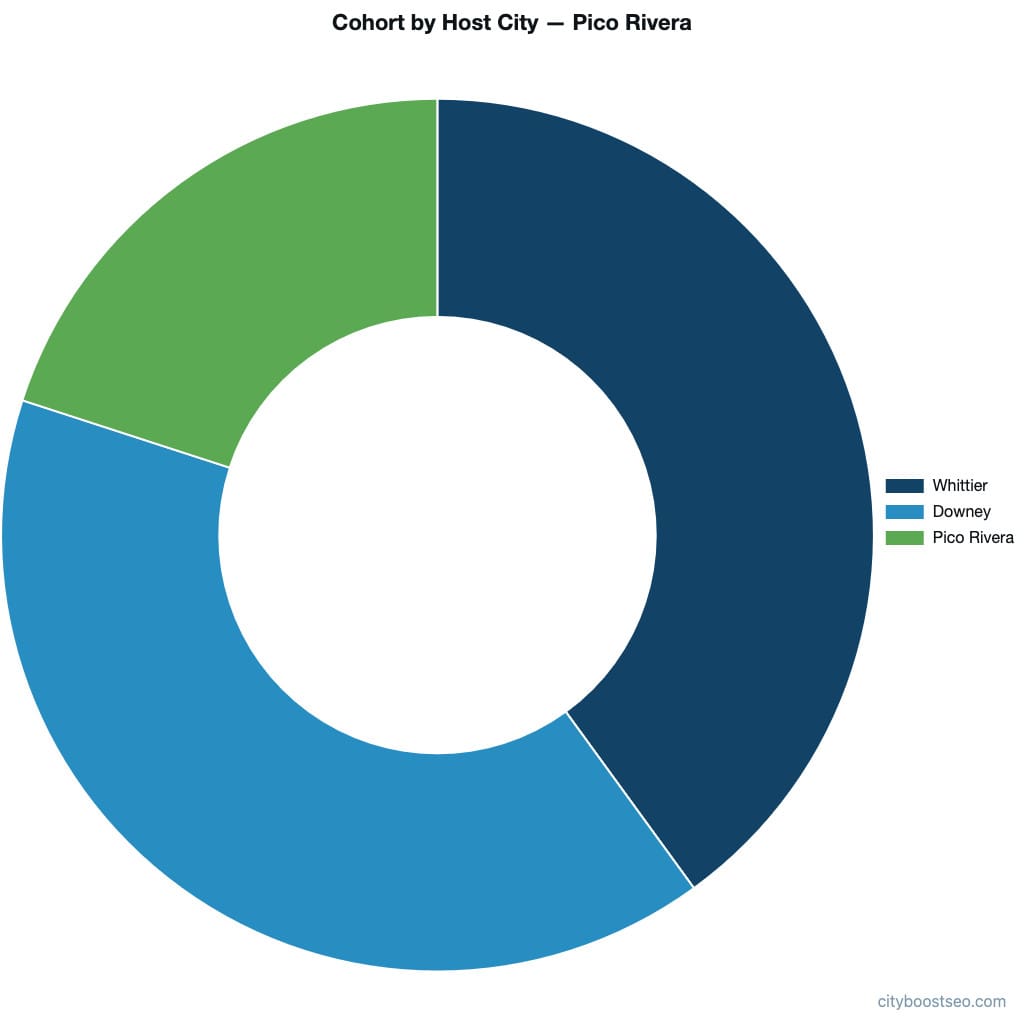
Here’s what makes the Pico Rivera market worth paying attention to: only 2 of the 18 profiles in this cohort are actually based in Pico Rivera. The rest are serving from neighboring cities. The top host cities in this cohort are Whittier (4 businesses) and Downey (4 businesses), with Pico Rivera itself accounting for just 2. The cohort density is 0.23 profiles per square kilometer within 5km of Pico Rivera — a tight, competitive zone where most of the players are outsiders trying to reach in. For comparison, a typical suburban SGV market runs 0.10–0.15 — so Pico Rivera is roughly twice as crowded per square kilometer
That matters for data consistency. When a business based in Whittier lists Pico Rivera as a service area on Google but doesn’t mention it on their website, or lists a Whittier address on Yelp but a Pico Rivera address on Facebook — the AI sees a business that can’t get its own story straight. And in a market where 16 of 18 competitors are already working from outside the city, any signal confusion makes you easier to skip.
The Profile A vs. Profile B problem
Here’s the finding that should bother you.
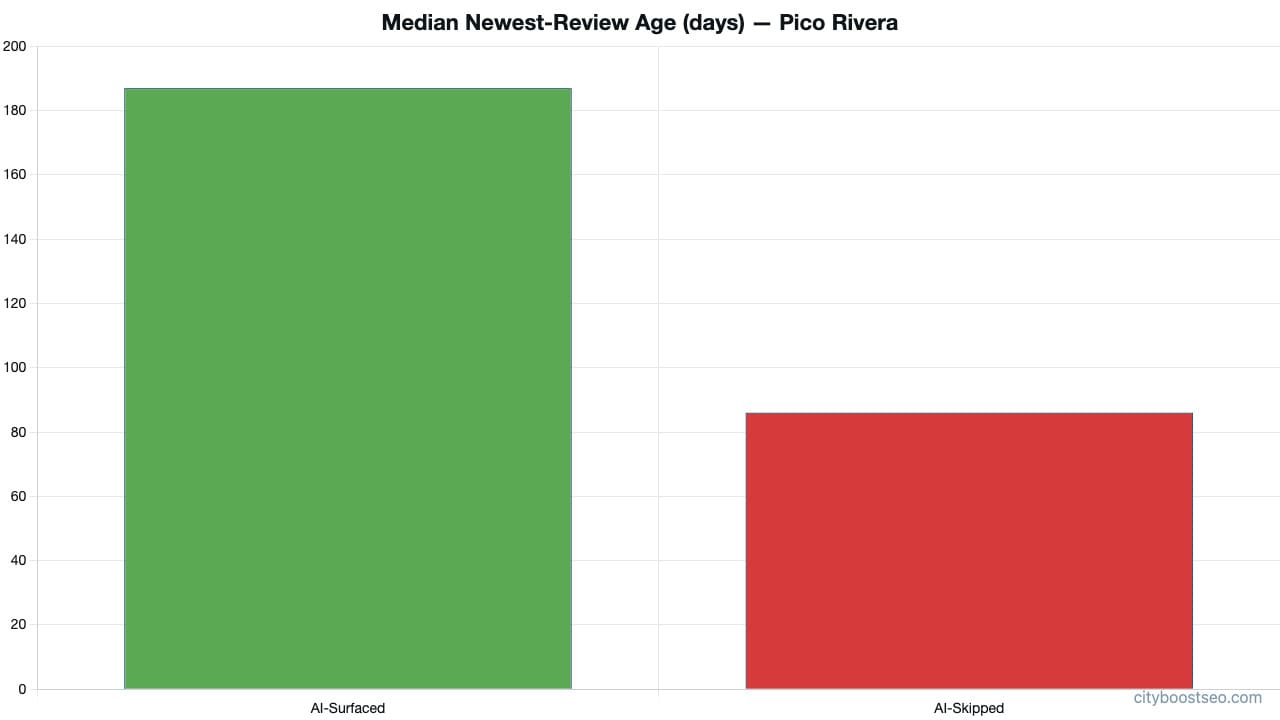
Profile A — surfaced by Google’s AI — has 35 reviews. Its newest review is 339 days old. It’s based in Whittier, not Pico Rivera.
Profile B — skipped — has 80 reviews. Its newest review is 111 days ago. It’s based in Commerce.
Profile B has more than twice the reviews and a fresher review signal. It still didn’t make the cut.
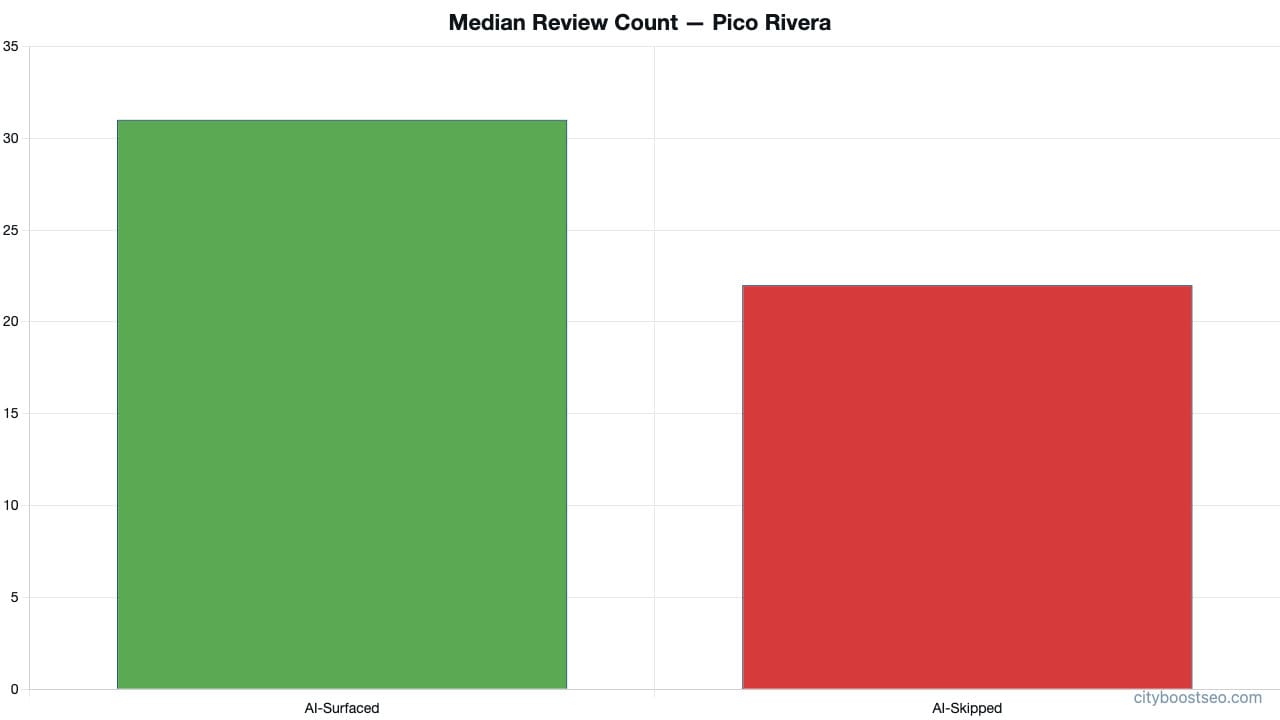
The difference isn’t review count. The surfaced profiles in this cohort had a median of 31 reviews; the skipped profiles had a median of 22. More reviews helped, but they weren’t the deciding factor. Profile B had 80 and still got passed over.
We can’t pull Profile B’s cross-platform data from the outside — but that’s exactly the audit we’d run. The pattern is consistent with signal confusion, not review weakness.
Where the inconsistencies actually live
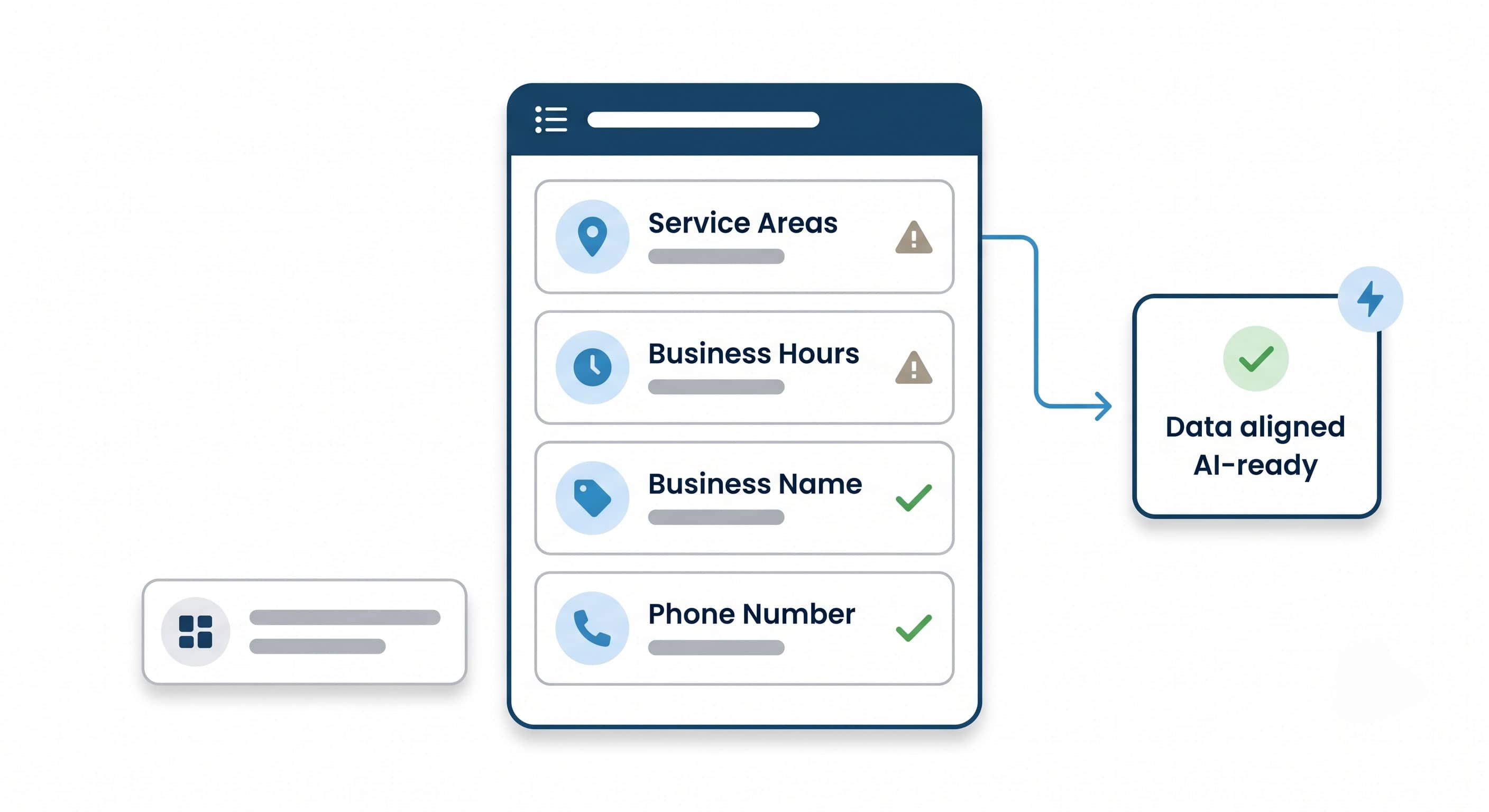
For most home-service businesses in the SGV, the data problems cluster in four places:
1. Service area listings. Your GBP service area says you cover Pico Rivera, Downey, and Whittier. Your website footer says “Serving the Greater LA Area.” Your Facebook page says nothing. The AI has three different answers to “do they serve Pico Rivera?” and no clean way to reconcile them.
2. Business hours. You updated your GBP hours when you changed your schedule, but Yelp still has the old ones. A language model pulling from multiple sources sees a conflict and can’t confirm your availability.
3. Business name variations. [Your Business Name],’ ‘[Your Business Name] LLC,’ and ‘[Your Business Name] & Termite are three different businesses to a language model. Pick one name and use it everywhere, exactly.
4. Phone numbers. If you’ve ever used a tracking number on one platform and your real number on another, you’ve introduced a conflict. Call-tracking tools are fine — but the primary number needs to be consistent.
None of these are SEO problems in the traditional sense. There’s no keyword to fix. There’s no page to optimize. It’s operational data, and it either lines up or it doesn’t.
The rating floor is already set — don’t let bad data drag you below it
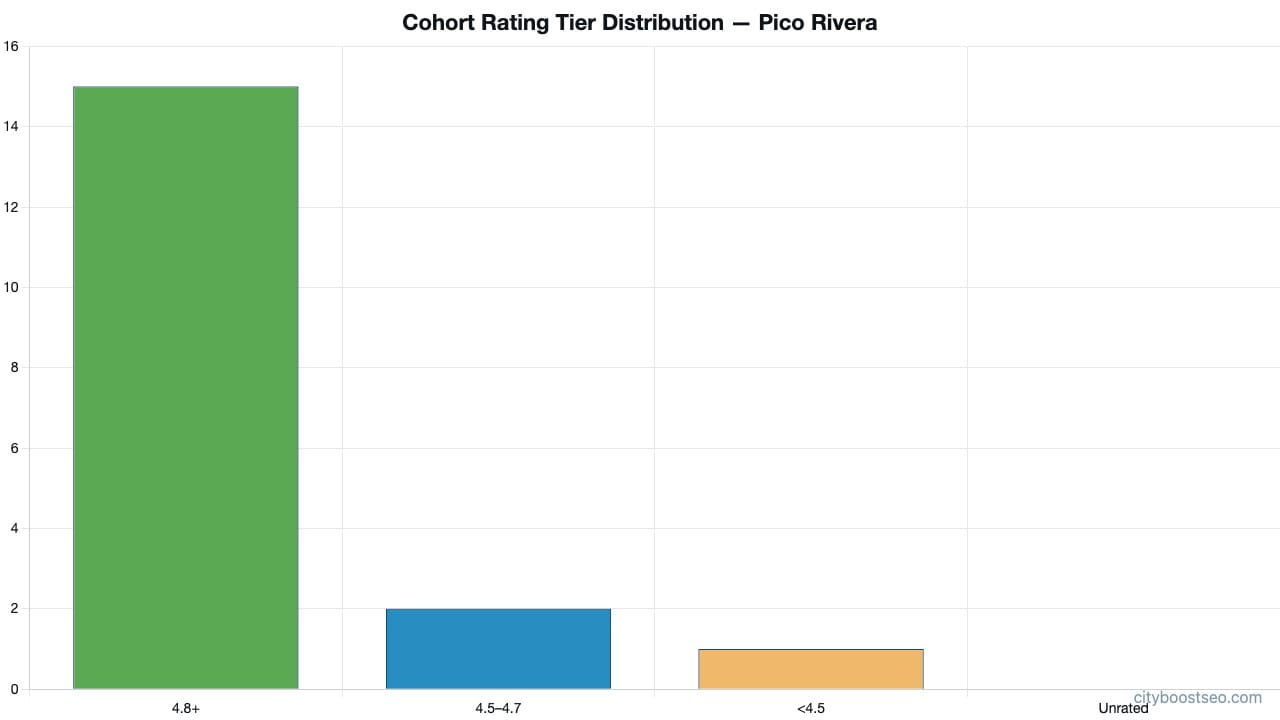
One more thing from the Pico Rivera cohort: 15 of the 18 profiles are rated 4.8 or higher. Two are in the 4.5–4.7 range. One is below 4.5. Nobody is unrated.
That means ratings aren’t a differentiator in this market — they’re a floor. Everyone competing seriously already has a strong rating. If your data inconsistencies make the AI uncertain about you, a 4.9 rating won’t save you. The AI will surface a 4.8 competitor whose data is clean over a 4.9 competitor whose service area listing is a mess. The four profiles Google’s AI surfaced were all in the 4.8+ tier — but so were eight of the fourteen that got nothing. Stars got you in the room; data consistency decided who got the call.
You’re not competing on stars anymore. You’re competing on clarity.
What to do Monday morning
Pick one platform and audit your business listing against your GBP. Start with Facebook — it’s where the most inconsistencies hide because nobody updates it after the initial setup.
Check three things: your service cities (do they match GBP exactly?), your hours (do they match GBP exactly?), and your business name (is it character-for-character identical?).
Fix what’s wrong. Then do Yelp. Then your website footer and contact page.
Before you start comparing listings by hand, run our free AI Search Readiness Score. It checks your Google profile, your schema, your reviews, and whether AI crawlers can reach your site at all, and lists the fixes in order.
This isn’t glamorous work. But it’s the work that makes the AI’s job easy — and when the AI’s job is easy, it picks you.
We do this kind of cross-platform data audit as part of our Local SEO work across the SGV. If you want someone to run the full cross-platform audit for you — every platform, every conflict, a clean fix list — that’s the Local SEO work we do across the SGV.