
AI Overviews Are Citing Local Electricians — Here’s Why Yours Gets Skipped
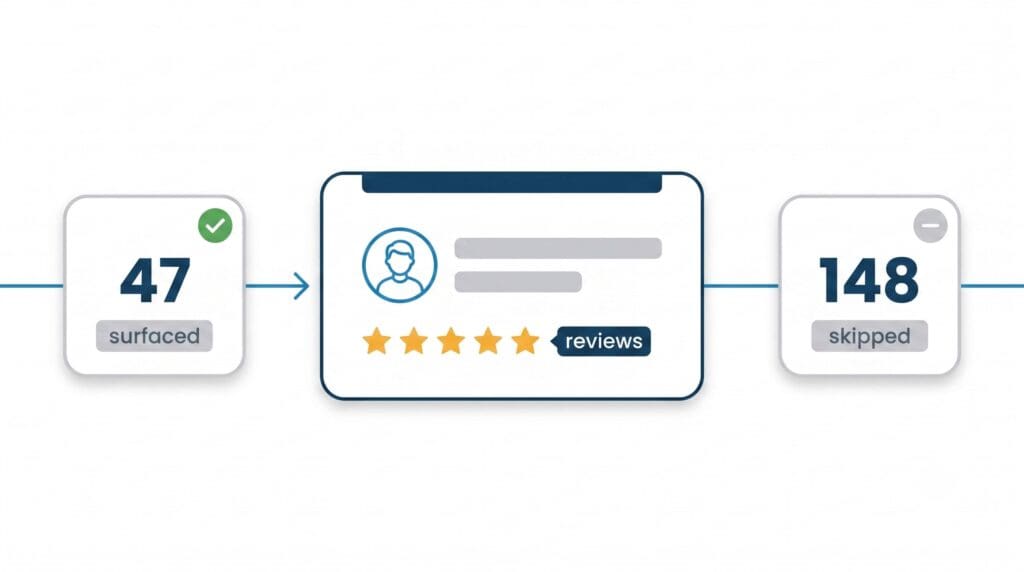
Google's AI is already picking which electricians, plumbers, and HVAC contractors to recommend in Whittier. Of 20 profiles we tracked, only 6 got cited — and the gap wasn't keywords. It was review recency.
Your phone rings when someone searches “electrician near me” and you show up.
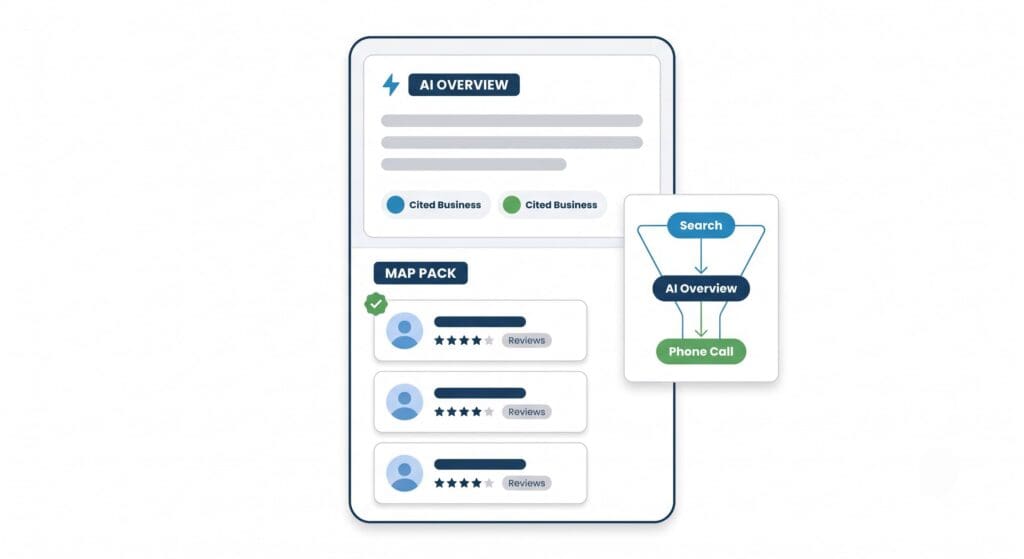
Google’s AI Overviews — the paragraph of recommendations that now appears above the regular search results — are quietly deciding which contractors get named and which get buried. If you’re in Whittier, Pasadena, Downey, or Long Beach and you haven’t thought about this yet, here’s what’s actually happening.
What we actually tested
We ran a Maps-grounded AI query — “best-rated electrician in Whittier” — and tracked which of the 20 profiles in the result cohort got cited and which got passed over.
The cohort: 20 electrician profiles competing for that search. Six got surfaced. Fourteen got nothing.
The question everyone asks is: what’s the difference? Keywords? Website quality? Years in business?
None of those. Here’s what the numbers actually show.
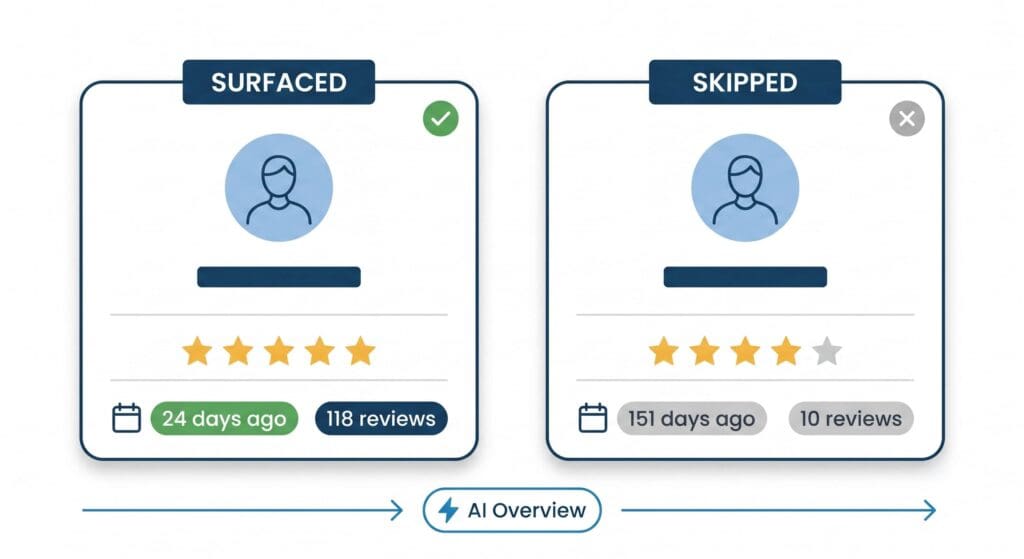
Review recency is the sharpest dividing line. The median newest review among the six surfaced profiles was 24 days old. The median newest review among the fourteen skipped profiles was 151 days old. That’s not a small gap — that’s the difference between a business that looks active and a business that looks like it might have closed.
Review count is the second signal. Surfaced profiles had a median of 118 reviews. Skipped profiles had a median of 10. One of those numbers says “established, trusted, people keep using them.” The other says “maybe they’re new, maybe they’re not that good.”
Here’s the example that makes it concrete. Profile A (business names withheld from publication) got surfaced: 34 reviews, newest one 25 days ago, hours set, based in Whittier. Profile B got skipped: 50 reviews, newest one 195 days ago, hours set, based in La Habra. Profile B had more reviews and still lost. Why? Because those reviews had gone cold. Google’s AI reads a 195-day gap the same way a customer does — it wonders what happened.
The Whittier market is tighter than it looks
Here’s something specific to this particular search area that matters for how you think about competition.
Of the 20 profiles in this cohort, 17 are physically based in Whittier itself. One is in Pico Rivera. One is in La Mirada. The density of the competitive field — measured as profiles per square kilometer within five kilometers of Whittier — is 0.25, which works out to roughly one serious competitor per four square kilometers of service area.
That’s a relatively concentrated market. You’re not competing against a sprawling field of out-of-area operators trying to serve-area their way in. Most of your competition is local, and most of them are real businesses with real trucks. The separation isn’t going to come from proximity — almost everyone in the top 20 is already close. It comes from who looks most active and most trusted right now.
The rating picture reinforces this: 14 of the 20 profiles in this cohort are rated 4.8 or above. Three sit between 4.5 and 4.7. Only one is below 4.5. If your rating is under 4.5, that’s the first thing to fix. But if you’re already at 4.8 — which most of the serious players in Whittier are — the rating itself is table stakes. Review recency is where the game is actually being played.
The fake-citation trap (and why it backfires)
Some agencies have started selling something like this: “We’ll get you mentioned in Reddit threads and forum posts so Google’s AI cites you.” The pitch sounds clever because AI Overviews do pull from Reddit and community forums.
Don’t buy it.
Google’s spam enforcement has extended into AI answers. Manufactured citations — fake Reddit posts, planted forum mentions, paid “community” discussions — are getting filtered the same way Google filtered paid links back when link farms were the move. The pattern is identical: a shortcut works briefly, agencies productize it, Google catches up, the businesses that paid for it get penalized, and the agencies move on to the next shortcut.
The businesses that survive every Google update are the ones who built signals that can’t be faked at scale: real customers leaving real reviews on a real Google Business Profile (GBP), consistently, over time. That’s not a hack. It’s not exciting to sell. But it’s the only thing that compounds.
What actually earns AI citations for a local contractor
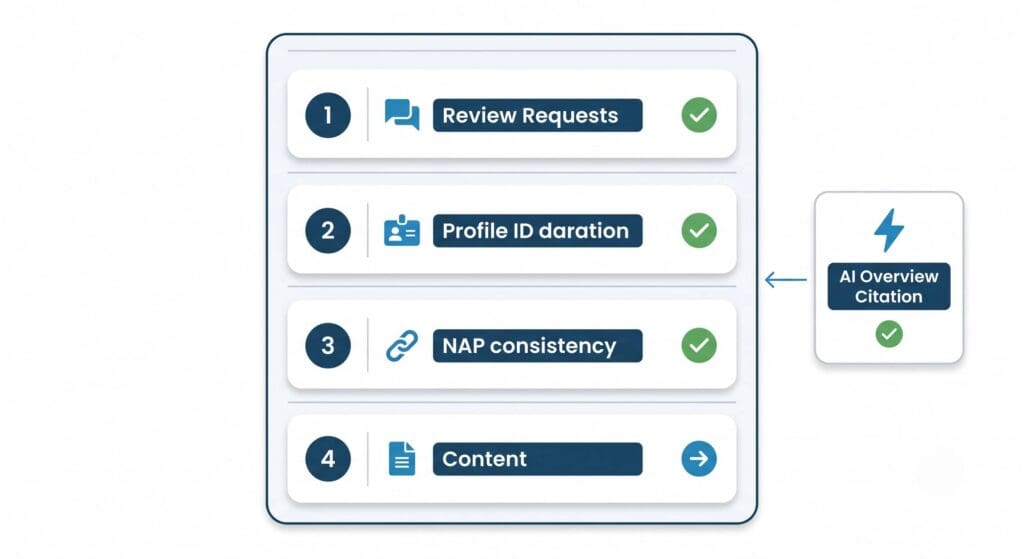
Google’s AI is pulling from the same signals your GBP has always sent — it’s just weighing them differently now. Based on what we saw in the Whittier cohort, here’s what moves the needle:
1. Review velocity, not just review count. Getting 50 reviews two years ago and then going quiet is worse than having 34 reviews with one posted last month. The AI is reading recency as a proxy for whether you’re still operating and still satisfying customers. A simple system — text your customer after every job, one tap to leave a review — is worth more than any citation-building campaign.
2. A complete, accurate GBP. Hours set. Service areas defined. Photos updated. Business description written in plain language that matches how customers describe what they need. This isn’t new advice, but the AI now reads your profile as structured data, not just a listing. Gaps in your profile are gaps in the AI’s confidence about your business.
3. Consistency across the web. Your business name, address, and phone number should match exactly on your GBP, your website, Yelp, and anywhere else you appear. The AI is cross-referencing. Inconsistencies read as noise, and noise gets filtered out.
4. Real content that answers real questions. Not four blog posts a week. One page that genuinely explains what you do, where you do it, and what a customer can expect. “Electrical panel upgrades in Whittier — what to expect, what it costs, how long it takes.” That’s the kind of content that earns a citation because it’s actually useful, not because it was optimized.
The myth the agencies are selling right now
“You need an AI SEO strategy.”
Maybe you’ve heard this pitch. It usually involves a new package with “AI” in the name, a deck full of screenshots of ChatGPT results, and a monthly retainer that costs more than your last truck payment.
Here’s what’s actually true: the signals that earn you an AI Overview citation are the same signals that have always determined whether you show up in local search. Review recency. Profile completeness. Consistent business information. Real content. The AI reads the same web Google’s regular algorithm has always read — it just synthesizes it differently.
You don’t need a new playbook. You need to execute the existing one consistently.
That’s not a popular thing for agencies to say, because “keep doing the fundamentals” doesn’t sell a $2,000/month AI package. But it’s what we see every time we run these cohort audits in this market.
The businesses getting cited are the ones with fresh reviews, complete profiles, and real content. Every single time.
What to do Monday morning
Pull up your Google Business Profile right now and check the date on your most recent review. If it’s more than 30 days ago, that’s your first problem — and it’s fixable this week.
Text the last three customers you completed work for. Ask them directly: “Would you mind leaving us a quick Google review? It really helps.” Most will. One message, three texts, potentially three new reviews. That moves your recency number immediately.
That’s it. That’s the Monday action. Not a new package. Not a Reddit post. Three texts.
If you want to understand where your GBP stands against the rest of the field in your city — and what specifically is costing you citations — our Local SEO work starts with exactly that audit.
How City Boost helps
We run cohort audits like the one above for HVAC, plumbing, electrical, and roofing contractors across the San Gabriel Valley and Southeast LA — pulling the real competitive data for your specific city and trade, not a generic report. Our Local SEO work focuses on the signals that actually move your GBP into AI Overviews and map packs: review systems, profile completeness, and content that earns citations because it’s genuinely useful. If you want to know exactly where you stand in your market, start there.
Sources

// where we help
Get cited when AI answers 'best electrician'
The cohort we audited split on review signals. Here's where we help you land on the right side.
Local SEO
The review velocity and profile signals that decide who AI Overviews cite.
Electrical
Local SEO for electricians built around how customers search for the work you do.
Whittier
Featured in this audit — see how we help Whittier trades get surfaced.
// stay sharp
Keep Reading
All Posts →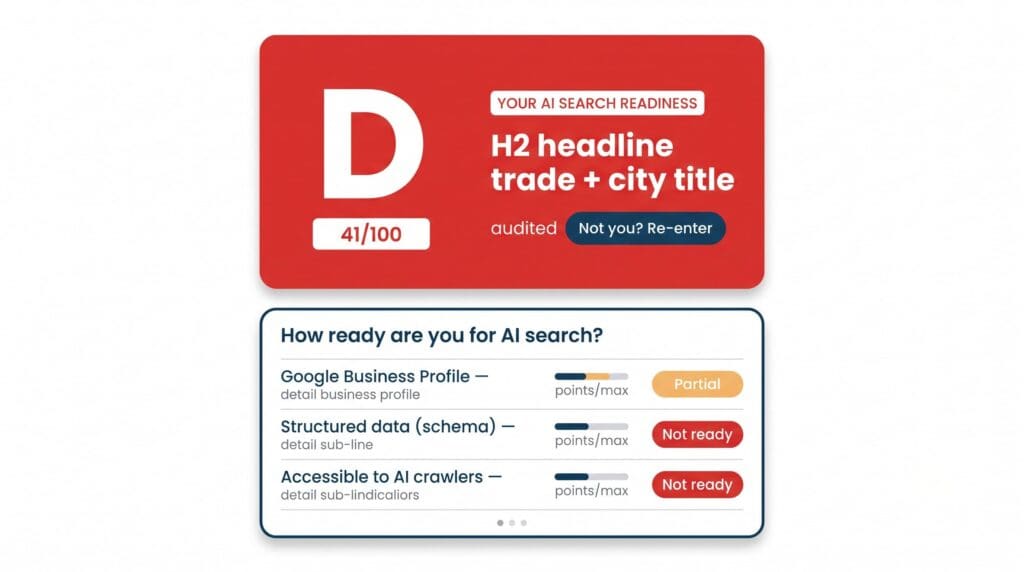

See where you rank today.
Get a free audit and we'll show you exactly where your business stands in the local map pack — and how to climb.