
The $15,000 Leak: Why Your Glendale Plumbing Leads Are Disappearing Before You Call Them Back
A Glendale plumbing company getting 50 leads a month from Google Local Services Ads and converting only 20% isn't a marketing problem — it's a follow-up problem. Here's what that costs you and how to fix it.
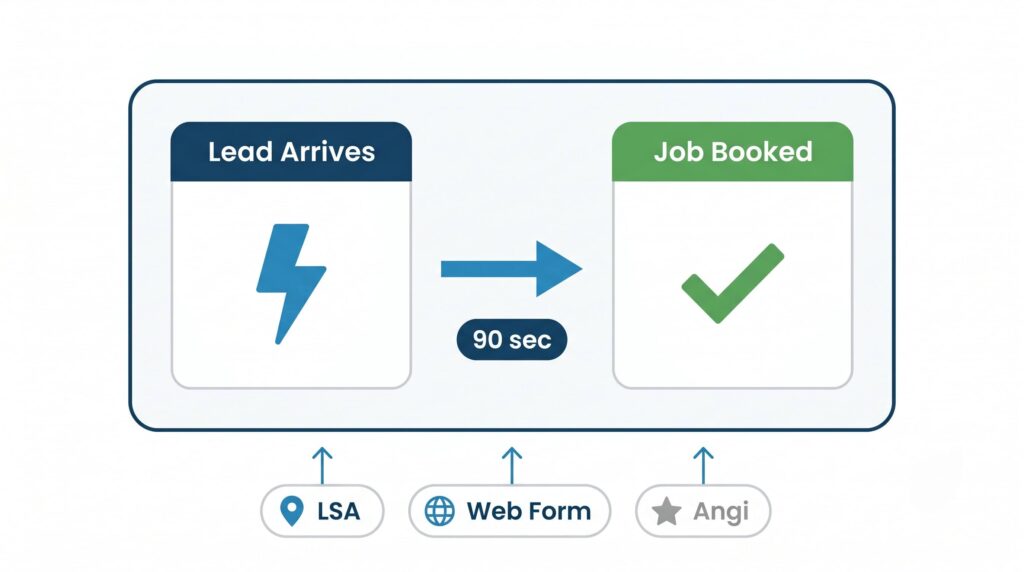
You’re paying for leads. Google Local Services Ads, maybe Angi or Thumbtack on the side. The phone rings, a form submission lands, a request comes in. And then — nothing happens fast enough, and the job goes to someone else.
This is not a marketing problem. You don’t need more leads. You need to stop losing the ones you already bought.
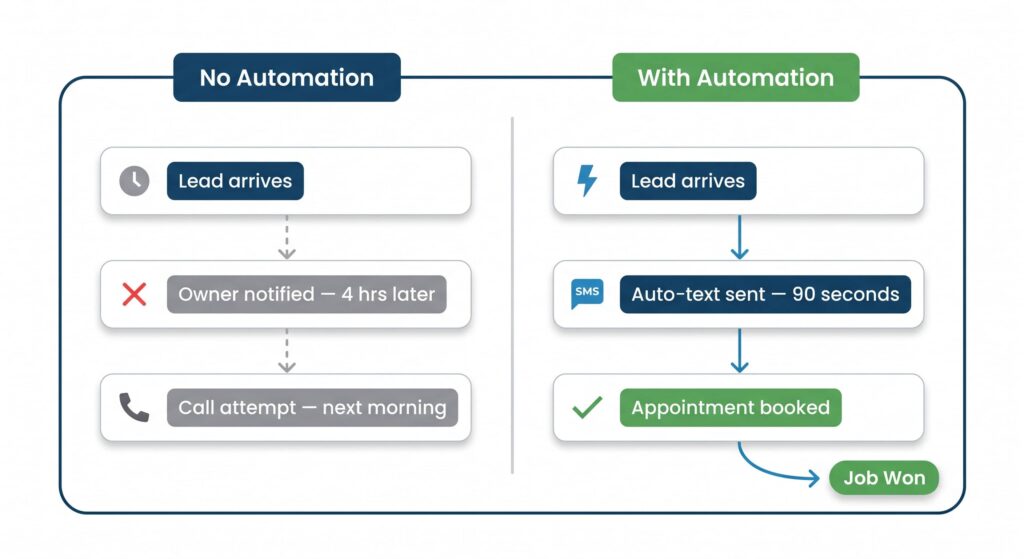
The math on a Glendale plumbing company
Take a plumbing operation in Glendale running Google Local Services Ads. Fifty leads a month is realistic for a well-set-up profile in a market that dense. At an average ticket of maybe $500 for a service call — and plumbing skews higher once you’re diagnosing anything real — that’s $25,000 in potential monthly revenue sitting in the pipeline.
If you’re converting 20% of those leads, you’re booking 10 jobs and leaving 40 on the table. And LSA bills per lead, not per click — in a competitive LA-area plumbing market, typically $70 to $120+ apiece — so you paid for all 50, including the 40 that went nowhere. Some of those 40 were never serious. But a meaningful chunk of them — call it a third — were ready to hire someone. They just hired whoever called them back first.
That’s roughly 13 recoverable jobs a month. At $500 average, you’re looking at $6,500 a month in revenue that walked out the door. Over a year, that’s north of $75,000. Even if your average ticket is lower and your recovery rate is more conservative, you’re still looking at $15,000 to $20,000 a year in jobs you already generated the lead for and didn’t close.
The lead cost was already paid. The truck was already available. The only thing that failed was the follow-up.
Why follow-ups slip
You’re running a crew. You’re on a job in La Cañada at 2pm when three form submissions come in from your website. You don’t see them until 6pm. By then, two of those homeowners have already booked someone else.
This is not a discipline problem. It’s a systems problem.
The most common failure points look like this:
Leads come in through multiple channels with no single inbox. Google Local Services Ads has its own message thread. Your website form sends an email. Angi sends a text. Thumbtack sends a notification. None of them talk to each other, and you’re checking four different places when you have time — which is rarely immediately.
There’s no automatic first response. The homeowner submitted a form at 9pm on a Tuesday. You’re not calling anyone at 9pm. But the homeowner in Burbank who submitted at the same time got an auto-text from a competitor within two minutes saying “Got your request — we’ll call you first thing tomorrow to confirm.” That competitor just won the job before you even knew the lead existed.
Follow-up sequences aren’t written down anywhere. Your office manager tries to call once. If there’s no answer, the lead sits. Nobody sends a follow-up text the next day. Nobody sends a second call attempt 48 hours later. The lead just ages out.
There’s no CRM, so nothing is tracked. You can’t improve what you’re not measuring. If you don’t know your contact rate, your conversion rate, or your average time-to-first-response, you’re flying blind on one of the most important numbers in your business.
What the window actually looks like
Speed matters more in the trades than in almost any other service category. The reason is urgency.
When someone searches for an emergency plumber in Glendale at 11pm, they are not comparison shopping. They have water coming through a ceiling or a toilet that won’t flush with guests in the house. They will hire the first person who responds and sounds competent.
Even for non-emergency work — a water heater replacement, a drain cleaning, a fixture install — the homeowner’s motivation peaks at the moment they submit the request. That motivation decays fast. The longer you wait, the more likely they’ve either found someone else, talked themselves out of spending the money, or simply forgotten they submitted the request.
A response within five minutes dramatically outperforms a response within an hour. A response within an hour outperforms a response the next morning. These aren’t small differences in conversion — they’re the difference between a 20% close rate and something closer to 40%. A lot of that gap comes down to contact rate: studies on speed-to-lead — the InsideSales.com research is the most-cited — put the difference at 100x between a 5-minute and a 30-minute response. You can’t close a lead you never reach, and the odds of reaching one drop off sharply inside the first half hour.
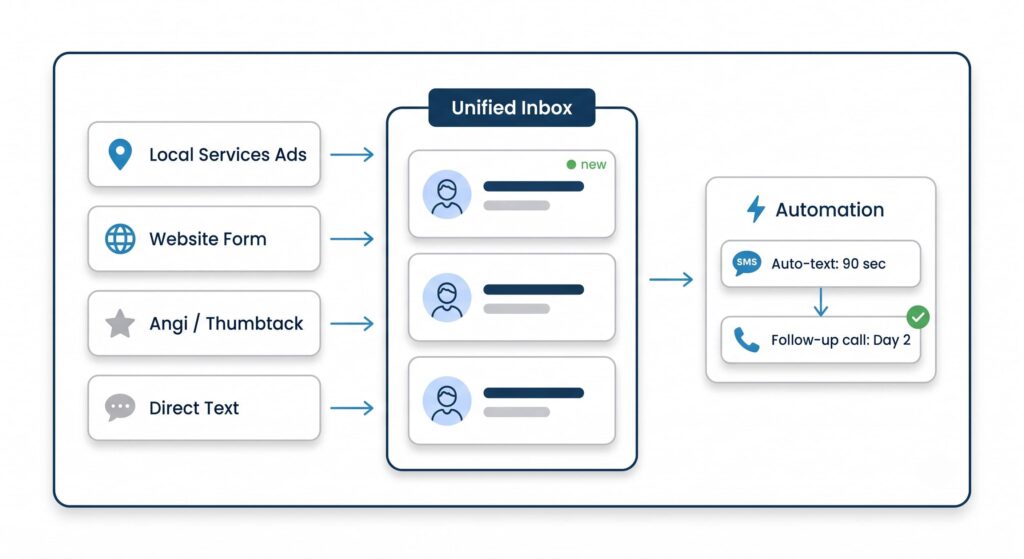
What an automated follow-up system actually looks like
This isn’t complicated. You don’t need a developer. The tools exist and they work.
The core setup has three parts:
1. One inbox for all your leads. Tools like CityBoost’s CRM pull your Google Local Services Ads messages, your website form submissions, your Angi and Thumbtack leads, and your direct texts into one place. Your office manager — or you — looks at one screen. Nothing falls through because you forgot to check the Angi app.
2. An automatic first-touch message. The moment a lead comes in, an auto-text goes out. Not a robotic wall of text — a short, human-sounding message. Something like: “Hey, this is [Your Name] from [Company]. Got your request — we’ll give you a call in the next few hours to go over the details. If it’s urgent, call us direct at [number].” That message does two things: it tells the homeowner you’re real and responsive, and it captures their attention before they submit a request to the next company on the list.
3. A follow-up sequence that runs automatically. If they don’t respond or you don’t reach them on the first call, the system doesn’t forget. A follow-up text goes out the next day. Another call attempt 48 hours later. A final check-in at day five. Most of the time, you’ll reach them within the first two touches — but having the sequence run automatically means you’re not relying on memory or a sticky note.
Zapier can connect a lot of this if you’re already using separate tools. CityBoost’s CRM does it as a more integrated package built specifically for service businesses. Either way, the setup is a few hours of work, not a months-long IT project.
This is exactly the kind of system we build as part of our lead management and automation work with home-service companies in the SGV.
The Glendale market specifically
Glendale is a competitive market for plumbing, HVAC, and electrical. The city itself is dense, the surrounding cities — Burbank, La Crescenta, Montrose, Eagle Rock — are all within reasonable service range, and there are a lot of active contractors competing for the same Local Services Ads placements.
In a market that tight, speed is a real differentiator. Most of your competitors are also small operations with the same follow-up problem you have. The shop that builds a working system first — even a simple one — picks up the jobs that everyone else is dropping.
You’re not trying to out-market the big national brands. You’re trying to be faster and more reliable than the other three local plumbers who are also bidding on the same keywords. That bar is lower than you think.
Three things you can do Monday morning
You don’t need to rebuild everything at once. Start here:
Check your average response time. If you don’t have a CRM, pull your last 20 LSA message threads and check the timestamps — Google shows when the lead arrived and when you first replied. How long between the time the lead came in and the time someone from your company made first contact? If you don’t know, that’s the first problem.
Write one follow-up text. Just one — the auto-response that goes out the moment a new lead arrives. Keep it under 50 words. Sound like a person, not a company. You can send it manually for now while you set up the automation.
Pick one channel to consolidate first. If your website form submissions are going to an email inbox that nobody monitors closely, fix that first. Route them to a phone number that gets a text alert. One channel, fully covered, beats four channels half-covered.
The goal isn’t a perfect system on day one. It’s stopping the bleeding on the leads you’ve already paid for.
How City Boost helps
We set up lead management and automation systems for home-service businesses in the SGV — the unified inbox, the auto-response sequences, the follow-up workflows. It’s not a software subscription you figure out yourself; we build it, test it, and hand it to you running. If this is the problem you’re dealing with, take a look at what we do.
Sources

Keep Reading
All Posts →

See where you rank today.
Get a free audit and we'll show you exactly where your business stands in the local map pack — and how to climb.